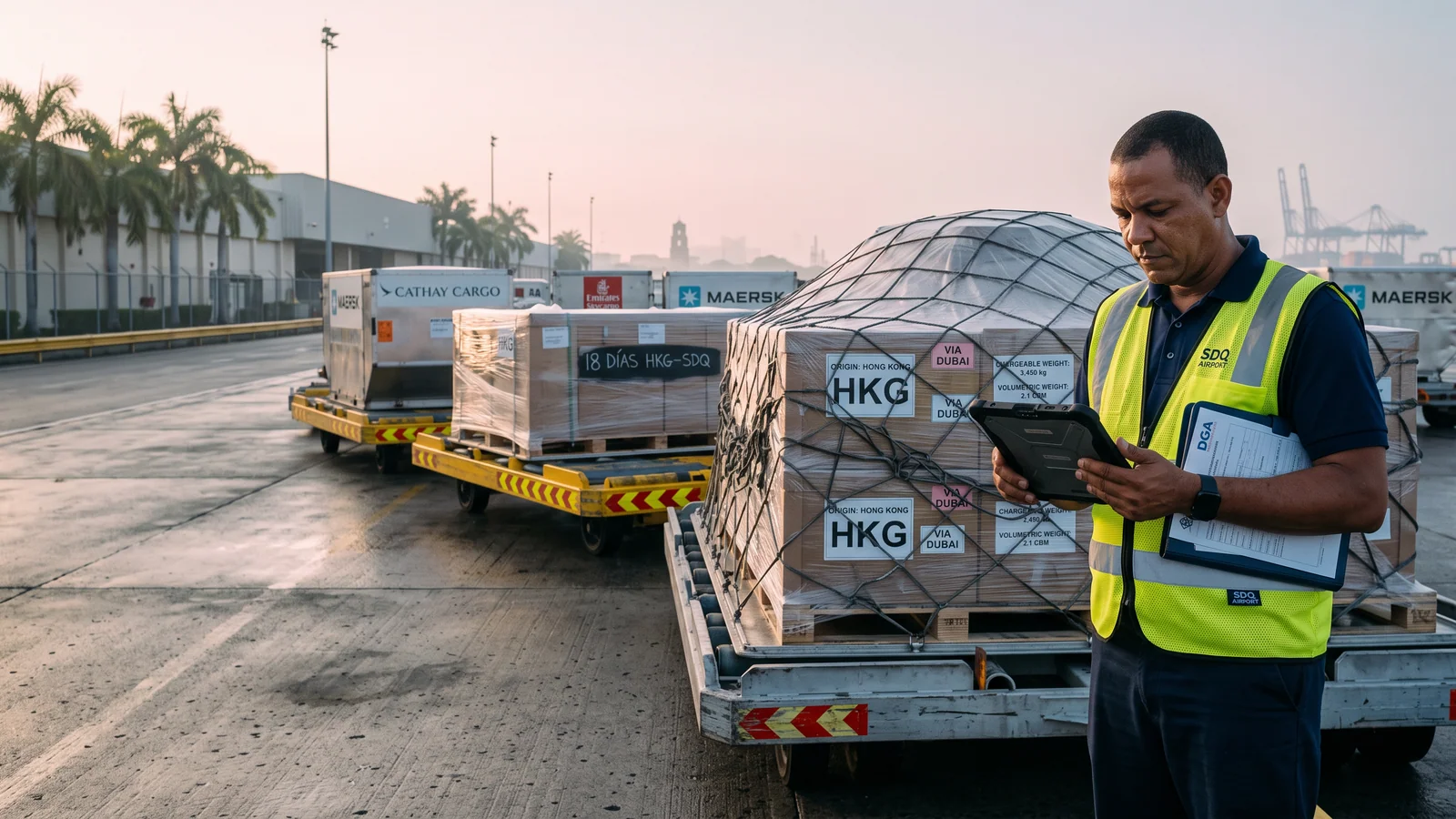
Quick Answer: Sea-air from Hong Kong to the Dominican Republic runs 16–25 days port to airport, with freight from $6.06 per chargeable kg at 300–499 kg and from $4.02/kg at 5,000+ kg. Minimum billed weight is 300 kg. Walio's calculator prices your exact port, airport and weight in seconds.
- Sea-air freight on this lane starts from $6.06/kg for 300–499 kg, from $5.15/kg for 500–999 kg, from $4.48/kg for 1,000–4,999 kg and from $4.02/kg at 5,000+ kg, cheapest port and airport.
- Total transit is 16–25 days: ocean to Los Angeles (12–18 days), truck Los Angeles to Miami (3–5 days), air Miami to Santo Domingo SDQ (1–2 days).
- Chargeable weight is the greater of actual weight and volume × 167 kg per m³, with a 300 kg minimum billed weight.
- Dominican customs charges duty plus 18% ITBIS on the CIF value, so freight cost feeds directly into your tax bill.
Dominican importers searching calculadora marítimo aéreo hong kong república dominicana want one thing: a number on screen, not a quote request. This page explains how the rate is built, then hands you the calculator that prices your exact shipment.
Sea-Air Hong Kong to Dominican Republic Calculator: How Does It Work?
Quick Answer: A sea-air calculator prices a shipment that travels by ocean for the long leg and by air for the final leg. You enter origin port, destination airport, weight and dimensions. Walio returns a live rate in seconds from real carrier contracts — no signup, no quote form, no follow-up call.
Sea-air is one multimodal service sold under one price. Your cargo sails from Asia to a United States gateway, then flies to the destination airport. You get ocean economics with air-level speed on the final leg, which is why electronics buyers in Santo Domingo use it for restock runs that cannot wait for a slow vessel.
Three inputs change the number more than anything else. The load port sets the ocean transit and the base rate. The chargeable weight sets the band you fall into. The destination airport sets the final flight and the handling at arrival.
What service scope does Walio sell on this lane?
The published rate is port to airport. The shipper delivers the cargo to the origin port, and the consignee collects it at Las Américas (SDQ) in Santo Domingo. Door pickup in Hong Kong or mainland China and door delivery anywhere in the Dominican Republic are quoted on request inside the calculator.
Buyers based in Hong Kong usually tender cargo through a nearby mainland load port. Shenzhen, Guangzhou, Xiamen and Shanghai all appear on the lane, and each one carries a different ocean transit and a different rate. The calculator prices the exact port you choose rather than an average.
Which terms do you need to know first?
- FCL — full container load. You buy the whole 20 ft, 40 ft or 40 ft high cube box.
- LCL — less than container load. Your cargo shares a container and bills per cubic meter.
- CBM — cubic meter. Length × width × height in meters.
- Chargeable weight — the greater of actual weight and the volume-based weight. It is what you actually pay on.
- B/L — Bill of Lading, the ocean contract of carriage for the first leg.
- AWB — Air Waybill, the air contract for the Miami–Santo Domingo leg.
- Incoterms 2020 — EXW, FOB, CIF, DAP and DDP define who pays and who carries the risk at each point.
Pro tip
Buy FOB from your Hong Kong supplier whenever you can. FOB puts the cargo at the port at the supplier's cost and leaves the freight decision with you, so the rate you see in the calculator is the rate you actually pay. EXW looks cheaper on the invoice and then adds origin trucking, export clearance and terminal fees you never budgeted.
How Much Does Sea-Air Cargo From Hong Kong to the Dominican Republic Cost in 2026?
Quick Answer: Sea-air freight on this lane starts from $6.06 per chargeable kg at 300–499 kg, from $5.15/kg at 500–999 kg, from $4.48/kg at 1,000–4,999 kg and from $4.02/kg at 5,000 kg and above. Rates are port to airport, cheapest port and airport, from Walio's live rate table.
The rate drops as weight climbs. That is the single most useful fact for a Dominican importer planning purchase orders, because splitting one 1,200 kg order into three monthly 400 kg shipments pushes you from the $4.48/kg band back up to the $6.06/kg band.
| Chargeable weight band | Sea-air freight, from | Billing basis |
|---|---|---|
| 300–499 kg | $6.06/kg | Per chargeable kg, port to airport |
| 500–999 kg | $5.15/kg | Per chargeable kg, port to airport |
| 1,000–4,999 kg | $4.48/kg | Per chargeable kg, port to airport |
| 5,000 kg and above | $4.02/kg | Per chargeable kg, port to airport |
These are "from" rates at the cheapest port and airport combination on the lane. Your exact figure depends on the load port you pick and the destination airport you fly into. The calculator at #quote-calc returns that figure instantly.
What does the 300 kg minimum mean for small orders?
A shipment lighter than 300 kg is still billed as 300 kg. A 120 kg sample order therefore pays for 180 kg of air it never used. Below roughly 70 kg, an express courier almost always lands cheaper and faster, so keep sea-air for real restock volumes.
What else gets added to the per-kg rate?
Origin and destination handling charges are added per shipment inside the calculator. They are never folded into the per-kg figure, because that hides what you are paying for. Walio shows them itemized, not as all-in guesswork, before you book.
Five things move your number up or down:
- Load port — Shenzhen, Guangzhou, Xiamen, Shanghai, Ningbo, Qingdao, Fuzhou, Dalian and Xingang all sail on different schedules.
- Destination airport — SDQ, STI and PUJ each price separately.
- Density — light, bulky cargo bills on volume and costs far more per kilo of actual product.
- Peak season surcharge — pre-Golden Week and pre-Christmas sailings carry a premium.
- Stackability — non-stackable pallets consume deck space twice and are priced accordingly.
How Do You Calculate Chargeable Weight, Volumetric Weight and CBM?
Quick Answer: Chargeable weight is the greater of actual weight and volume × 167 kg per cubic meter on sea-air. Pure air cargo uses length × width × height in centimeters divided by 6,000. Ocean LCL bills per CBM: length × width × height in meters. The calculator applies the right rule automatically.
Each mode converts space into weight differently. Get the formula wrong and your budget misses by thousands of dollars, which is exactly why the Spanish search for a calculadora marítimo aéreo hong kong república dominicana is so common among first-time importers.
| Mode | Formula | Unit billed | Minimum |
|---|---|---|---|
| Sea-air | Volume in m³ × 167 kg | Chargeable kg | 300 kg |
| Air cargo | (L × W × H in cm) ÷ 6,000 | Chargeable kg | Carrier minimum |
| Ocean LCL | L × W × H in meters = CBM | Per m³ or per 1,000 kg, whichever is greater | 1 m³ typical |
| Ocean FCL | Flat rate per container | Per 20 ft / 40 ft / 40 HC | Container payload limit |
Worked example: 20 cartons of consumer electronics
Twenty cartons measuring 60 × 40 × 40 cm give 0.096 m³ each, so 1.92 m³ in total. Multiply 1.92 by 167 kg per cubic meter and you get 321 chargeable kg. That clears the 300 kg minimum and prices in the 300–499 kg band.
Worked example: density decides the bill
800 kg of power banks packed into 3 m³ gives a volume weight of 501 kg. Actual weight wins, so you pay on 800 kg. Flip it: 3 m³ of LED panels weighing 200 kg bills on 501 kg, because volume wins. Dense cargo is always the better value on sea-air.
How do you lower the chargeable weight?
- Ask suppliers to tighten carton sizes and remove void fill before export packing.
- Palletize only when the carrier requires it — a pallet adds 15 cm of height to every stack.
- Declare true dimensions. Carriers re-measure at the CFS and reissue the invoice when figures do not match.
- Consolidate several Hong Kong and Shenzhen suppliers into one shipment to reach a cheaper weight band.
How Many Days Does a Shipment From Hong Kong to Santo Domingo Take?
Quick Answer: Sea-air takes 16–25 days total: 12–18 days ocean to Los Angeles, 3–5 days truck Los Angeles to Miami, and 1–2 days air Miami to Santo Domingo. Full ocean service via transshipment in Panama or Kingston typically runs far longer; straight air cargo is fastest and most expensive.
| Leg | Route | Mode | Transit |
|---|---|---|---|
| 1 | China load port → Los Angeles | Ocean | 12–18 days |
| 2 | Los Angeles → Miami | Truck linehaul | 3–5 days |
| 3 | Miami → Santo Domingo (SDQ) | Air | 1–2 days |
| Total | Port to airport | Sea-air | 16–25 days |
The fast end of the range belongs to the South China ports with direct Pacific strings. The slow end belongs to northern ports and sailings that call at extra terminals before crossing.
 Hong Kong region(via mainland ports)
 Santo Domingo(SDQ)
Why does the cut-off matter more than the sailing date?
Your cargo must be at the terminal before the documentation and gate cut-offs, not before the vessel's ETD. Those cut-offs typically fall several days ahead of departure. Miss one and the box rolls to the next weekly string, which adds a full week to a 16–25 day plan. Plan around port cut-off, not vessel ETD.
How does sea-air compare with all-ocean and straight air?
Conventional all-ocean service from South China to Caucedo transships in Panama or Kingston and takes considerably longer than sea-air. Straight air from Hong Kong lands in days but prices at a level most consumer-goods margins cannot absorb. Sea-air sits deliberately in the middle.
Clearance time with the Dirección General de Aduanas sits on top of transit. A green-channel declaration releases quickly; a red channel means physical inspection and extra days at the airport warehouse. If you are weighing Caribbean options, our Sea-Air Hong Kong to Jamaica Calculator: 2026 Rates guide shows how the same three-leg structure performs into Kingston.
Sea-Air vs Ocean FCL vs LCL vs Air vs Courier: Which Wins at Your Volume?
Quick Answer: Courier wins below about 70 kg. Sea-air wins from 300 kg up to a few tons when speed matters more than the lowest rate. LCL wins on low-value, non-urgent cargo. FCL wins past roughly 10–15 m³. Straight air wins only for urgent, high-value electronics.
| Mode | Typical transit | Billed on | Ideal size | Core documents | Best use case |
|---|---|---|---|---|---|
| Sea-air | 16–25 days | Chargeable kg (m³ × 167) | 300 kg – 5,000+ kg | Invoice, packing list, B/L, AWB | Restock that cannot wait for a vessel |
| Ocean FCL | Longest | Per container | 10–15 m³ and up | Invoice, packing list, B/L | Full-volume, planned purchasing |
| Ocean LCL | Long | Per m³ or 1,000 kg | 1–15 m³ | Invoice, packing list, B/L | Low-value, non-urgent goods |
| Air cargo | 3–7 days | Chargeable kg (÷6,000) | 50–2,000 kg | Invoice, packing list, AWB | Urgent, high-value electronics |
| Courier | 3–6 days | Chargeable kg (÷5,000) | Under 70 kg | Invoice, courier waybill | Samples, spare parts, small orders |
Which mode fits each cargo size?
| Scenario | Approx. chargeable weight | Recommended mode | Why |
|---|---|---|---|
| 50 kg of phone accessories | 50 kg | Courier | Below the 300 kg sea-air minimum |
| 1 CBM of tablets | 167 kg | Courier or LCL | Still billed as 300 kg on sea-air |
| 5 CBM of small appliances | 835 kg | Sea-air | Prices in the 500–999 kg band, from $5.15/kg |
| 15 CBM of TVs | 2,505 kg | Sea-air or FCL | Speed vs lowest cost per m³ |
| Full 40 ft container | Container load | Ocean FCL | Cheapest per cubic meter at volume |
10–15 m³ is the FCL crossover. Below it, LCL and sea-air usually win on total cost. Above it, a 20 ft box beats paying per cubic meter, and you also avoid CFS deconsolidation and the destination handling that LCL adds at arrival.
Choose sea-air when
Your Black Friday or school-season stock is already late, your margin cannot absorb a full air rate, and the order weighs between 300 kg and a few tons. Dominican electronics buyers use sea-air precisely for this gap: the shelf date is fixed, the vessel is too slow, and straight air would erase the markup.
Choose ocean FCL when
You buy to a forecast, the goods are not seasonal, and the volume passes roughly 10–15 m³. One container of TVs delivered to Caucedo costs far less per cubic meter than any airborne leg. The trade-off is a longer, transshipment-dependent transit through Panama or Kingston.
Regional comparisons help when you source for several Caribbean and Central American markets. Our Sea-Air Hong Kong to Costa Rica Calculator: 2026 Rates guide uses the same weight-band logic on a Pacific-side lane. Courier below 70 kg remains the rule across all of them.
Which Ports and Airports Does the Hong Kong–DR Lane Use?
Quick Answer: Cargo leaves through Kwai Tsing in Hong Kong or a nearby mainland port such as Shenzhen, Guangzhou, Xiamen or Shanghai. It sails to Los Angeles, trucks to Miami, and flies into Las Américas (SDQ). Punta Cana (PUJ) and Santiago (STI) serve regional consignees; Caucedo and Haina handle pure ocean freight.
| Dominican gateway | Type | Modes served | Typical users | Inland coverage |
|---|---|---|---|---|
| Las Américas (SDQ) | Airport | Sea-air, air cargo, courier | Electronics and consumer goods importers | Santo Domingo, San Pedro, La Romana |
| Puerto Multimodal Caucedo | Seaport | FCL, LCL, transshipment | Container importers and re-exporters | National, via Autopista Las Américas |
| Río Haina | Seaport | FCL, LCL, bulk | Industrial and project cargo | Greater Santo Domingo, Azua, Barahona |
| Puerto Plata | Seaport | FCL, LCL | North-coast importers | Puerto Plata, Santiago, Moca |
| Cibao Intl. (STI) | Airport | Air cargo, courier | Santiago manufacturers and free zones | Cibao region, La Vega, San Francisco |
| Punta Cana (PUJ) | Airport | Air cargo, courier | Hotels, retail and tourism supply | La Altagracia, Higüey, Bávaro |
Why do Hong Kong exporters load at Yantian or Nansha?
Kwai Tsing is convenient but often more expensive than the deep-water terminals next door. Yantian in Shenzhen and Nansha in Guangzhou sit within trucking distance of most Hong Kong trading offices and carry heavy Transpacific capacity. Picking one over the other shifts both the ocean transit and the per-kg rate, which is why the calculator asks for the port instead of the country.
What role do Los Angeles and Miami play?
Los Angeles/Long Beach is the ocean entry point, where the box is discharged and drayed to a transload warehouse. The cargo is then trucked across the country on a 3–5 day linehaul. Miami is the Caribbean air hub, with daily lift into Las Américas (SDQ) and the rest of the region.
Inland trucking inside the Dominican Republic from SDQ to Santiago, La Vega, San Pedro de Macorís or Punta Cana is arranged separately by your broker or by Walio on request. Importers based in the Cibao often save real last-mile money by flying into STI instead, and importers serving Bávaro hotels do the same with PUJ.
What Duties and Taxes Does the DGA Charge on Imports From Hong Kong?
Quick Answer: The Dirección General de Aduanas charges import duty by HS code, 18% ITBIS, and selective consumption tax on some goods. All three are calculated on the CIF value — product cost plus freight plus insurance. A lower freight bill therefore lowers your tax base as well as your landed cost.
CIF value means cost, insurance and freight: what you paid the supplier, plus the cargo insurance premium, plus the freight to the Dominican border. Duty is applied to that CIF figure. ITBIS is then applied to CIF plus duty, not to CIF alone.
| Step | Base | Charge | Notes |
|---|---|---|---|
| 1. Valuation | Invoice + freight + insurance | CIF value | Declared on the DGA declaration |
| 2. Import duty | CIF value | Rate set by HS code | Many electronics sit at 0%; other consumer goods higher |
| 3. ITBIS | CIF + duty | 18% | Standard national rate |
| 4. ISC | CIF + duty | Selective consumption tax | Applies to specific categories only |
Duty is charged by HS code, so classification is the single decision that moves your tax bill most. 18% ITBIS on the CIF value then applies on top for almost every commercial import.
Does Ley 168-21 help small importers?
Ley 168-21, the Dominican customs law, provides a simplified regime for low-value shipments and a de minimis threshold below which duty does not apply. Commercial importers rarely qualify, because a 300 kg-plus sea-air consignment of resale goods sits far above the threshold and is treated as a commercial entry.
Who files the declaration?
A licensed Dominican customs broker — an agente de aduanas — files the declaration with the DGA using your RNC. The DGA then assigns a review channel, which determines whether the cargo is released on documents or physically inspected.
Do not undervalue the commercial invoice
Declaring a lower value on the Factura Comercial to cut ITBIS invites reassessment by the DGA, fines, and storage charges while the cargo sits at SDQ. Duty, tax and classification questions belong with a licensed Dominican customs broker or tax adviser. Walio is a shipping platform and prices freight, not tax positions.
What Documents and Customs Steps Does a Sea-Air Shipment Need?
Quick Answer: You need a commercial invoice, packing list, the ocean Bill of Lading for the first leg, the Air Waybill for the Miami–Santo Domingo leg, and a certificate of origin when a trade preference applies. Your broker files the declaration with the DGA under your RNC before the cargo is released at SDQ.
- Factura Comercial — commercial invoice with unit prices, Incoterm and currency.
- Packing list — carton count, weights and dimensions that match the measured cargo.
- Bill of Lading (B/L) — covers the ocean leg to Los Angeles.
- Air Waybill (AWB) — covers the Miami–SDQ flight.
- Certificado de Origen — only when a trade preference applies to the goods.
- RNC or cédula — the importer's tax identity used on the declaration.
- Import permits — required for regulated categories such as medical devices, cosmetics and food.
How do documents hand off between the legs?
A sea-air move produces two transport documents, not one. The B/L closes out at the United States transload point and the AWB opens for the flight. The consignee name must match across the invoice, packing list, B/L and AWB. A mismatch stops release at SDQ until an amended document arrives.
Lithium batteries are dangerous goods
Power banks, loose lithium cells and battery-powered devices are regulated as dangerous goods on the air leg and need correct UN packaging, labeling and declarations. Radio and telecom equipment, medical devices, cosmetics and food may also need clearance from MISPAS or INDOCAL before the DGA releases the cargo. Flag these in the calculator so a Walio specialist can confirm acceptance before booking.
Which Incoterm should you buy on?
FOB keeps the freight decision and the freight cost with you, which is what makes a live calculator useful. EXW shifts origin trucking and export clearance onto your account. DDP pushes Dominican import liability onto a Hong Kong supplier who rarely handles DGA requirements well, and you lose visibility of what you actually paid in duty.
Pro tip for consolidators
When you combine several Hong Kong and Shenzhen suppliers into one sea-air consignment, keep one commercial invoice per supplier but produce a single consolidated packing list with sequential carton numbers. The DGA reviews a clean, cross-referenced set far faster than a stack of unrelated paperwork.
What Hidden Charges Should Dominican Importers Budget For?
Quick Answer: Beyond freight, budget origin and destination handling, terminal handling charges, fuel and currency adjustments, cargo insurance, airport storage at SDQ, broker fees and inland trucking. Walio itemizes every charge it controls inside the calculator, so you see the all-in figure before you book instead of after the cargo lands.
- THC / DTHC — terminal handling at origin and destination for moving the box on and off the terminal.
- BAF — bunker adjustment factor, the fuel component on the ocean leg.
- CAF — currency adjustment factor, applied when rates are contracted in another currency.
- Peak season surcharge — applied on heavily booked sailings and flights.
- Security and screening fees — mandatory on the air leg out of Miami.
- Airport storage — charged at SDQ once free time ends.
How do demurrage and detention work here?
Free time is the number of days you may use equipment or terminal space without extra charge. Demurrage applies when a container sits at the terminal past free time. Detention applies when you keep the container outside the terminal too long. On a sea-air move the container never reaches the Dominican Republic, so your exposure is airport storage at SDQ instead — and that clock starts fast, often within a few days of arrival.
Anything lighter still pays for 300 kg. Pair that with the 167 kg per m³ conversion and you can predict your invoice before you place the purchase order.
What does Walio not control?
Three destination costs sit outside the freight quote: DGA duty and taxes, your customs broker's fee, and inland trucking from SDQ to your warehouse. Cargo insurance is worth separating too. The premium is based on CIF value, and it is the only charge that also raises your ITBIS base.
Everything Walio does control appears line by line in the calculator. You compare options, see the itemized, not all-in guesswork total, and book online. A specialist follows up only when the cargo is oversized, non-stackable or classified as dangerous goods.
Stop emailing forwarders and waiting two days for a PDF. Walio compares live rates from carriers including Maersk, MSC, CMA CGM and Hapag-Lloyd across the ocean, trucking and air legs, then shows one price with every charge named. If you arrived here looking for a calculadora marítimo aéreo hong kong república dominicana, this is it. Enter your load port, destination airport, weight and dimensions in the calculator above and see your price in seconds — no signup, no follow-up calls.
Full-container ocean pricing depends on the load port, the sailing and the week you book, so there is no single fixed figure. Walio's sea-air service on this lane is priced per chargeable kilogram instead, from $6.06/kg at 300–499 kg down to $4.02/kg at 5,000 kg and above, port to airport. Enter your port, airport and cargo details in the calculator to see your exact number in seconds.
Sea-air takes 16–25 days in total: 12–18 days on the water to Los Angeles, 3–5 days trucking to Miami, then 1–2 days flying into Santo Domingo. Conventional all-ocean service to Caucedo takes considerably longer because it transships in Panama or Kingston. Customs clearance with the DGA is added on top of transit.
Multiply length by width by height in centimeters and divide by 6,000 to get volumetric weight in kilograms for standard air cargo. Sea-air uses a different rule: volume in cubic meters times 167 kg. You pay on the greater of actual weight and that calculated figure, with a 300 kg minimum billed weight on this lane.
You pay import duty set by the HS code of your goods, 18% ITBIS, and selective consumption tax on certain categories. All of them are calculated on the CIF value, meaning product cost plus freight plus insurance. A licensed Dominican customs broker files the declaration with the DGA using your RNC and can confirm the exact rates for your products.
Ocean is cheaper per kilogram, air is faster, and sea-air sits between the two at 16–25 days with freight from $4.02/kg at 5,000 kg and above. Below roughly 70 kg a courier usually beats all three. Past about 10–15 cubic meters a full container becomes the cheapest option per cubic meter.