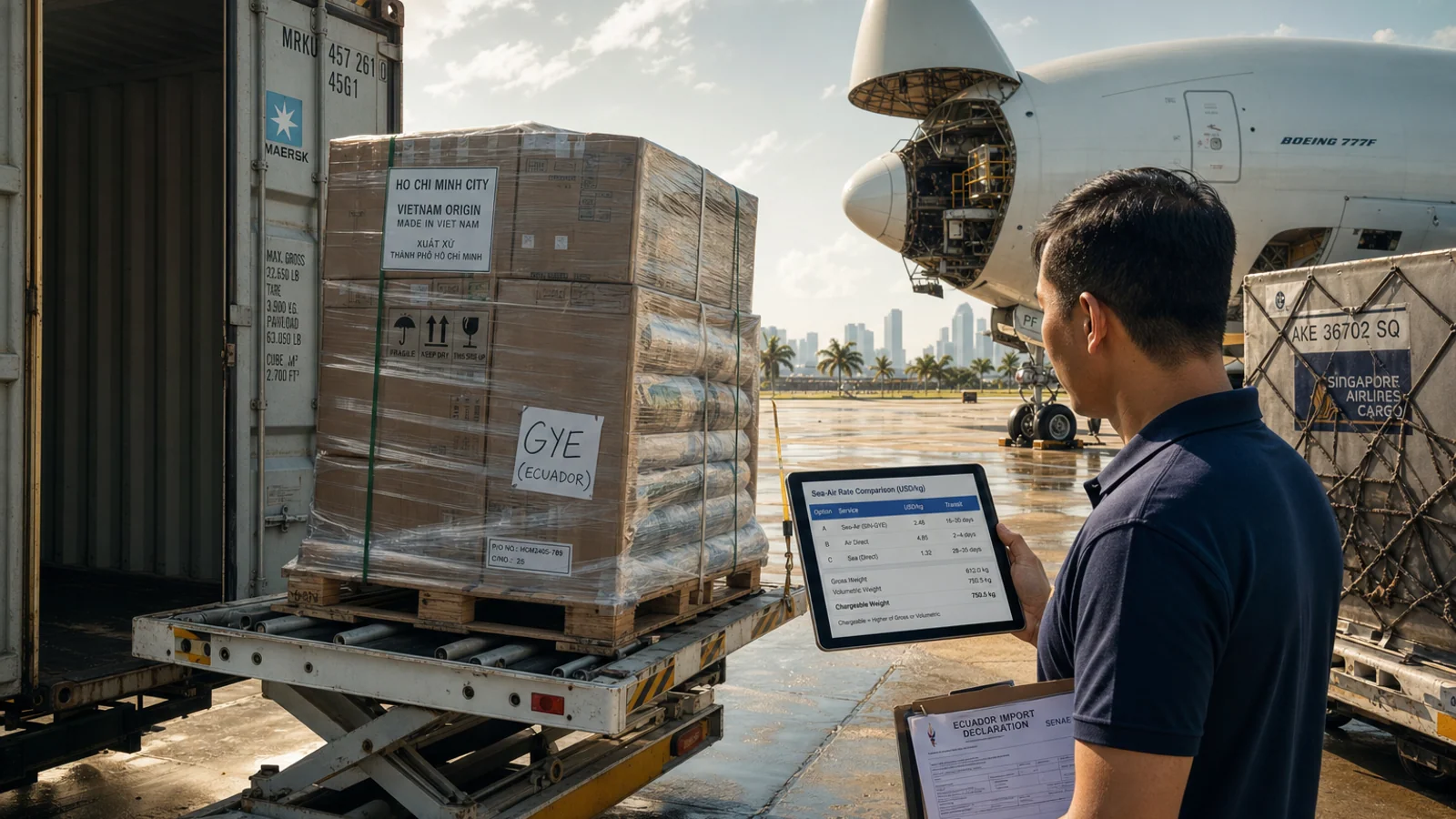
Quick answer Sea-air cargo from Vietnam to Ecuador takes 16-25 days: ocean to Los Angeles, truck to Miami, then air to Guayaquil (GYE) or Quito (UIO). Walio's sea-air rates start from $3.56/kg for 1,000-4,999 kg and from $3.10/kg above 5,000 kg, with a 300 kg minimum billed weight.
- Sea-air from Asia to Ecuador runs 16-25 days port to airport: 12-18 days ocean to Los Angeles, 3-5 days trucking to Miami, 1-2 days air to GYE or UIO.
- Walio's sea-air rate starts from $5.15/kg at 300-499 kg and drops to from $3.10/kg at 5,000 kg and above, on the cheapest port-airport pairing.
- Chargeable weight is the greater of actual weight and volume x 167 kg per m³, and the minimum billed weight on this service is 300 kg.
- Ecuador applies ad valorem duty by HS code plus FODINFA 0.5% and IVA on the CIF value; SENAE clears everything through ECUAPASS.
Ecuadorian importers buying from Vietnam face a hard choice between a 40-day ocean transit and an air freight invoice that eats the margin. Sea-air sits in the middle, and the calculator on this page prices it instantly.
See your price in seconds
Real carrier rates, no signup, no follow-up calls.
How fast is sea-air cargo from Vietnam to Ecuador?
Quick answer Sea-air moves cargo from Asia to Ecuador in 16 to 25 days total. The ocean leg to Los Angeles takes 12 to 18 days, the truck leg to Miami 3 to 5 days, and the flight to Guayaquil or Quito 1 to 2 days. Your origin port decides where you land in that range.
The service runs in three legs under one booking. Ocean carriers such as Maersk, MSC, CMA CGM and Hapag-Lloyd move the container across the Pacific to Los Angeles/Long Beach. A linehaul truck then crosses the United States to Miami, where the cargo is deconsolidated at a CFS and flown south.
This is a multimodal service: three modes, one price, one point of contact. The ocean leg carries the cost advantage and the air leg carries the speed. You never pay to fly a box across the Pacific, which is where pure air freight spends most of its money.
 Shenzhen(CNSZX)
 Los Angeles(USLAX)Los Angeles(USLAX)Miami(USMIA)Miami(MIA)
 Guayaquil(GYE)
Where does Vietnamese cargo actually load?
Cargo leaving Haiphong, Cat Lai or Cai Mep usually connects through a South China or East China hub before the Pacific crossing. Feeder vessels move the boxes to Shenzhen, Xiamen, Ningbo or Shanghai, where the deep-sea service loads. That feeder leg is why two shipments from the same Vietnamese factory can land in Ecuador a week apart.
The calculator asks for the exact loading port for that reason. The price and the transit both move with the gateway you choose. Importers comparing neighbouring Pacific markets can see the same structure on the Sea-Air Vietnam to Panama Calculator: 2026 Rates page.
| Ocean gateway | Ocean days to Los Angeles | Total port to airport |
|---|---|---|
| Shenzhen | 12-15 | 16-22 |
| Guangzhou | 13-16 | 17-23 |
| Xiamen | 13-16 | 17-23 |
| Ningbo | 13-16 | 17-23 |
| Shanghai | 13-16 | 17-23 |
| Fuzhou | 14-17 | 18-24 |
| Qingdao | 14-17 | 18-24 |
| Dalian | 15-18 | 19-25 |
| Xingang | 15-18 | 19-25 |
Cut-off is not ETD
The port cut-off closes one to three days before the vessel sails. Missing it by two hours does not delay you by two hours. Your cargo rolls to the next sailing, and on this lane that is a full week, not a day. Book the supplier's delivery against the cut-off date, never against the ETD.
Sea air cargo calculator Vietnam Ecuador: how do you get a price?
Quick answer Enter the loading port, the destination airport and your weight and volume in the calculator on this page. It returns the sea-air price in seconds from Walio's live rate table. Rates start from $5.15/kg at 300-499 kg, from $4.25/kg at 500-999 kg, from $3.56/kg at 1,000-4,999 kg and from $3.10/kg above 5,000 kg.
The sea air cargo calculator Vietnam Ecuador importers need does three things. It reads your chargeable weight, matches it to a bracket, and adds the per-shipment handling for the port and airport you picked. No form to submit, no email to wait for.
| Chargeable weight | Sea-air rate per kg | Billing note |
|---|---|---|
| 300-499 kg | from $5.15 | 300 kg minimum applies |
| 500-999 kg | from $4.25 | bracket break at 500 kg |
| 1,000-4,999 kg | from $3.56 | bracket break at 1,000 kg |
| 5,000 kg and above | from $3.10 | bracket break at 5,000 kg |
These rates are the cheapest port and airport pairing on the lane, as of October 12, 2026. Your exact figure depends on which Asian gateway loads the container and whether you fly into GYE or UIO. The calculator resolves both in seconds.
What is chargeable weight on sea-air?
Chargeable weight is the greater of your actual kilos and your volume multiplied by 167 kg per cubic meter. That factor is the standard air density rule, applied because the final leg flies. Ten cubic meters of light cartons bills as 1,670 kg even if the scale shows 900 kg.
The minimum billed weight is 300 kg. A 180 kg shipment is charged as 300 kg, full stop. Below that threshold, international courier is almost always the cheaper answer for a Vietnamese supplier sending samples or a small first order.
What is included in the quoted price?
The quote is port to airport. The shipper delivers the cargo to the origin port, and the consignee collects it at Guayaquil or Quito. Origin and destination handling charges are added per shipment inside the calculator, never buried inside the per-kg rate.
- Ocean freight from your chosen Asian gateway to Los Angeles
- Trucking Los Angeles to Miami, including the CFS deconsolidation
- Air freight Miami to GYE or UIO with a house Air Waybill
- Transport documents for each leg of the chain
- Origin and destination handling, itemized separately per shipment
Door pickup at a Vietnamese factory and door delivery in Guayaquil, Quito, Cuenca or Manta are quoted on request. Submit the request through the same calculator and a Walio specialist follows up. Duties and taxes in Ecuador are never Walio charges — SENAE sets those.
See your price in seconds
Real carrier rates, no signup, no follow-up calls.
Sea-air vs air freight vs full ocean: which is cheapest?
Quick answer Air freight is the fastest and the most expensive. Full ocean to Guayaquil is the cheapest per kilo but can run 35 to 50 days with transshipment. Sea-air lands between them: roughly half the ocean transit at a fraction of pure air pricing, which is why Ecuadorian importers use it for replenishment, not for first stock.
Compare the three on three axes only: total transit days, cost per chargeable kilo, and the cost of waiting. Marketing adjectives do not belong in the decision. The third axis is the one most importers skip, and it is usually the one that decides.
| Mode | Transit Asia to Ecuador | Relative cost per kg | Best for |
|---|---|---|---|
| Full ocean FCL/LCL | 35-50 days | Lowest | Heavy, dense, low-value cargo |
| Sea-air | 16-25 days | Middle | Mid-value replenishment |
| Straight air | 3-7 days | Highest | Under 300 kg, true emergencies |
Sea-air to GYE or UIO
You trade a container rate for roughly half the transit. Cargo lands at the airport, clears through ECUAPASS and reaches your warehouse in under a month from the Asian port. The 167 kg per m³ factor punishes bulky goods, so density decides whether the economics work. Dense cartons of footwear, hardware or spare parts price well. Pillows and foam do not.
Full ocean to Guayaquil or Posorja
One 40 ft high cube absorbs a huge volume at a single container price, with no density penalty at all. You pay for it in time: 35 to 50 days is normal with a Panama or Caribbean transshipment, plus port congestion risk. Add demurrage and detention exposure if your agente de aduana is slow. This is the right call for first stock and for anything heavy and cheap.
Sea-air wins when a selling window is at risk. Seasonal collections, spare parts that stop a production line, and e-commerce restocks all justify the middle rate. Importers running the same calculation into other Latin American markets can compare the Sea-Air Vietnam to Colombia Calculator: Rates 2026 for the neighbouring Pacific lane.
Straight air still wins in three cases: shipments under the 300 kg minimum, machinery breakdowns, and time or temperature critical goods. Everything else is a candidate for sea-air. Run both numbers before you commit.
See your price in seconds
Real carrier rates, no signup, no follow-up calls.
How do you cut your cost per kilo on this lane?
Quick answer Cost per kilo on sea-air falls in steps, not smoothly. Crossing 500 kg, 1,000 kg and 5,000 kg moves you into a cheaper bracket, so consolidating two orders into one booking often costs less than shipping them separately. Density is the second lever: cartons under 167 kg per m³ are billed on volume.
The bracket math surprises people. A 950 kg shipment prices from $4.25/kg, while a 1,050 kg shipment prices from $3.56/kg. Adding 100 kg of stock moves you across the line and can lower the total freight invoice, not just the unit rate.
Check the math before you finalize the purchase order. If you sit 40 kg below a break, ask the supplier to add product. The same logic applies at 500 kg and again at 5,000 kg.
Every cubic meter you remove from the shipment removes 167 chargeable kilos. Ask your Vietnamese supplier for export cartons without void fill, flat-packed where possible, and stacked to a uniform pallet height. Shaving 2 m³ off a bulky order can save more than any rate negotiation.
Five levers that actually move the number
- Top up to the next bracket. Compare a 950 kg booking against a 1,050 kg booking before you confirm.
- Cut volumetric weight. Tighter cartons, no air inside, correct pallet height.
- Consolidate suppliers. Deliver three Vietnamese factories' cargo to the port as one lot and pay one origin handling charge instead of three.
- Respect the 300 kg floor. Below it you pay for 300 kg anyway, so either grow the order or move it by courier.
- Plan around Tet. Vietnamese factories close for the Lunar New Year, sailings compress, and surcharges follow the squeeze.
Bracket pricing behaves the same way on every sea-air lane out of Asia. The Sea-Air Cargo Vietnam to Paraguay Calculator: Rates 2026 shows the same step structure into a landlocked South American market, which makes the pattern easy to see.
What does SENAE require to clear your cargo in Ecuador?
Quick answer SENAE clears every import through the ECUAPASS system with a Declaración Aduanera de Importación filed by a licensed agente de aduana. You need the Factura Comercial, packing list, the transport document, and a Certificado de Origen when you claim preference. Ecuador charges ad valorem duty by HS code, FODINFA 0.5% and IVA on the CIF value.
The Servicio Nacional de Aduana del Ecuador (SENAE) runs all import declarations through ECUAPASS. Your agente de aduana files the DAI against your RUC. Nothing moves out of the airport terminal until that declaration is accepted and the taxes are paid.
- Factura Comercial from the Vietnamese supplier, with values, Incoterm and HS codes
- Lista de empaque showing cartons, weights and cubic meters
- Air Waybill covering the Miami to Ecuador leg
- Bill of Lading or sea waybill covering the Pacific ocean leg
- Certificado de Origen issued in Vietnam
- RUC of the Ecuadorian importer, active and in good standing
How does the tax stack work?
Every charge is calculated on the CIF value, not on the invoice value alone. That means freight and insurance enter the tax base. Importers who quote only the FOB price to their accountant consistently underestimate the landed cost.
| Charge | Basis | Who sets it |
|---|---|---|
| Ad valorem duty | HS code in the national arancel | SENAE / COMEX |
| FODINFA | 0.5% of CIF | Published national rate |
| IVA | Published rate on CIF plus duties | SRI |
| ICE | Specific goods only | SRI |
Control previo catches Vietnamese goods often
Textiles, footwear, toys, appliances and electronics frequently require an INEN technical regulation (RTE INEN) certificate and a registry entry before release. Vietnam has no trade preference agreement with Ecuador, so the Certificado de Origen documents origin but does not reduce the tariff. Confirm your HS classification with a licensed agente de aduana before you place the purchase order, not after the cargo lands.
Which Incoterm fits sea-air best?
Most Vietnamese suppliers sell FOB, and FOB maps cleanly onto a port-to-airport booking. The supplier delivers to the port and you control the freight chain from there. EXW adds inland Vietnamese trucking and export clearance to your side of the ledger.
DDP is the one to avoid here. Under Incoterms 2020, DDP moves import liability onto a seller who does not hold an Ecuadorian RUC and does not know ECUAPASS. For duty, valuation and classification questions, use a licensed customs broker. Walio prices transport, not duty rulings.
Which cargo belongs on sea-air from Vietnam?
Quick answer Sea-air suits mid-value, time-sensitive, reasonably dense cargo: footwear, apparel, furniture hardware, electronics, auto and machinery spare parts, and e-commerce restocks. It is wrong for heavy low-value commodities, which belong in an ocean container, and for anything restricted on the air leg, such as lithium batteries, aerosols and flammable liquids.
Vietnam exports a product mix that fits this service well. Footwear and apparel carry enough value per kilo to justify the rate. Furniture hardware, fasteners and small electronics are dense, so the volumetric calculation stays friendly.
| Cargo from Vietnam | Sea-air fit | Why |
|---|---|---|
| Footwear and apparel | Strong | Season-driven, good value per kg |
| Machinery and auto spare parts | Strong | Dense, downtime costs more than freight |
| Small electronics and accessories | Strong | High value, low volume |
| Furniture hardware and fittings | Good | Dense metal components |
| Ceramic tile, stone, raw timber | Poor | Heavy and low value, use FCL |
| Foam, cushions, bulky plastics | Poor | Volumetric weight destroys the math |
The air leg sets the restrictions
Even though most of the journey floats, the Miami to Ecuador flight governs what you can ship. Loose lithium batteries, aerosols, paints, adhesives and flammable liquids need a dangerous goods declaration and special handling, and some simply cannot fly. Oversized and over-height pieces also fail: the air leg caps dimensions far below a 40 HC or a flat rack. Declare any of this before booking.
Household goods and personal effects are a separate service entirely. A family relocating to Ecuador needs a detailed inventory and a used-goods declaration, which sea-air cargo bookings do not cover. Price that as an international move, not as freight.
If you ship the same product mix into several markets, compare the structure on the Vietnam to Argentina Sea-Air Calculator: 2026 Rates and the Sea-Air Vietnam to Barbados Calculator: Rates 2026 pages. The weight brackets behave identically; only the destination rules change.
How do you book sea-air from Vietnam to Ecuador online?
Quick answer Price it in the calculator on this page, pick the weight bracket and destination airport, and book in the same session. You then deliver the cargo to the origin port by the cut-off, Walio issues the transport documents for each leg, and your consignee collects at Guayaquil or Quito with a customs broker.
Anything lighter is still billed as 300 kg on sea-air. Check your chargeable weight before you quote, and move genuinely small shipments to international courier instead.
- Get the chargeable weight right. Pull total kilos and total cubic meters from the supplier's packing list, then apply the 167 kg per m³ rule.
- Price it. Enter the loading port, the destination airport (GYE or UIO) and the weight. Compare the result against your supplier's own freight offer — suppliers rarely quote the cheapest routing.
- Book online. Confirm in the same session, then schedule the factory's delivery to the port against the published cut-off, not the vessel ETD.
- Collect documents by leg. Bill of Lading or sea waybill for the ocean leg, house Air Waybill for Miami to Ecuador, plus Factura Comercial and lista de empaque for SENAE.
- Appoint your agente de aduana early. Have the DAI ready before arrival so you avoid storage charges at the airport terminal.
Oversized pieces, dangerous goods and project cargo need a human. Submit the shipment through the calculator and a Walio specialist follows up, or open the chat on this page. No phone queue, no sales call.
See your price in seconds
Real carrier rates, no signup, no follow-up calls.
Sea-air takes 16 to 25 days from the origin port to the destination airport, depending on which Asian gateway your cargo loads at. That breaks down as 12 to 18 days of ocean to Los Angeles, 3 to 5 days of trucking to Miami, and 1 to 2 days of flying to Guayaquil or Quito. Full ocean on the same lane commonly runs 35 to 50 days with transshipment.
Walio's sea-air rates start from $5.15/kg for 300-499 kg, from $4.25/kg for 500-999 kg, from $3.56/kg for 1,000-4,999 kg and from $3.10/kg above 5,000 kg on the cheapest port and airport pairing. Origin and destination handling charges are added per shipment, so the calculator on this page shows your real total in seconds. The exact rate depends on your loading port and whether you fly into GYE or UIO.
The minimum billed weight is 300 kg. A 150 kg shipment is still charged as 300 kg, so anything smaller is usually cheaper as international courier. Chargeable weight is the greater of actual weight and volume multiplied by 167 kg per cubic meter.
Yes, sea-air is substantially cheaper than straight air freight because the long Pacific crossing moves by ship and only the final leg flies. The trade-off is time: sea-air lands in 16 to 25 days while pure air freight lands in days. For replenishment orders that are not emergencies, sea-air is the usual compromise.
Ecuador charges an ad valorem duty set by the HS code in the national tariff, plus FODINFA at 0.5% and IVA, all calculated on the CIF value. Some goods also carry ICE or need INEN technical compliance before SENAE releases them. Confirm your classification with a licensed agente de aduana before you buy, because the tariff can change the landed cost more than the freight does.
You now know the transit, the brackets, the chargeable weight rule and what SENAE will ask for. The only number left is yours. Enter your loading port, destination airport and weight in the calculator above and see your price in seconds — no signup, no follow-up calls.