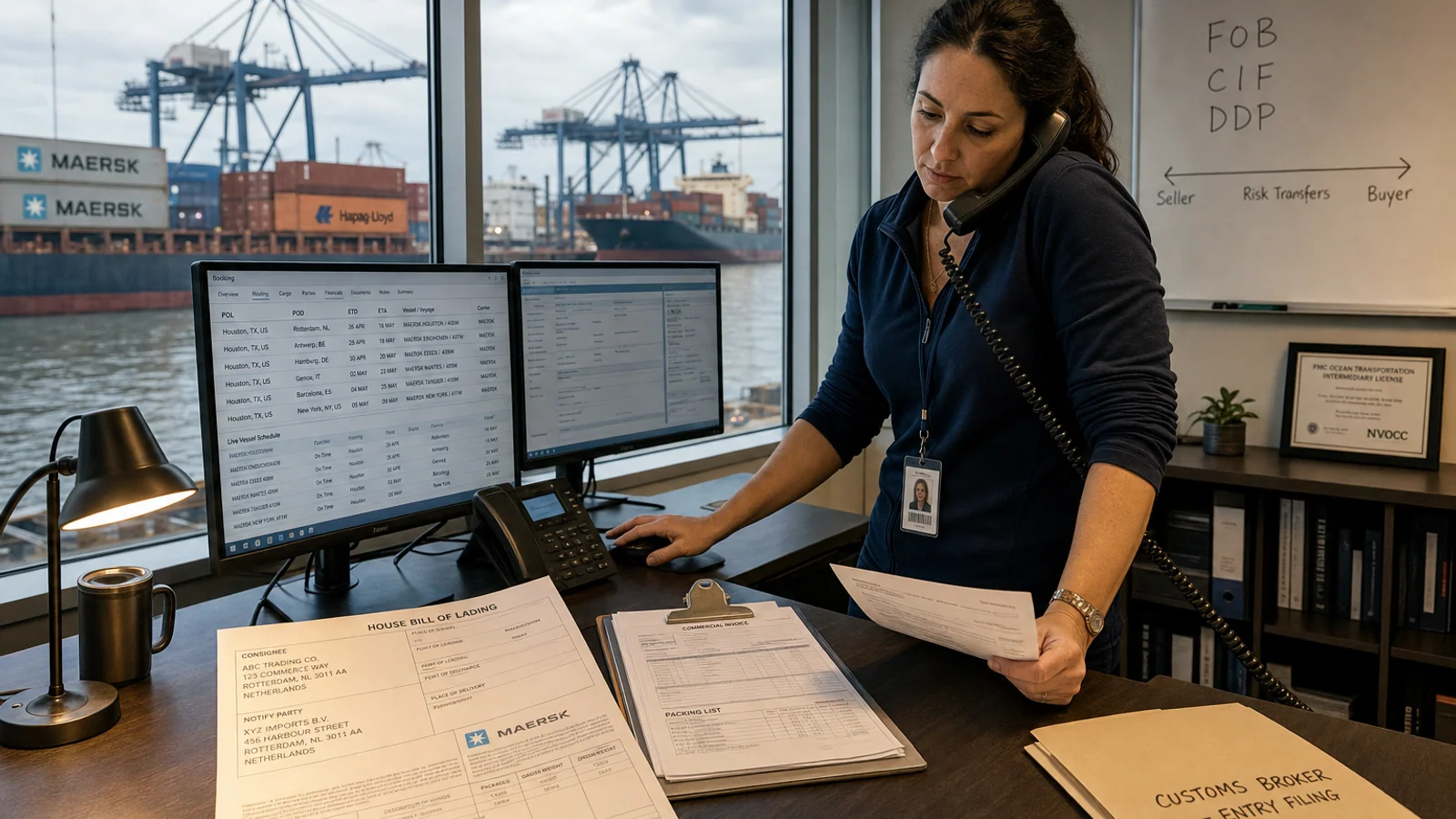
Quick answer A freight forwarder arranges your shipment end to end: it books space with ocean, air and trucking carriers, issues the house bill of lading or air waybill, files ISF and AES, coordinates customs clearance through a licensed broker, and tracks the cargo to final delivery. It moves paperwork and bookings, not the vessel itself.
- A freight forwarder arranges transport and documents; it does not own the ship, plane or truck — the carrier does.
- US ocean forwarders and NVOCCs must hold an FMC Ocean Transportation Intermediary license; customs entries need a separate CBP-licensed broker.
- ISF must be filed 24 hours before the vessel loads at origin, or CBP can issue a $5,000 penalty per late filing.
- Walio prices FCL, LCL, air, parcels and vehicle shipping online in seconds — no quote form, no sales call.
First-time importers usually meet a forwarder at the worst moment: after the supplier says "cargo ready" and nobody has booked a vessel. This guide explains exactly what the job covers, what it does not, and when you can skip it.
See your price in seconds
Real carrier rates, no signup, no follow-up calls.
What Does a Freight Forwarder Do?
Quick answer A freight forwarder arranges the movement of cargo on your behalf. It compares carriers, books vessel or flight space, consolidates LCL cargo, issues transport documents, files ISF and AES, arranges drayage and last mile, buys cargo insurance, and tracks the box. It sells transport it does not own.
A freight forwarder is a transport intermediary. It buys capacity from ocean carriers, airlines, railroads and trucking companies, then resells and manages that capacity as a single door-to-door service. You sign one contract with the forwarder instead of six contracts with six vendors.
That is the distinction most first-time importers miss. The forwarder contracts with the carrier; you contract with the forwarder. If Maersk, MSC, CMA CGM or Hapag-Lloyd carries your container, your commercial relationship is still with the forwarder that booked it.
The eight core duties of a freight forwarder
- Carrier booking — securing vessel, flight, rail or truck space on your lane and sailing week.
- Consolidation and deconsolidation — building LCL containers at an origin CFS and breaking them at destination.
- Transport documentation — issuing the house bill of lading or air waybill and the shipping instructions.
- Export filings — ISF "10+2" for US imports and AES/EEI for US exports over $2,500 per Schedule B line.
- Customs coordination — instructing a licensed broker at origin and destination and passing the document pack.
- Cargo insurance — placing all-risk marine coverage, which is never automatic.
- Warehousing — short-term storage, palletizing, labeling and export packing.
- Tracking and last mile — drayage from the terminal, delivery appointment and proof of delivery.
The forwarder also chooses your gateway. A shipper in Florida usually routes through PortMiami or Port Everglades. Texas and the central states load at Port Houston. California and the Southwest use Los Angeles/Long Beach, the Northeast uses New York/New Jersey, the Southeast uses Savannah, and the Pacific Northwest uses Seattle. The Midwest moves by rail through Chicago. In Canada, Ontario feeds Toronto, Quebec and the Atlantic provinces feed Montreal, and the west feeds Vancouver.
Gateway choice changes both price and transit. The forwarder's job is to pick the one that fits your pickup address, not the one closest to its own office. Our guide to what a bill of lading is and why you need one explains the document that comes out of that booking.
According to CBP, the Importer Security Filing must be transmitted 24 hours before the cargo is loaded onto the vessel at the foreign port — not before arrival in the US.
See your price in seconds
Real carrier rates, no signup, no follow-up calls.
What Are the Steps in the Freight Forwarding Process?
Quick answer The freight forwarding process runs in ten stages: quote, booking, export pickup, origin documentation, port cut-off, loading and sailing, in-transit filings, arrival and deconsolidation, customs release, and final delivery. Each stage has a deadline, and missing the port cut-off is the most common reason cargo rolls to the next vessel.
- Quote (day 0). You give origin, destination, Incoterm, weight and volume. A modern platform returns the price on screen instead of emailing it days later.
- Booking (day 0–1). The forwarder books the sailing with the carrier and returns a booking number and an empty container release.
- Export pickup and packing (days 1–3). Trucker collects at the supplier. Cargo is palletized, shrink-wrapped and marked.
- Shipping instructions and VGM. The forwarder submits the SI and the Verified Gross Mass, mandatory under the SOLAS convention, usually 48–72 hours before port cut-off.
- Port cut-off. The container must gate in at the terminal. This is days earlier than the vessel ETD.
- Loading and sailing. The carrier loads, the master bill is issued, and the forwarder releases your house bill of lading.
- In-transit filings. ISF went in 24 hours before loading. AES/EEI covers qualifying US exports. The forwarder confirms both accepted.
- Arrival notice (3–5 days before ETA). Destination agent notifies the consignee and quotes destination charges.
- Deconsolidation and customs release. LCL cargo is stripped at a CFS. The broker files the entry. Free time starts counting.
- Drayage and final delivery. Trucker pulls the box, delivers, and returns the empty before detention accrues.
 Miami(USMIA)
 Cartagena(COCTG)Houston(USHOU)Cartagena(COCTG)Miami(USMIA)
 Caucedo(DOCAU)
Attach those stages to a real lane. On Houston → Cartagena, the forwarder books a Monday sailing, gates the box in Thursday for a Sunday departure, releases the house B/L Monday, and the destination agent in Cartagena files with DIAN once the vessel berths. The ocean leg is short; the paperwork window is what actually sets your delivery date.
Port cut-off is not the sailing date
Cargo must be inside the terminal days before the vessel leaves. A supplier who says "ready Friday" for a Sunday ETD has already missed the Wednesday cut-off. The booking rolls to the next week's vessel, and nobody pays for that but you.
What Is the Difference Between a Freight Forwarder and a Customs Broker?
Quick answer A freight forwarder arranges transport; a customs broker files the entry with CBP and is legally responsible for that filing. Only a CBP-licensed broker can clear your goods for consumption in the United States. Many forwarders hold both licenses or subcontract the brokerage, but they are separate legal functions.
| Provider | Core role | What they own | License required (US) | Contracts with | Best for |
|---|---|---|---|---|---|
| Freight forwarder | Arranges transport and documents | Nothing physical | FMC OTI (ocean); IATA accreditation (air) | Shipper, as agent | Cross-border cargo, LCL, FCL, air |
| Customs broker | Files the import entry | Nothing physical | CBP customs broker license | Importer of record | Entry summary, duty payment, HTS |
| Carrier | Physically moves cargo | Ships, planes, trucks | FMC VOCC / DOT / FAA | Forwarder or shipper | Port-to-port capacity |
| NVOCC | Acts as carrier on paper | Slot allocations, containers | FMC OTI + bond + published tariff | Shipper and steamship line | Consolidated ocean freight |
| 3PL | Outsourced logistics operations | Warehouses, WMS, fleets | Varies by service | Shipper, long-term | Inventory, fulfillment, distribution |
| Courier | Door-to-door small parcels | Aircraft, vans, hubs | Air carrier + broker authority | Sender directly | Boxes under about 70 kg |
NVOCC meaning, explained simply
An NVOCC is a Non-Vessel Operating Common Carrier. It issues its own house bill of lading and acts as the carrier toward you, while acting as the shipper toward the steamship line. In the US an NVOCC must hold an FMC license, post a bond and publish a tariff. A pure forwarder acts only as your agent and does not take on carrier status.
That difference shows up on paper. Your house bill of lading (HBL) names the forwarder's destination agent as consignee's point of contact. The master bill of lading (MBL) runs between the NVOCC and the ocean carrier. You will never see the MBL, and you do not need it — but you do need the original HBL to take delivery when the shipment moves on original bills.
The customs broker's scope is narrower and deeper: HTS classification review, entry summary filing, duty and MPF payment, and the customs bond. A single-entry bond covers one shipment; a continuous bond covers 12 months and usually pays for itself above roughly four entries a year. Ask your broker which fits.
Latin America mirrors this split. Colombia requires an agente de aduanas registered with DIAN, Peru works through SUNAT, Mexico through SAT and ANAM with a agente aduanal, and Brazil through Receita Federal. Your US forwarder cannot clear cargo at Buenaventura or Callao without a local licensed broker.
See your price in seconds
Real carrier rates, no signup, no follow-up calls.
What Documents Does a Freight Forwarder Prepare?
Quick answer A freight forwarder issues the house bill of lading or air waybill, prepares the shipping instructions and VGM, files ISF and AES/EEI, and collects your commercial invoice, packing list and certificate of origin. It prepares transport documents; you supply the commercial facts that go on them.
| Document | Issued by | Purpose | Air / Ocean | If missing |
|---|---|---|---|---|
| House Bill of Lading | Forwarder / NVOCC | Contract of carriage and title | Ocean | No cargo release |
| Master Bill of Lading | Ocean carrier | Carrier-to-NVOCC contract | Ocean | Container not released to agent |
| Sea Waybill | Carrier / forwarder | Non-negotiable release | Ocean | Delay at telex release |
| Air Waybill | Airline / IATA agent | Contract of carriage, non-negotiable | Air | Flight not accepted |
| Commercial Invoice | Seller | Customs value and duty basis | Both | Entry rejected |
| Packing List | Seller | Pieces, weight, dimensions | Both | Exam delay |
| Certificate of Origin | Chamber of commerce | Preferential duty under FTA | Both | Full duty rate applied |
| ISF "10+2" | Forwarder or broker | Advance security data to CBP | Ocean imports | Up to $5,000 penalty |
| AES / EEI | Forwarder (USPPI agent) | US export declaration | Both | Export hold |
| VGM | Shipper via forwarder | SOLAS weight certification | Ocean | Container not loaded |
One nuance matters more than the rest. An original bill of lading is a document of title; an air waybill is not negotiable. Whoever holds the original B/L controls the cargo, which is why sellers use it as payment security. A sea waybill or telex release removes the courier step and speeds up short Caribbean lanes. Read the full breakdown in our bill of lading guide.
ISF deserves its own line. The forwarder or broker transmits ten data elements against your importer of record number, 24 hours before loading at the foreign port. Late or inaccurate filings expose you to liquidated damages, and CBP can place a hold on the container at arrival.
Documents your destination will ask for in Spanish
- Factura Comercial — the commercial invoice, in Spanish, with full product description.
- Certificado de Origen — required for preferential duty under trade agreements.
- RUT and NIT — Colombian tax registration numbers for the importer of record.
- Menaje de Casa — the used household goods declaration for family moves.
- US Form 3299 — declaration for free entry of unaccompanied articles for returning US residents.
How Much Does a Freight Forwarder Cost?
Quick answer A forwarder's invoice has two layers: the carrier's freight charge, and the forwarder's own fees. Typical line items are ocean or air freight, origin THC, documentation fee, ISF or AES filing, destination THC, deconsolidation, customs entry, drayage and delivery. Ask for an itemized quote, not a single all-in number.
Each line has a different owner, and knowing who charges what stops you from paying twice:
- Ocean or air freight — charged by the carrier, resold by the forwarder.
- THC and DTHC — terminal handling at origin and destination, set by the port.
- BAF, CAF, peak season surcharge — carrier surcharges for fuel, currency and capacity.
- Documentation and filing fees — the forwarder's own charge for B/L issuance, ISF and AES.
- Customs entry fee — the broker's charge, plus the bond.
- Deconsolidation / CFS handling — charged on LCL at destination.
- Drayage and last mile — the trucker, billed per move with waiting time.
Forwarders earn money three ways: a buy-sell spread on carrier rates, flat service fees, and commission on cargo insurance. An all-in quote hides the spread completely, which is why two quotes for the same sailing can differ by hundreds of dollars with identical service.
Your actual cost depends on lane, gateway port, volume in cubic meters or chargeable weight, container size, season, Incoterm and destination charges. Duties and taxes sit outside all of it: they are the destination country's published percentages applied to your HTS classification, and a licensed customs broker or tax adviser should confirm the rate before you commit.
Ask for the destination charges in writing before booking, not after the arrival notice. On a CIF purchase the seller controls the ocean leg, and the destination agent bills you for handling, documentation and release at rates you never negotiated.
Walio prices FCL in 20', 40', 40HC and 45', LCL per cubic meter, air cargo, parcels, vehicle shipping and trucking on screen in seconds, from real carrier rates. Oversized loads, RoRo moves and project cargo go to a specialist after the calculator takes the request.
See your price in seconds
Real carrier rates, no signup, no follow-up calls.
How Do Incoterms Change What Your Forwarder Does?
Quick answer Incoterms 2020 decide where the forwarder's job starts and stops. Under EXW the forwarder works for you from the supplier's door. Under FOB it takes over at the origin port. Under CIF the seller's forwarder controls main carriage. Under DDP the seller carries import clearance and duty liability.
| Incoterm | Books main carriage | Clears export | Clears import | Pays duty | Your forwarder's scope |
|---|---|---|---|---|---|
| EXW | Buyer | Buyer | Buyer | Buyer | Supplier door to your door |
| FCA | Buyer | Seller | Buyer | Buyer | Named origin point onward |
| FOB | Buyer | Seller | Buyer | Buyer | Origin port onward |
| CIF | Seller | Seller | Buyer | Buyer | Destination port onward only |
| DAP | Seller | Seller | Buyer | Buyer | Import clearance and duty only |
| DDP | Seller | Seller | Seller | Seller | None, or monitoring only |
The FOB trap catches most first-time importers. Under FOB the seller hands cargo to its own nominated forwarder at the port. That forwarder then bills you destination charges you never agreed to — handling, documentation, release, sometimes storage. Nominating your own forwarder at origin fixes it.
DDP looks easy and often is not. The seller becomes responsible for import clearance and duty in your country, which many foreign suppliers cannot legally do without a resident importer of record. They price the unknown duty high to protect themselves, and you pay for that padding inside the unit price.
Incoterm also interacts with mode choice. A DDP air shipment from Bogotá can beat a CIF ocean shipment once you count inventory carrying cost; our comparison of air freight versus ocean freight shows where the crossover sits. For most first-time importers, FOB plus your own forwarder gives the best control of destination costs.
What Does a Freight Forwarder NOT Do?
Quick answer A freight forwarder does not own the vessel, aircraft or truck, does not sign your customs entry unless it holds a CBP broker license, does not guarantee a sailing date, and does not insure your cargo by default. Carrier liability is capped by law and is far below cargo value.
Liability is the gap that surprises people. Under COGSA, ocean carrier liability is capped at $500 per package unless you declare a higher value. The Montreal Convention caps air carrier liability at roughly 22 SDR per kilogram. A pallet of electronics worth $40,000 is worth $500 to the carrier if it goes overboard.
All-risk cargo insurance is a separate purchase, priced on declared value. A forwarder can place it, but it will not be on your invoice unless you ask.
Other limits worth knowing:
- HTS classification stays the legal responsibility of the importer of record, not the forwarder.
- CBP exams — VACIS, tailgate or intensive — are ordered by the government and billed to you.
- Rolled bookings happen when vessels are overbooked; a forwarder rebooks but rarely compensates.
- Port congestion and labor action sit outside everyone's control, including the carrier's.
Demurrage and detention are not the same charge
Demurrage accrues when your container sits inside the terminal past free time. Detention accrues when the container is outside the terminal and not yet returned empty. Free time is typically a handful of calendar days and starts at discharge, not at customs release. Confirm your free time in writing before the vessel arrives.
For duty rates, tax treatment and regulatory eligibility, use a licensed customs broker or a tax adviser. A freight forwarder arranges transport; it is not legal counsel.
Do I Need a Freight Forwarder for My Shipment?
Quick answer You need a freight forwarder when the shipment crosses a border, fills a container, moves household goods, or carries a vehicle. You do not need one for a few boxes under 70 kg — an international courier is faster and cheaper. The break point sits around one pallet.
| Mode | Typical transit | Cost driver | Practical minimum | Forwarder adds value? |
|---|---|---|---|---|
| Ocean FCL | 4–30 days | Per container | About 15 m³ | Yes |
| Ocean LCL | 6–35 days | Per m³ or 1,000 kg | 1 pallet | Yes |
| Air freight | 2–7 days | Chargeable weight | 100 kg | Yes |
| Express courier | 2–5 days | Per kg, door to door | 1 box | No |
When LCL beats FCL
Below roughly 10–15 cubic meters, LCL usually costs less in total than a 20 ft container. Above that, the per-cubic-meter rate crosses over and a full container wins — plus you skip CFS deconsolidation and the handling fees that come with it.
When a courier beats a forwarder
Under about 70 kg and a few cartons, an integrated courier clears customs, delivers to the door and tracks every scan. Adding a forwarder to that move adds a handoff and a markup without adding speed.
Some shipments always need a forwarder. A single sedan fills a 20 ft container, and vehicle shipping needs a title, a bill of sale and CBP export clearance 72 hours before loading. Household goods need an inventory and a used-goods declaration — the same logic described in our guide to moving to Spain requirements, documents and customs. Dangerous goods, flat rack cargo and RoRo moves need a specialist, full stop.
Between air and ocean there is a third option worth pricing on long lanes: sea-air shipping, which moves the first leg by vessel and the second by plane.
See your price in seconds
Real carrier rates, no signup, no follow-up calls.
How Do You Choose and Verify a Freight Forwarder?
Quick answer Verify the license first. US ocean forwarders and NVOCCs appear in the FMC's public OTI list with a bond on file. Air forwarders carry IATA accreditation. Then check lane experience, destination agent network, itemized quoting and tracking. A forwarder without a named destination agent is a red flag.
- FMC OTI license number and bond on file, searchable in the FMC's public database.
- Published tariff if they operate as an NVOCC.
- IATA accreditation and CASS participation for air cargo.
- CBP broker license if they also clear your entries.
- FIATA membership, and C-TPAT or AEO status for faster CBP treatment.
Questions to ask before you book
- Who is your destination agent at Cartagena, Callao, Caucedo or Veracruz?
- Is this quote itemized, and what is excluded?
- What exactly are the destination charges, in writing?
- How many days of free time, counted from discharge?
- Who files the ISF, and against whose bond?
- What is your claims process, and is insurance quoted separately?
The clearest red flag is a single all-in number with no breakdown and no named destination agent. If a forwarder will not itemize THC, documentation and destination handling before booking, those charges will appear on the arrival notice instead.
Then check the digital side. Online rates, live tracking, document upload and milestone alerts replace the old cycle of emailed quotes and phone chases. Walio prices FCL, LCL, air cargo, courier parcels, vehicle shipping, international moves and trucking in the US, Canada, Mexico and Colombia on screen, bookable online, with a specialist picking up the cargo that needs human judgment.
See your price in seconds
Real carrier rates, no signup, no follow-up calls.
A freight forwarder books carrier space, prepares the house bill of lading or air waybill, files ISF and AES, and coordinates customs clearance and final delivery so a small team does not have to manage five vendors. For a business shipping one or two containers a month, the forwarder's main value is rate leverage and exception handling when cargo is held or a booking rolls. Price your own lane in the calculator on this page in seconds.
Partly. A freight forwarder prepares and files transport documents and export filings like ISF and AES, but only a CBP-licensed customs broker can file the import entry in the United States. Many forwarders hold both licenses or work with an in-house broker, so ask directly who signs your entry and whether the brokerage fee is in the quote.
Yes, for anything bigger than a few boxes. A container or LCL consignment from Shenzhen or Ningbo needs carrier booking, a house bill of lading, ISF filed 24 hours before loading, and a customs broker at arrival — a forwarder coordinates all of it. Under 70 kg, an express courier handles the whole move faster and for less.
An NVOCC is a Non-Vessel Operating Common Carrier: it issues its own house bill of lading and acts as the carrier in your contract, while a pure freight forwarder acts only as your agent with the steamship line. Both need an FMC Ocean Transportation Intermediary license and a bond in the US, and an NVOCC must publish a tariff.
The cost is the carrier's freight charge plus the forwarder's own fees — documentation, filing, handling and any markup on the carrier rate. Terminal handling, BAF, destination charges, drayage and the customs entry are billed separately, so always ask for an itemized quote. Walio shows the all-in price for your exact route and cargo on screen in seconds.
You now know what a freight forwarder does, what it cannot do, and where the real money sits on the invoice. Enter your route in the calculator above and see your price in seconds — no signup, no follow-up calls.