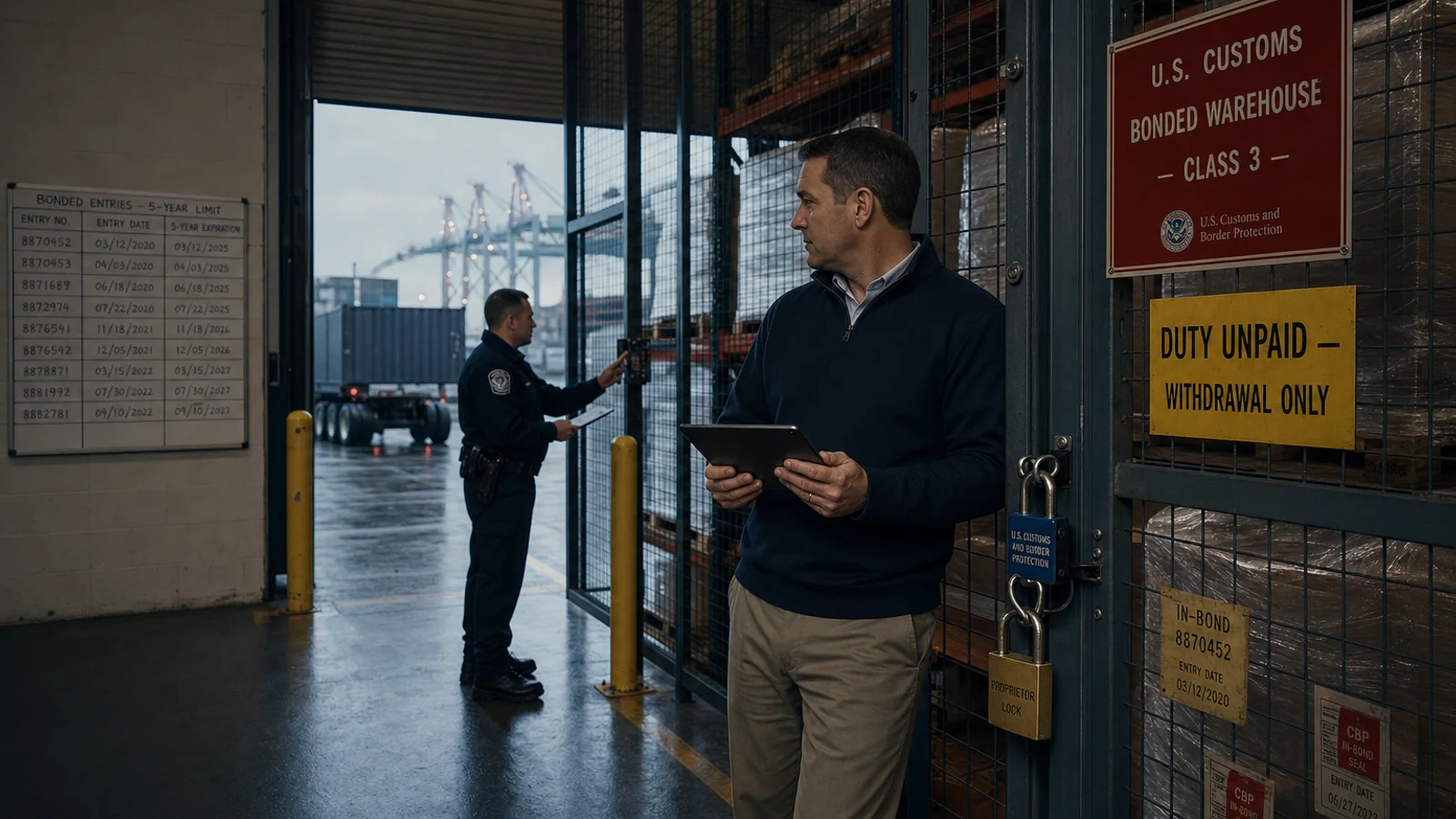
Quick answer A bonded warehouse is a CBP-supervised facility where imported goods are stored up to five years without paying duty or tax until they are withdrawn for consumption. Re-export the goods and the duty is never owed. The operator posts a customs bond and CBP controls every entry, manipulation and withdrawal.
- Goods can sit in a U.S. customs bonded warehouse for five years from the date of importation, the longest deferral window of any major market.
- Duty and tax are calculated at the rate and value in effect on the date of withdrawal for consumption, not the date of arrival.
- Re-exported goods leave the bonded warehouse without ever incurring U.S. duty, which is why transshippers to Latin America and the Caribbean use them.
- CBP recognizes 11 classes of bonded warehouse; manipulation, sorting and repackaging are allowed, manufacturing is not (except Class 6).
This guide walks through the entry and withdrawal paperwork, the five-year clock, the 11 CBP classes, and how bonded storage compares with a free trade zone. It is written for U.S. importers who control duty timing, transship to Latin America and the Caribbean, or hold stock against tariff changes.
Get your quote for bonded and in-bond cargo
Enter your route, commodity and volume. A Walio specialist confirms space and price with the carrier and sends your exact price within 1 business day.
What is a bonded warehouse and how does it work?
Quick answer A bonded warehouse is a secured facility under U.S. Customs and Border Protection supervision where imported merchandise is stored before duty is paid. The warehouse proprietor posts a customs bond guaranteeing the duty. Goods stay up to five years, and duty becomes payable only when the importer withdraws them for U.S. consumption.
A bonded warehouse is a building or yard approved by CBP for storing imported goods before duty is paid. Bonded cargo is merchandise that has arrived in the United States but has not been entered for consumption. Bonded inventory is the stock record CBP holds the proprietor accountable for, unit by unit.
The legal basis sits in 19 U.S.C. 1555 and 19 CFR Part 19. CBP supervises the facility, and the warehouse proprietor is the bonded party on the hook for the revenue. The importer keeps title to the goods the whole time.
That distinction matters. The bond protects the government's interest in uncollected duty, not ownership of your cargo. You can sell bonded inventory, assign it, or transfer it to another bonded facility while it still sits under CBP control.
The key principle: duty is deferred, not forgiven — unless the goods are re-exported. Most trading countries run an equivalent program under a different name. The European Union calls it customs warehousing, Canada uses sufferance and bonded warehouses under CBSA, and the United Kingdom runs customs warehousing through HMRC.
You do not need to own a bonded facility to use one. A Class 3 public bonded warehouse accepts merchandise from any importer, and your customs broker files the warehouse entry in your name. Setting up your own Class 2 facility only pays off at steady, high-volume throughput.
How do goods enter, sit in, and leave a bonded warehouse?
Quick answer Goods move in six steps: arrival and CBP release, warehouse entry filed on CBP Form 7501 with entry type 21, in-bond movement on CBP Form 7512 if the warehouse is inland, physical receipt and inventory tagging, permitted manipulation under CBP permit, then withdrawal for consumption or export.
- Ocean arrival. Your container lands at PortMiami, Port Houston, LA/Long Beach, NY/NJ or Savannah. The ISF "10+2" filing is already on file, 24 hours before vessel loading.
- Warehouse entry. Your customs broker files CBP Form 7501 as entry type 21. No duty is paid at this point.
- In-bond movement. If the warehouse sits inland, the cargo travels on CBP Form 7512 under CBP control.
- Receipt and tagging. The warehouse matches the bill of lading and the in-bond number, then logs every pallet into bonded inventory.
- Permitted manipulation. Sorting, repacking and relabeling happen under a CBP permit.
- Withdrawal. You pay duty for consumption, export the goods, transfer them, or destroy them under CBP supervision.
An in-bond shipment is cargo moving between U.S. ports under CBP control with no duty paid. There are three types on CBP Form 7512: immediate transportation (IT), transportation and exportation (T&E), and immediate exportation (IE). An IT move is how Midwest importers pull cargo off a Savannah vessel and clear it in Chicago.
Timing is where importers lose money. The port cut-off is not the vessel ETD, and a late in-bond filing leaves cargo sitting at the CFS after discharge. Once free time expires, demurrage runs at the terminal and detention runs on the carrier's equipment.
Receipt verification depends on two documents matching: the in-bond number and the ocean bill of lading. If you are unclear on what that document controls, read What Is a Bill of Lading and Why You Need One? before you file.
Withdrawals do not have to be all-or-nothing. Partial withdrawals are allowed — pay duty only on what you pull. That single rule is why seasonal importers and e-commerce sellers use bonded storage at all.
Common mistake: assuming the warehouse files for you
The bonded warehouse proprietor does not file your entry. Your customs broker files the type 21 warehouse entry and the Form 7512 in-bond. If neither is on file when the vessel discharges, the cargo stays at the terminal and the demurrage clock starts on day one of chargeable time.
Do you have to pay duty on goods in a bonded warehouse?
Quick answer No. Duty and merchandise processing fee are not owed while goods sit in customs bonded storage. CBP assesses duty at the rate, classification and value in effect on the date of withdrawal for consumption. Goods re-exported directly from the warehouse never incur U.S. duty at all.
Here is the cash-flow math in a worked example. Assume a 40HC container of dutiable goods valued at $300,000 at a 10% HTS rate. Duty at arrival would be $30,000, payable before the cargo moves.
Put the same container in bond and you withdraw against sales. Pull 25% per quarter and you pay $7,500 four times instead of $30,000 up front. Deferred duty storage lets duty follow revenue instead of leading it.
Merchandise exported straight from a bonded warehouse never enters U.S. commerce, so no duty or merchandise processing fee is ever assessed on it.
Rate timing cuts both ways. If the HTS rate on your classification drops before withdrawal, you pay the lower rate. If it rises, you pay the higher one, because CBP applies the rate in effect on the withdrawal date.
That nuance drove heavy bonded demand through the Section 301 period and the 2025 tariff changes. Importers parked goods in bond while exclusions, effective dates and rate schedules settled. Re-export from bond and the duty is never owed, which makes bonded storage the cleanest tariff-mitigation tool for cargo destined onward to Latin America.
One point importers miss: no duty does not mean no bond. A customs bond on CBP Form 301 is still required, and the proprietor carries a separate warehouse bond covering the stored merchandise.
How long can goods stay in a bonded warehouse?
Quick answer Five years from the date of importation in the United States, with no extensions beyond that limit. Other countries are far stricter: the EU allows unlimited customs warehousing in principle, Canada runs four years, India three years for capital goods, China two years, and the UAE one year renewable.
| Country | Regulator | Maximum storage | Key rule |
|---|---|---|---|
| United States | CBP | 5 years | Clock runs from date of importation; no extensions |
| United Kingdom | HMRC | No fixed limit | Customs warehousing under authorization |
| European Union | National customs authorities | No fixed limit | Unlimited in principle, subject to the authorization terms |
| Canada | CBSA | 4 years | Shorter periods apply to some controlled goods |
| India | CBIC | 1 year general / 3 years capital goods | Interest accrues on extended warehousing |
| China | GACC | 2 years | Extension requires customs approval |
| UAE | Federal Customs / local authority | 1 year | Renewable on application |
| Australia | ABF | Indefinite | Subject to warehouse licence conditions |
What happens at expiry in the United States is blunt. CBP treats goods left past five years as abandoned and sells them at a general order auction. The proceeds cover duty and storage first.
There is a second, much shorter clock importers confuse with this one. Cargo that arrives with no entry filed goes to general order (G.O.) status after 15 calendar days. The five-year clock starts on the date of importation, not the date of warehouse receipt.
Some commodities never get near the limit. Perishables, alcohol and tobacco carry extra CBP and excise restrictions, plus practical shelf-life and security conditions that shorten real dwell time considerably.
What are the 11 classes of U.S. bonded warehouses?
Quick answer CBP recognizes 11 classes under 19 CFR 19.1. They run from government-owned storage (Class 1) through public storage (Class 3), private proprietor warehouses (Class 2), manipulation warehouses (Class 8), duty-free stores (Class 9) and manufacturing warehouses for export (Class 6). Each class limits who may store what.
| Class | Description | Who can use it | Typical goods |
|---|---|---|---|
| Class 1 | Government-owned or leased premises | CBP | Seized and unclaimed merchandise |
| Class 2 | Private warehouse, proprietor's own goods | Importer-proprietor | Own imported inventory |
| Class 3 | Public bonded warehouse | Any importer | General merchandise |
| Class 4 | Bonded yard or shed | Bulk and heavy-cargo importers | Lumber, machinery, livestock |
| Class 5 | Bonded bins, elevators, tanks | Bulk commodity traders | Grain, oils, liquids |
| Class 6 | Manufacturing warehouse, export only | Licensed manufacturers | Tobacco, distilled spirits, export goods |
| Class 7 | Smelting and refining | Smelters and refiners | Ores, crude metals |
| Class 8 | Manipulation, cleaning, sorting, repacking | Importers and 3PLs | Apparel, e-commerce inventory |
| Class 9 | Duty-free store | Duty-free operators | Liquor, perfume, tobacco |
| Class 10 | International travel merchandise | Airlines and cruise lines | Onboard sales and supplies |
| Class 11 | General order warehouse | Approved G.O. operators | Unclaimed and abandoned cargo |
The public versus private split is the one that matters commercially. A Class 3 public warehouse stores merchandise for any importer who files a warehouse entry. A Class 2 private warehouse stores only the proprietor's own goods, which suits a single importer with steady volume.
Most importers need one of two classes. Class 3 covers general distribution and duty deferral. Class 8 is the one e-commerce sellers want — repack and relabel without paying duty first.
A single building can carry more than one designation. Many Miami and Houston operators hold Class 3 and Class 8 together, so storage and repacking happen under one roof and one bond.
What is the difference between a bonded warehouse and a free trade zone?
Quick answer A bonded warehouse defers duty for up to five years under direct CBP supervision and bans manufacturing outside Class 6. A free trade zone is legally outside U.S. customs territory, has no storage time limit, allows manufacturing and inverted tariff treatment, but costs more to set up and run.
| Feature | Bonded warehouse | Free trade zone (FTZ) | Standard warehouse |
|---|---|---|---|
| Duty timing | Paid at withdrawal for consumption | Paid when goods enter U.S. commerce | Paid at import, before delivery |
| Storage time limit | 5 years | None | None |
| Manufacturing allowed | No, except Class 6 for export | Yes, with FTZ Board approval | Yes, duty already paid |
| Customs supervision | Direct CBP control of every movement | CBP oversight with zone-level reporting | None |
| Bond required | Yes, CBP Form 301 | Yes, FTZ operator bond | No |
| Typical cost profile | Moderate setup, per-pallet storage | High setup and compliance overhead | Lowest storage cost, highest cash cost |
| Best use case | Duty deferral and re-export | Manufacturing and inverted tariffs | Domestic stock already cleared |
Inverted tariff relief is the FTZ's unique advantage. If components carry a higher HTS rate than the finished article, an FTZ producer can pay the finished-goods rate. A bonded warehouse offers no inverted tariff relief at all.
A standard warehouse offers neither. Duty is due on arrival before the goods ever reach the rack, which is why transshippers routing cargo onward to Cartagena or Caucedo never use one.
Choose bonded over FTZ for single-site programs, smaller volumes, no manufacturing and a fast start. Both sit under CBP, but they run on different statutes and different application paths. Put simply, an FTZ is a zone you join; a bonded warehouse is a building you use.
Price the freight around your bonded program
FCL, LCL, air or drayage into a bonded facility — submit the details and a specialist sends your exact price within 1 business day.
What can and cannot happen inside a bonded warehouse?
Quick answer Permitted manipulation includes sorting, repacking, relabeling, cleaning, testing, sampling, consolidation and kitting under a CBP permit filed on Form 3499. Manufacturing — any process that creates a new article with a different name, character or use — is prohibited outside a Class 6 manufacturing warehouse operating for export only.
Permitted manipulation
Sort damaged units from sellable ones. Repack bulk cartons into retail packs. Apply country-of-origin and retail labels. Clean, test, sample and weigh. Consolidate multiple entries into one outbound pallet, or build kits from parts that stay unchanged. All of it runs under a CBP permit on Form 3499, with officer supervision where the port director requires it.
Prohibited processing
Do not assemble components into a new article. Do not machine, cut to shape, mix, cook or chemically alter goods. Do not add parts that change the HTS classification. If the work produces an article with a new name, character or use, it is manufacturing and CBP will treat it as a violation outside a Class 6 facility.
The Class 6 exception is narrow. Manufacturing is allowed, but the finished goods must be exported or destroyed. Class 6 output can never be entered for U.S. consumption.
The line between the two lists is practical, not theoretical. Relabeling for a retailer's spec is manipulation; adding a component is manufacturing. Get the classification question wrong and CBP can assess duty, penalties and liquidated damages against the bond.
The three compliance failures CBP finds most
Unlogged inventory movement, broken or unrecorded seals, and commingling bonded and non-bonded stock in the same rack location. Each one triggers findings at the annual reconciliation. Ask a licensed customs broker to review your HTS classification and your Form 3499 permit scope before you start any repacking program.
How much does it cost to store goods in a bonded warehouse?
Quick answer Bonded storage is priced on four lines: storage per pallet or per square foot per month, inbound and outbound handling, the in-bond entry filing fee, and the customs bond premium. Drayage from the port and last-mile delivery sit outside those rates. Volume, dwell time and commodity class drive the total.
Storage pricing follows pallet positions or square footage, billed monthly. Dwell time compounds it, and temperature-controlled or high-security commodities move to a higher rate class. Handling in, handling out, pick-and-pack and periodic inventory reporting to CBP are separate lines.
The bond is its own cost. A single transaction bond covers one entry, a continuous bond covers a year of entries, and the proprietor's warehouse bond on CBP Form 301 covers the stored merchandise. Premiums scale with the liability amount CBP sets.
- Ocean freight — FCL or LCL, with LCL usually winning below roughly 10–15 m³
- THC and DTHC at origin and destination terminals
- BAF, CAF and peak season surcharge where the carrier applies them
- Drayage from PortMiami, Port Houston, LA/Long Beach, NY/NJ or Savannah to the bonded facility
- CFS deconsolidation for LCL cargo before it reaches the bonded rack
- Demurrage and detention are the hidden cost of a late in-bond filing
Your gateway shapes both price and transit. Florida ships through Miami, Texas and the central states through Houston, California and the Southwest through LA/Long Beach. The Northeast moves through NY/NJ, the Southeast through Savannah, the Midwest by rail via Chicago, the Pacific Northwest through Seattle. In Canada, Ontario routes through Toronto, Quebec and the Atlantic provinces through Montreal, and Western Canada through Vancouver.
Enter your route, commodity and volume in the calculator on this page, then submit the request. A Walio specialist confirms space and price with the carrier — Maersk, MSC, CMA CGM and Hapag-Lloyd among them — and sends your exact price within 1 business day. No signup and no sales call.
Compare bonded storage cost against the duty you defer, not against general warehouse rates. If deferred duty on a container exceeds a year of bonded storage and handling, the program pays for itself — and re-exported volume removes the duty entirely.
Quote your lane into bonded storage
Ocean, air, drayage and in-bond moves priced by a specialist, with your exact price in 1 business day.
When do you actually need a bonded warehouse?
Quick answer You need customs bonded storage when duty timing, re-export or tariff uncertainty controls your margin. Transshippers sending goods on to Latin America and the Caribbean, importers holding stock against Section 301 exposure, seasonal importers, alcohol and tobacco distributors, and e-commerce sellers splitting inventory by market all qualify.
Transshipment through Miami to the Caribbean basin
Consolidate inbound cargo in Miami, hold it in bond, and re-export without U.S. duty. The lane economics are short and fast.
 Miami(USMIA)
 Cartagena(COCTG)Miami(USMIA)
 Kingston(JMKIN)Miami(USMIA)
 Caucedo(DOCAU)
The same pattern works onward to Puerto Cortés in Honduras and Acajutla in El Salvador. Cargo that never enters U.S. commerce never owes U.S. duty.
Tariff mitigation, seasonality and e-commerce
- Park Section 301 exposure in bond while exclusions and effective dates resolve
- Pay duty quarter by quarter on seasonal stock as units actually sell
- Repack and relabel under a Class 8 permit before the duty bill lands
- Split one arrival between U.S. consumption entries and re-export entries
Personal cargo, relocations and vehicles
Household goods moving abroad usually clear at destination, not in the United States. Families shipping to Central America should read Moving to Panama in 2026: Complete Guide to Documents, Customs & Costs, and those heading to Europe should review Moving to Spain Requirements 2026 for the inventory and used-goods declarations each side expects.
Vehicles waiting on title or compliance paperwork are another classic bonded case. For the duty mechanics on the vehicle side, see the Import Car Canada to USA Calculator: 2.5% Duty (2026).
How to become a bonded warehouse operator
- Application to the CBP port director under 19 CFR 19.2
- Site plan, blueprint and a list of the classes requested
- Customs bond on CBP Form 301 in the amount CBP sets
- Alarm, access control and a CBP-acceptable inventory control system
- Annual reconciliation report and ongoing CBP audit cooperation
Ready to move cargo in bond?
Submit your route, commodity and volume. A specialist confirms carrier space and sends your exact price within 1 business day.
Bonded storage is a timing tool, and timing starts with the freight. Enter your origin, destination, commodity and volume in the calculator above, submit the request, and a Walio specialist sends your exact price within 1 business day — no signup, no sales calls.
A bonded warehouse is a CBP-supervised facility where imported goods are stored before duty and tax are paid. The warehouse proprietor posts a customs bond, files a warehouse entry on CBP Form 7501, and CBP controls every movement in and out. Duty becomes payable only when the importer withdraws the goods for U.S. consumption.
Five years from the date of importation in the United States, and CBP does not grant extensions. Canada allows four years, China two years, and the UAE one year renewable, while the EU and UK generally allow unlimited customs warehousing under authorization. Goods left past the U.S. limit are treated as abandoned and sold at a general order auction.
No. Duty, merchandise processing fee and applicable excise taxes are suspended while goods sit in bond. You pay at the rate and value in effect on the date of withdrawal for consumption, and if you re-export the goods straight from the warehouse you never owe U.S. duty at all.
The main difference is manufacturing and time limits. A bonded warehouse defers duty for up to five years and bans manufacturing outside Class 6, while a free trade zone sits legally outside U.S. customs territory, has no storage time limit, and permits manufacturing with inverted tariff treatment. Bonded warehouses are faster and cheaper to start using.
An in-bond shipment is cargo moving under CBP control between U.S. ports without duty being paid, filed on CBP Form 7512. The three types are immediate transportation, transportation and exportation, and immediate exportation. It is how goods reach an inland bonded warehouse from PortMiami, Port Houston or LA/Long Beach without clearing customs at the arrival port.