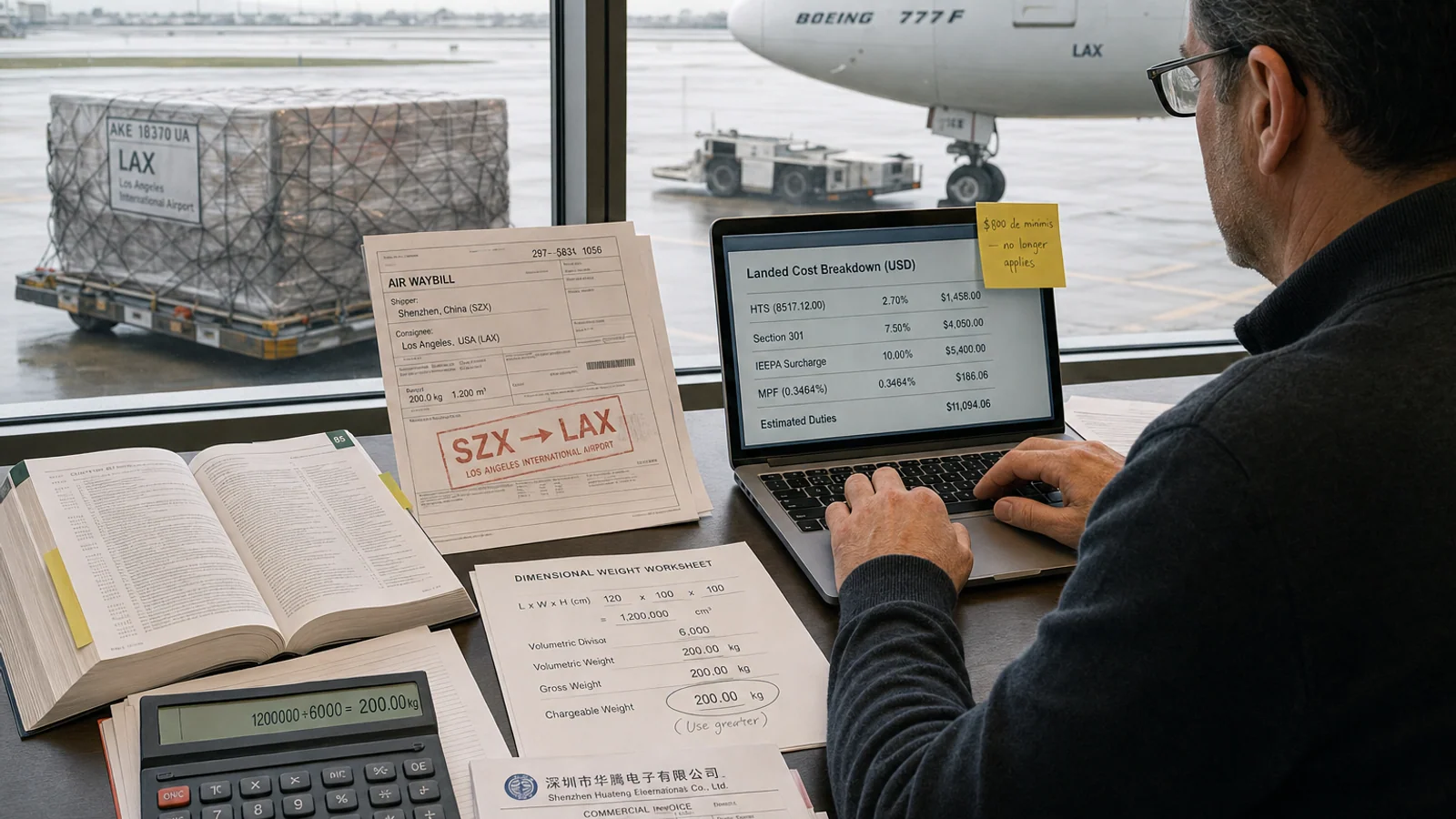
Quick answer US import duty on air cargo from China equals the customs value (FOB price) multiplied by the HTS rate plus Section 301 and IEEPA surcharges, then add the 0.3464% Merchandise Processing Fee. Air freight is not part of customs value. Walio's calculator prices your duties, clearance and US delivery instantly.
- US duty is charged on FOB transaction value — international air freight and insurance are excluded from customs value on most China–US air imports.
- The $800 de minimis exemption ended for China shipments on 2 May 2025 and worldwide on 29 August 2025, so almost every air parcel now needs a formal or informal entry.
- Chargeable weight = gross weight vs volume (cm) ÷ 6000, whichever is higher. It drives freight and surcharges, never duty.
- Walio's US customs clearance for an air shipment starts at $610 (DDP: entry, bond, AMS/ISF filing, CBP fee minimums); duties and door delivery are priced by the calculator.
This page is a working calculadora aranceles carga aerea china estados unidos: enter your HS code, value and US ZIP, and see duties, CBP fees, clearance and delivery. The math behind every line is explained below.
See your price in seconds
Real carrier rates, no signup, no follow-up calls.
How do you calculate import duties from China to the USA?
Quick answer Duty equals customs value times the stacked rate. Take your FOB invoice value, apply the base HTS rate, add the Section 301 List rate for your code, add the IEEPA surcharge, then add the 0.3464% Merchandise Processing Fee. Air freight sits outside customs value, so it is not taxed.
The formula is short and you can run it on paper before you place a purchase order:
- Duty = Customs value × (HTS base rate + Section 301 rate + IEEPA rate)
- Landed cost = air freight + duty + MPF + customs clearance + airport-to-door delivery
- Customs value = transaction value at FOB China, per the CBP valuation rules in 19 U.S.C. 1401a
Each surcharge applies to the same customs value. They do not compound on top of each other. A 3.9% base rate plus a 25% Section 301 surcharge equals 28.9% of the invoice value, not 3.9% then 25% of the result.
The Merchandise Processing Fee runs at 0.3464% of value for formal entries, with a published per-entry minimum and maximum set by CBP. The Harbor Maintenance Fee does not apply to air cargo at all — it is a port fee charged only on ocean imports. For surcharge detail by List, see our Section 301 Tariff Calculator: China to USA 2026.
Ask your supplier for an FOB-stated invoice even when you buy CIF. CBP accepts the transaction value, but a clean FOB figure with freight itemized separately makes the deduction defensible if the entry is reviewed.
See your price in seconds
Real carrier rates, no signup, no follow-up calls.
Free calculadora aranceles carga aerea china estados unidos: what it prices
Quick answer Walio's calculator prices the US side of your air import in seconds: customs clearance, duties and tariffs for your HS code and value, CBP fees, and delivery from the airport to your ZIP. US customs clearance for an air shipment starts at $610 before duties and delivery.
You enter four things: HS code, country of origin (China), commercial value and US delivery ZIP. The result splits duties, CBP fees, clearance and door delivery into separate lines.
Walio's DDP US customs clearance covers the customs entry, the bond, AMS/ISF filing, handling and CBP fee minimums. It starts at $610 for an air shipment, $695 for LCL and $745 for FCL, before duties and delivery.
DDP customs entry, bond, AMS/ISF filing and CBP fee minimums for an air import. Duties and airport-to-door delivery are calculated separately by the calculator.
One limit worth stating plainly: this tool does not price the China-to-US air freight leg. A Walio specialist quotes that within one business day. The duty dollars shown come from published US government rates, not from a Walio margin.
How do I calculate the chargeable weight of an air shipment from China?
Quick answer Chargeable weight is the higher of gross weight in kilograms and volumetric weight. Volumetric weight equals length × width × height in centimeters divided by 6000, which equals 166.67 kg per cubic meter. Airlines bill the higher figure. Chargeable weight drives freight and surcharges, never the duty calculation.
Take 200 kg gross occupying 1.2 m³. Volumetric weight is 1.2 × 166.67 = 200 kg. Both figures match, so chargeable weight is 200 kg. Carriers out of PVG, SZX, CAN and PEK all use the IATA divisor of 6000.
| Cargo type | Gross weight | Volume | Volumetric weight | Chargeable weight |
|---|---|---|---|---|
| Machine parts | 400 kg | 1.0 m³ | 167 kg | 400 kg |
| Consumer electronics | 200 kg | 1.2 m³ | 200 kg | 200 kg |
| Apparel in cartons | 120 kg | 1.8 m³ | 300 kg | 300 kg |
| Foam-packed goods | 60 kg | 2.5 m³ | 417 kg | 417 kg |
| Lithium batteries (UN3480) | 350 kg | 0.9 m³ | 150 kg | 350 kg |
Repacking can pay. Cutting one carton dimension by 10 cm across a pallet often drops the shipment below the volumetric threshold. It lowers freight and fuel surcharges — but never your tariff, because duty is charged on invoice value.
Can I still import duty-free if my shipment is under $800?
Quick answer No. The $800 de minimis exemption ended for China and Hong Kong shipments on 2 May 2025 and for all countries on 29 August 2025. Every commercial air import from China now needs an entry with CBP, pays applicable duties and Section 301 surcharges, and is subject to MPF minimums.
The dates matter. Per CBP and the Federal Register notices implementing the executive orders, China and Hong Kong lost de minimis on 2 May 2025, and the suspension went worldwide on 29 August 2025.
The effect on e-commerce air cargo is structural. Per-parcel duty-free clearance is gone. Sellers now consolidate orders under one master air waybill and file a single entry through a customs broker.
Check the current CSMS message before you book
IEEPA fentanyl-related tariffs and the reciprocal tariff program have both been amended and extended by truce agreements during 2025. Rates in force on the date of entry govern. Read the latest CBP CSMS notice, or ask a licensed customs broker, before you commit to a purchase order.
Two bond choices follow. A single-entry bond suits a one-off import. A continuous customs bond pays for itself at roughly four or more entries a year and covers all ports.
Where do I find the HTS code for my product?
Quick answer The HTS code is the 10-digit US tariff classification that sets your duty rate. Find it in the free USITC HTS Search at hts.usitc.gov by typing the product name, then read the General column for the base rate and Chapter 99 notes for Section 301 and IEEPA surcharges.
- Open hts.usitc.gov and search the plain product name, such as "bluetooth speaker".
- Narrow the result to the right chapter — electronics sit in Chapter 85, apparel in 61 and 62.
- Open the heading and read the General rate of duty column, which applies to China.
- Follow the Chapter 99 cross-reference for the Section 301 and IEEPA add-on lines.
- Copy the full 10 digits into the calculator on this page.
When two headings could fit, the General Rules of Interpretation decide. For composite goods, the component that gives the article its essential character controls the classification.
For a repeat import worth real money, ask a licensed customs broker to request a CBP binding ruling. Past rulings are searchable free in the CROSS database. Misclassification is the leading cause of penalties and post-entry adjustments on China air imports.
What tariffs do Chinese products pay in 2026?
Quick answer Chinese goods pay a stacked rate: the base HTS duty, the Section 301 List 1–4A surcharge, and the IEEPA surcharge where it applies. Electronics, lithium batteries, auto parts and textiles each sit in different HTS chapters with different totals. Confirm your exact code before you commit to a purchase order.
| Product category | HTS chapter | Typical base rate | Section 301 List | 301 surcharge |
|---|---|---|---|---|
| Consumer electronics | 85 | 0% – 3.9% | List 3 / 4A | 7.5% – 25% |
| Apparel and textiles | 61–62 | 8% – 32% | List 4A | 7.5% |
| Auto parts | 87 | 2.5% | List 1 / 3 | 25% |
| Lithium-ion batteries | 85 (8507.60) | 3.4% | List 3 | 25% |
| Commercial samples | varies | per code | per code | per code |
Rates above are published US government rates from the USITC tariff schedule and USTR notices, not Walio pricing. Section 232 steel and aluminum derivative duties can land on top for metal-content goods. USTR exclusions expire and get renewed, so a code excluded last year may not be excluded today. The Section 301 Tariff Calculator: China to USA 2026 breaks this down List by List.
See your price in seconds
Real carrier rates, no signup, no follow-up calls.
Worked example: 200 kg of electronics, Shenzhen to Los Angeles
Quick answer A 200 kg, 1.2 m³ consumer electronics shipment valued at $12,000 FOB from Shenzhen (SZX) to Los Angeles (LAX) carries 200 kg chargeable weight. Duty is calculated on the $12,000 value using the HTS rate plus Section 301, then MPF at 0.3464%. US clearance starts at $610.
 Shenzhen(SZX)
 Los Angeles(LAX)
| Cost line | Basis | Amount |
|---|---|---|
| Chargeable weight | max(200 kg, 1.2 m³ × 166.67) | 200 kg |
| Air freight SZX–LAX | USD per chargeable kg | Specialist quote, 1 business day |
| Fuel + security surcharge | per chargeable kg | Included in specialist quote |
| AMS filing | per master air waybill | Included in clearance |
| US customs clearance (DDP) | per entry | From $610 |
| Base HTS duty | $12,000 × base rate | Per your 10-digit code |
| Section 301 surcharge | $12,000 × List rate | Per your Chapter 99 line |
| MPF | $12,000 × 0.3464% | $41.57 |
| HMF | air cargo | $0 — not applicable |
| LAX airport to door | consignee ZIP | Priced by the calculator |
Note the valuation point. Air freight and insurance stay outside the dutiable value on this FOB purchase. Buying CIF from a different seller does not change how CBP values the goods — the transaction value basis stands.
Air cargo vs express courier vs ocean LCL and FCL
Quick answer Air cargo beats express courier above roughly 100–150 kg and beats ocean when inventory speed matters more than cost per kilo. Ocean LCL wins from about 2 m³ and FCL from about 10–15 m³. Duty is identical across all four modes because it is charged on value, not transport.
| Mode | Transit (China–US) | Break-even point | Customs handling | Insurance |
|---|---|---|---|---|
| Express courier | 3–5 days | Under 100 kg | Bundled by carrier | Carrier add-on |
| Air cargo | 4–8 days | 100 kg and up | Broker entry + AMS | Cargo policy |
| Sea-air via hub | 16–20 days | 300 kg and up | Broker entry | Cargo policy |
| Ocean LCL | 28–40 days | From ~2 m³ | Broker entry + ISF 10+2 | Cargo policy |
| Ocean FCL | 22–35 days | From ~10–15 m³ | Broker entry + ISF 10+2 | Cargo policy |
Express courier used to win on simplicity because small parcels cleared duty-free. With de minimis gone, every parcel carries an entry and Section 301, so the bundled-clearance advantage shrinks fast above 100 kg.
Sea-air through a transshipment hub cuts ocean transit roughly in half at a fraction of pure air cost — see the Sea-Air Cargo China to USA Calculator: 18-Day Transit 2026. For regional lanes, compare the Sea-Air China to Panama Calculator: 16-25 Days (2026) and the Sea-Air China to Costa Rica Calculator: $3.40/kg (2026).
Your gateway shapes transit and trucking. California and the Southwest clear at LAX, Texas and the central states at IAH, the Northeast at JFK or EWR, Florida at MIA, the Midwest at ORD. The calculadora aranceles carga aerea china estados unidos on this page prices delivery from your actual gateway to your ZIP.
What documents does a China air import need, and who files them?
Quick answer A China-to-USA air import needs a commercial invoice, packing list, master and house air waybill, a signed power of attorney for your broker, an AMS filing before wheels-up, and a customs bond. The broker files the entry with CBP; the shipper issues the invoice and air waybill.
- Commercial invoice — shipper, before departure. Must show FOB value, Incoterm, HTS code, country of origin and manufacturer.
- Packing list — shipper, before departure. Carton count, gross and volumetric weight.
- MAWB and HAWB — airline and forwarder, at tender.
- Power of attorney — importer signs to the customs broker, once.
- AMS filing — forwarder or broker, before wheels-up from China.
- Customs entry — broker, within 15 calendar days of arrival per CBP.
- Customs bond — single-entry or continuous, in place before entry.
ISF 10+2 is ocean only
Importers often try to file ISF for an air shipment. ISF 10+2 applies to containerized ocean cargo. Air cargo files AMS instead. Filing the wrong one wastes time and leaves the real filing missing at departure.
Legal ways to pay less: correct classification, first sale valuation, consolidating orders into one entry, duty drawback on re-exports, and any active USTR exclusion for your code. Confirm each with a licensed customs broker or tax adviser — Walio is a shipping platform, not legal counsel.
See your price in seconds
Real carrier rates, no signup, no follow-up calls.
Run your HS code, value and ZIP through the calculadora aranceles carga aerea china estados unidos above. You get duties, CBP fees, clearance from $610 and door delivery on screen in seconds — no signup, no follow-up calls — and a specialist adds the China air freight within one business day.
You pay the base HTS rate for your product plus the Section 301 surcharge and any IEEPA surcharge, all calculated on the FOB customs value, plus MPF at 0.3464% of value. A $12,000 shipment with a 25% stacked rate owes $3,000 in duty plus $41.57 MPF. Enter your HS code and value in the calculator to see your exact figure.
No. CBP values imports on the transaction value at FOB, so international air freight and insurance are excluded from the dutiable base on most China-to-USA shipments. That means a high freight bill does not increase your duty, though it does increase your landed cost.
The rate per chargeable kilogram changes weekly with capacity, fuel and peak season demand out of PVG, SZX, CAN and PEK. Walio does not publish a fixed per-kilo figure; a specialist quotes your China-to-US air freight within one business day. The calculator on this page prices the US side instantly — clearance from $610, duties, CBP fees and delivery to your ZIP.
No. De minimis treatment ended for China and Hong Kong on 2 May 2025 and for all origins on 29 August 2025. Every commercial air shipment from China now requires a customs entry and pays applicable duties, Section 301 surcharges and MPF regardless of value.
Ocean is cheaper per kilogram in almost every case, and FCL becomes the best value from around 10-15 cubic meters. Air wins when transit time, inventory turns or product value justify the premium, typically above $20 per kilogram of product value. Duty is the same either way because it is charged on goods value, not on the mode of transport.