Quick answer Section 301 duty is calculated on the customs value of your Chinese goods, not the landed cost. Add the MFN HTS rate, then the List 1–4A surcharge (7.5%, 25%, 50% or 100%), then MPF at 0.3464% and HMF at 0.125%. Walio's calculator prices all of it in seconds.
- Section 301 duty applies to the entered customs value (usually FOB), not to freight or insurance.
- List 3 goods carry 25%, List 4A 7.5%, and 2024–2025 increases pushed EVs to 100%, solar cells to 50% and semiconductors to 50%.
- Section 301 stacks on top of the base MFN HTS rate, and on top of Section 232 and IEEPA tariffs where both apply.
- Walio's US customs clearance starts at $745 FCL, $695 LCL and $610 air, before duties and door delivery — the calculator adds those for your HTS code and ZIP.
A section 301 tariff calculator only helps if it shows the math CBP actually runs. This page shows every line, then the calculator on this page prices your HS code, China origin, declared value and US delivery ZIP.
See your price in seconds
Real carrier rates, no signup, no follow-up calls.
How do I calculate Section 301 tariffs on goods from China?
Quick answer Take the customs value of the goods, apply the base MFN rate from your HTS code, then add the Section 301 surcharge tied to the Chapter 99 subheading (9903.88.xx). Add MPF at 0.3464% and HMF at 0.125% for ocean entries. The sum is what CBP collects at entry.
- Classify the product to a 10-digit HTS code in the USITC tariff schedule — same-day work with your supplier's spec sheet.
- Read the base MFN duty rate on that line (Column 1, General).
- Find the Chapter 99 subheading (9903.88.01 through 9903.88.15 and later notes) that assigns the List 1/2/3/4A rate.
- Add MPF at 0.3464% of customs value, within the 2026 minimum and maximum, plus HMF at 0.125% on ocean entries only.
Walio's calculator runs all four steps, then adds US clearance and port-to-door delivery.
The Chapter 99 line is a second HTS line on the same entry summary. Your broker files the Chapter 1–97 code and the 9903 code together — miss the 9903 line and CBP issues a rate advance later.
What is the Section 301 tariff rate for my HTS code?
Quick answer Section 301 rates run in four original lists plus the 2024–2025 strategic increases. List 1 and List 2 sit at 25%, List 3 at 25% after the 2019 step-up, and List 4A at 7.5%. Electric vehicles now carry 100%, solar cells and semiconductors 50%, and steel and aluminum products 25%.
| List | Rate | Effective | Chapter 99 | Example categories |
|---|---|---|---|---|
| List 1 | 25% | Jul 6, 2018 | 9903.88.01 | Industrial machinery, electrical equipment |
| List 2 | 25% | Aug 23, 2018 | 9903.88.02 | Plastics, semiconductor equipment, chemicals |
| List 3 | 25% | May 10, 2019 | 9903.88.03 | Furniture, lighting, auto parts, textiles |
| List 4A | 7.5% | Feb 14, 2020 | 9903.88.15 | Consumer electronics, apparel, footwear |
| 2024–25 increases | 25%–100% | Sep 2024 / Jan 2025 | Per USTR notice | EVs 100%, solar cells 50%, semiconductors 50%, EV batteries 25% |
List 3 covers the widest range of commercial cargo. The rate that applies is the one in force on the entry date, not the order date or the sailing date. Authoritative sources: USTR Section 301 notices in the Federal Register, USITC HTS Chapter 99 Subchapter III, and CBP CSMS messages.
Do Section 301 tariffs stack on top of regular import duties?
Quick answer Yes. Section 301 is additive. CBP applies the base MFN HTS rate first, then the Section 301 surcharge, then any Section 232 steel, aluminum or derivative duty, then IEEPA-based tariffs where they apply. MPF and HMF are calculated separately on customs value and are not duties.
| Layer | Legal basis | Covered origin | Typical rate | Stacks? |
|---|---|---|---|---|
| 1. MFN base | HTSUS Column 1 | All WTO origins | 0%–12% | Base layer |
| 2. Section 301 | Trade Act of 1974 | China only | 7.5%–100% | Yes |
| 3. Section 232 | Trade Expansion Act 1962 | Most origins, listed articles | 25% steel / 10%+ aluminum | Yes |
| 4. IEEPA | Emergency Economic Powers Act | By country proclamation | Varies by notice | Yes, layered over 301 |
| 5. MPF | 19 CFR 24.23 | All formal entries | 0.3464% | Fee, not duty |
| 6. HMF | 26 USC 4461 | Ocean entries | 0.125% | Fee, not duty |
A 3.7% MFN machinery line with List 3 treatment is dutiable at 28.7%, not 25%. Readers comparing a non-US import regime can see the same stacking logic applied elsewhere in our Vietnam to Brazil Import Calculator: Rates & Rules 2026.
Is Section 301 duty based on the product price or the landed cost?
Quick answer Section 301 duty is charged on the entered customs value — normally the transaction value of the goods on FOB terms. Ocean freight, insurance and inland US delivery are excluded. Assists, royalties, tooling and certain selling commissions must be added to that value even when they are invoiced separately.
- Transaction value is the price paid or payable for the goods, excluding international freight and insurance.
- Statutory additions importers forget: molds and tooling supplied free to the factory, foreign design work, and royalties tied to the sale.
- DDP purchase terms shift commercial liability to the seller, but the importer of record still answers to CBP for the entry.
Undervaluing is not a savings strategy
Lowering the invoice to shrink a 25% exposure is a false statement to CBP under 19 USC 1592. Penalties reach the domestic value of the goods. Walio's calculator asks for goods value, not landed cost, so the math matches CBP Form 7501.
Worked example: $50,000 shipment, every line to CBP
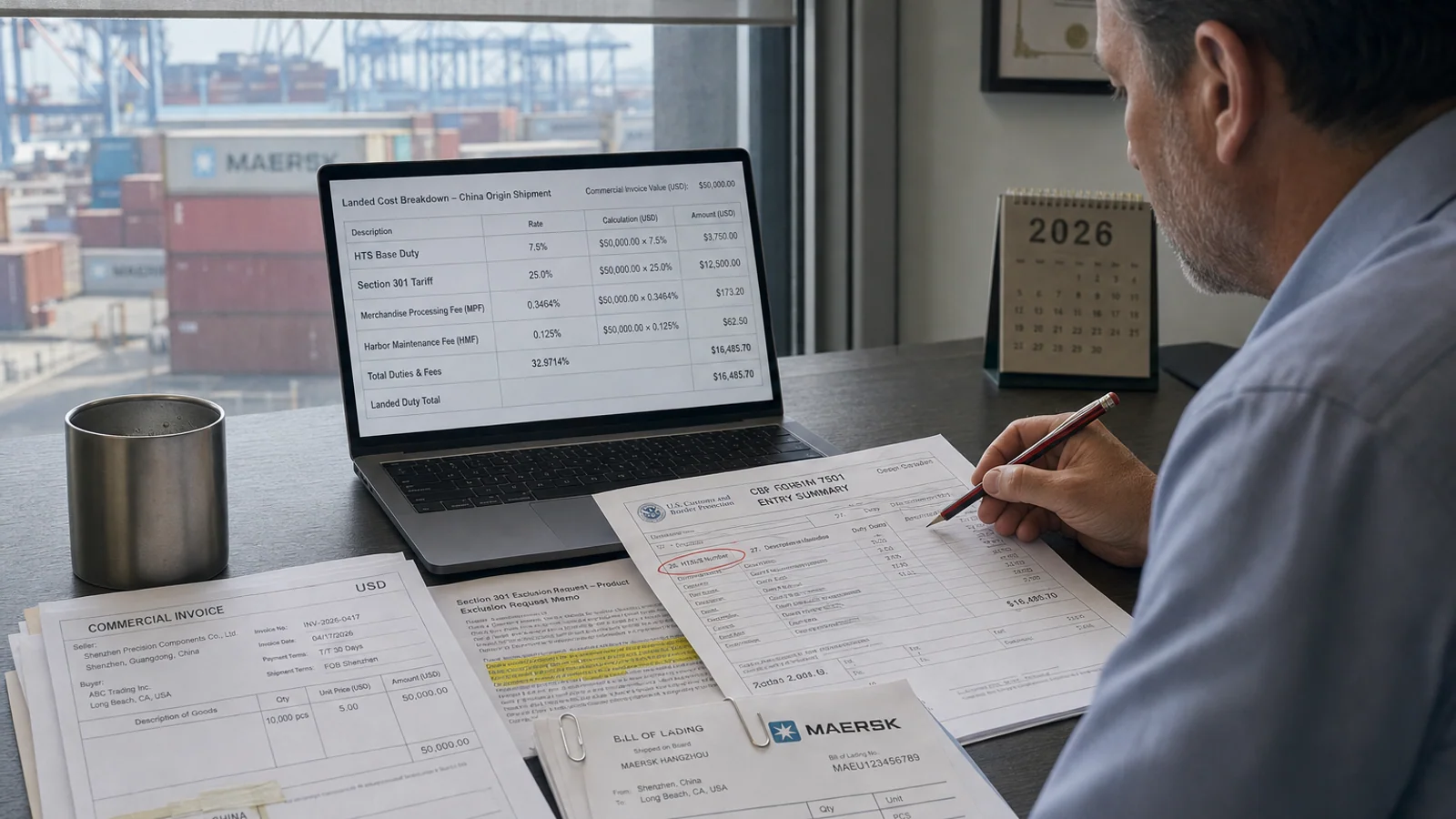
Quick answer On a $50,000 List 3 shipment with a 3.7% MFN rate, the math is: $1,850 MFN duty, $12,500 Section 301 duty, $173.20 MPF at 0.3464%, and $62.50 HMF at 0.125%. Total payable to CBP is $14,585.70 — before freight, clearance and delivery.
| Line | Rate | Amount (USD) |
|---|---|---|
| Customs value (FOB) | — | 50,000.00 |
| MFN duty | 3.7% | 1,850.00 |
| Section 301, List 3 | 25% | 12,500.00 |
| MPF | 0.3464% | 173.20 |
| HMF | 0.125% | 62.50 |
| Total to CBP | 28.7% + fees | 14,585.70 |
A 3.7% MFN line plus a 25% List 3 surcharge. That is the number to budget per dollar of cargo value.
| Container | Typical cargo value | 301 at 7.5% | 301 at 25% |
|---|---|---|---|
| 20 ft | $40,000 | $3,000 | $10,000 |
| 40 ft | $80,000 | $6,000 | $20,000 |
| 40 ft HC | $95,000 | $7,125 | $23,750 |
| Origin, same $50,000 goods | MFN duty | Section 301 | Total duty |
|---|---|---|---|
| China (List 3) | $1,850 | $12,500 | $14,350 |
| Vietnam | $1,850 | $0 | $1,850 |
| Mexico (USMCA qualifying) | $0 | $0 | $0 |
Walio's US customs clearance starts at $745 FCL, $695 LCL and $610 air (USD, from our quoting system on 2026-11-14) covering DDP entry, bond, ISF/AMS filing, handling and CBP fee minimums — before duties and delivery. The calculator prices the US side; a specialist quotes the China–US ocean or air freight within 1 business day.
See your price in seconds
Real carrier rates, no signup, no follow-up calls.
Section 301 tariff calculator: exclusions, origin and filing steps
Quick answer Check exclusions before you pay. USTR publishes active exclusions by HTS subheading with expiry dates, and an excluded line is entered under a separate Chapter 99 number. Country of origin follows substantial transformation, so routing Chinese goods through a third country does not remove the 301 duty.
- Commercial invoice with unit values and Incoterms 2020 term
- Packing list with gross and net weights
- Bill of Lading or Air Waybill
- 10-digit HTS classification plus the Chapter 99 line
- Country-of-origin declaration
- CBP Form 7501 entry summary
- Classification — same day, from the spec sheet.
- ISF "10+2" filed 24 hours before vessel loading in China.
- Entry filed up to 15 days before arrival.
- Duty paid on the periodic monthly statement, 15th working day of the following month.
High 301 exposure usually pushes importers from a single-entry bond to a continuous bond sized to annual duties. For vehicle-specific US entry rules, see our Import Car Canada to USA Calculator: 2.5% Duty (2026), the JDM Car Import Calculator: Japan to USA Rates (2026) and the Import Car Germany to USA Calculator: 2026 Quotes. Diverting China cargo to other markets? Compare timings in our Sea-Air China to Peru Calculator: 2026 Rates.
Transshipment does not change origin
Repacking or light assembly in Vietnam or Mexico keeps Chinese-origin goods Chinese. CBP pursues false origin claims through Enforce and Protect Act investigations. Classification disputes, exclusion claims and valuation questions belong with a licensed customs broker — Walio's specialists flag them and the calculator takes the request.
See your price in seconds
Real carrier rates, no signup, no follow-up calls.
Enter your HS code, China origin, goods value and US delivery ZIP in the calculator above and see your US duties, CBP fees, clearance and door delivery in seconds — no signup, no follow-up calls.
Multiply the customs value of the goods by the base MFN rate for your HTS code, then by the Section 301 rate tied to its Chapter 99 subheading, and add both. Then add MPF at 0.3464% of customs value and, on ocean entries, HMF at 0.125%. Walio's calculator runs the full stack for your HS code and US ZIP in seconds.
Yes. Section 301 is an additional duty that sits on top of the normal MFN rate in your HTS line, and Section 232 or IEEPA tariffs can stack on top of that. A 3.7% MFN product on List 3 is dutiable at 28.7% before MPF and HMF.
Section 301 is charged on the entered customs value, which is normally the FOB transaction value of the goods. International ocean freight, insurance and US inland delivery are not part of that base. Tooling, assists and royalties tied to the sale must be added to the declared value.
No. Country of origin for Section 301 is determined by substantial transformation, not by the port of export, so repacking or light assembly in Vietnam keeps the goods Chinese. False origin claims expose the importer of record to penalties and Enforce and Protect Act investigations by CBP.
USTR publishes active exclusions by HTS subheading, each with an effective date and an expiry date, and excluded goods are entered under a separate Chapter 99 number. Check the current USTR exclusion list and CBP CSMS messages for your entry date, then have a licensed customs broker confirm the claim before filing.