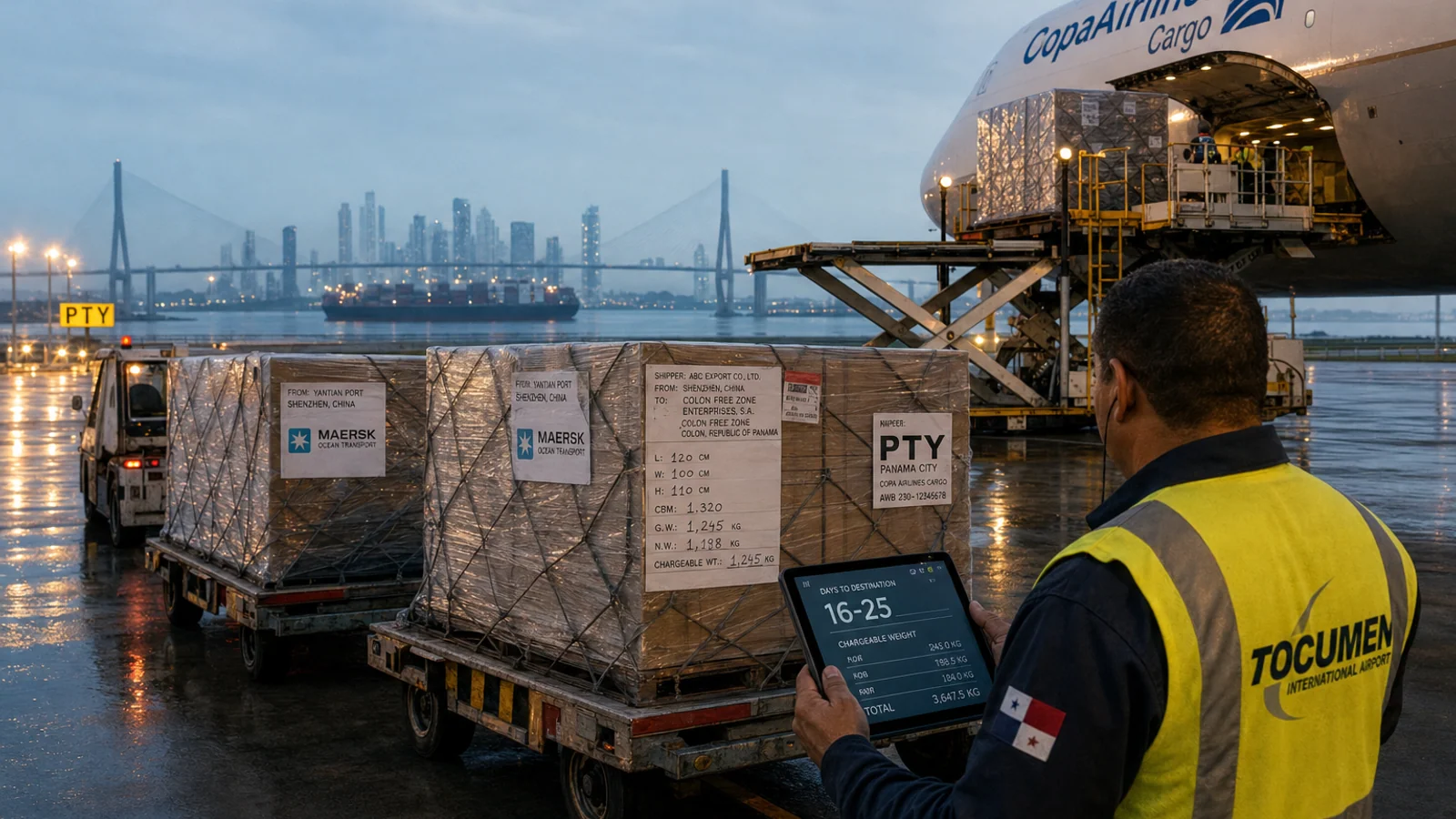
Quick answer Sea-air from China to Panama runs 16-25 days door-adjacent: ocean to Los Angeles (12-18 days), truck to Miami (3-5 days), then air to Tocumen (1-2 days). Walio's sea-air rates start from $5.91/kg at 300-499 kg and from $3.87/kg at 5,000+ kg, port to airport.
- Sea-air China to Panama takes 16-25 days total: ocean Shanghai/Ningbo/Shenzhen to Los Angeles, truck LA to Miami, air Miami to Panama City (PTY).
- Walio sea-air rates start from $5.91/kg for 300-499 kg and from $3.87/kg for 5,000+ kg, port to airport, on the cheapest port and airport pairing.
- Minimum billed weight is 300 kg, and chargeable weight is the greater of actual weight or volume x 167 kg per cubic meter.
- Panama charges 7% ITBMS plus duty by HS code on mainland imports; goods staying inside the Colon Free Zone are treated differently.
This guide explains how a sea air calculator China to Panama builds its number, leg by leg and charge by charge. Then you can price your own shipment on this page and book it without waiting for an email.
See your price in seconds
Real carrier rates, no signup, no follow-up calls.
What is sea-air shipping and does it work from China to Panama?
Quick answer Sea-air shipping moves one shipment by ocean for the long leg, then by air for the final leg, under a single multimodal booking. From China it sails to Los Angeles in 12-18 days, trucks to Miami in 3-5 days, then flies to Tocumen in 1-2 days. Total: 16-25 days.
Sea-air is one shipment, two or three modes, one price and one booking. In freight terms it is a multimodal service, sold as a single rate per chargeable kilo instead of separate ocean and air contracts. You do not manage the transfer points. The operator does.
Walio's China to Panama routing uses the US land bridge. Cargo sails from Dalian, Fuzhou, Guangzhou, Ningbo, Qingdao, Shanghai, Shenzhen, Xiamen or Xingang to Los Angeles. It then moves by truck from Los Angeles to Miami, and finally flies from Miami to Tocumen International Airport (PTY).
 Shanghai(CNSHA)
 Panama City(PTY)
Why the Americas hub beats Dubai or Singapore for Panama
Classic sea-air corridors transfer in Dubai or Singapore, which suits Europe and Africa. Panama sits on the wrong side of the planet for that. The US land bridge pairs cheap transpacific ocean capacity with short-haul widebody belly space into Tocumen, which keeps the air leg to one or two days.
Miami is the natural feeder airport for Panama. Flights to PTY run daily and multiple times a day, so cargo rarely waits for space. That reliability is what makes the 16-25 day window hold.
What the service includes and who uses it
The published service is port to airport. The shipper delivers the cargo to the origin port in China. The consignee collects it at the Tocumen cargo terminal in Panama. Door pickup in China and door delivery in Panama are quoted on request in the calculator.
Two groups lean on this lane hardest. Colon Free Zone traders restocking fast movers use it to keep shelves full between ocean sailings. Panama City importers use it after missing an ocean cut-off, when a full air booking would wipe out the margin.
Sea-air works best as a planned second channel, not an emergency button. Many importers move 80% of volume by container and keep their top 20 SKUs on sea-air, so a single late vessel never empties the warehouse.
See your price in seconds
Real carrier rates, no signup, no follow-up calls.
Sea air calculator China to Panama: how does it work?
Quick answer A sea-air calculator prices a multimodal shipment instantly from live carrier rates. Enter the origin port in China, the destination airport (PTY), gross weight and dimensions. Walio returns chargeable weight, the per-kg rate band, handling charges and transit days on screen in seconds, with no signup and no follow-up call.
The inputs are short on purpose. You pick the origin port, confirm Panama City (PTY) as the destination, and enter pieces, gross weight and carton dimensions in centimeters. Cargo type and Incoterm finish the picture.
| Field | What you enter | What it changes |
|---|---|---|
| Origin port | Shanghai, Ningbo, Shenzhen, Qingdao, Xiamen, Guangzhou, Dalian, Fuzhou, Xingang | Ocean transit and rate level |
| Destination airport | Panama City (PTY) | Air leg and destination handling |
| Pieces | Number of cartons or pallets | Handling and volume total |
| Gross weight | Kilograms, all pieces | Weight break applied |
| Dimensions | L x W x H in cm per piece | Volumetric weight at 167 kg/m³ |
| Cargo type | General, electronics, batteries, hazardous | Acceptance and specialist review |
| Incoterm | FOB, FCA, EXW, DAP, DDP | Who pays which leg and clearance |
The outputs sit side by side: chargeable weight, applicable weight break, the from-rate per kilo, origin and destination handling added per shipment, and transit days split by leg. Nothing is hidden behind a quote request.
Three worked examples
- 180 kg carton lot, 1.2 CBM. Volumetric weight is 200 kg, actual is 180 kg, but both sit under the floor. The shipment bills at the 300 kg minimum.
- 8 CBM consolidation, 900 kg actual. Volumetric weight is 1,336 kg (8 x 167). The higher figure wins, so the booking lands in the 1,000-4,999 kg band from $4.32/kg.
- 5,000 kg electronics lot, 18 CBM. Volumetric weight is 3,006 kg, below actual weight. The shipment bills on 5,000 kg at the lowest band, from $3.87/kg.
The calculator shows a from-rate because the exact price depends on three variables: the origin port, the airport pairing and the weight break. A Shenzhen booking and a Dalian booking do not price the same. Enter your real details and the screen resolves it.
The same US land bridge serves other Latin American markets. If you also ship to Mexico, compare the pattern in our Sea-Air China to Mexico Calculator: 16-25 Days (2026) guide.
See your price in seconds
Real carrier rates, no signup, no follow-up calls.
How do I calculate CBM and chargeable weight for a shipment from China to Panama?
Quick answer CBM equals length x width x height in meters. For sea-air, chargeable weight is the greater of actual gross weight and volume x 167 kg per cubic meter. Pure air uses cm³ divided by 6000; ocean freight uses 1 CBM versus 1,000 kg. Walio's calculator applies the right rule automatically.
Start with volume. Measure each carton in meters, multiply length by width by height, then multiply by the number of cartons. A carton of 0.60 x 0.40 x 0.50 m is 0.12 CBM. Forty of them make 4.8 CBM.
Now convert volume to weight. Multiply 4.8 CBM by 167 kg and you get 802 kg of volumetric weight. If the scale says 600 kg, you pay on 802 kg. The higher of the two figures is always billed.
| Mode | Conversion rule | Equivalent density | Billed unit |
|---|---|---|---|
| Air freight (IATA) | cm³ ÷ 6,000 | 167 kg per m³ | Chargeable kg |
| Sea-air (this lane) | CBM x 167 kg | 167 kg per m³ | Chargeable kg |
| Ocean LCL | 1 CBM vs 1,000 kg | 1,000 kg per m³ | Revenue ton (W/M) |
| Express courier | cm³ ÷ 5,000 | 200 kg per m³ | Chargeable kg |
Density decides everything. Cargo under roughly 167 kg per cubic meter pays on volume, not on the scale. Pillows, plastic housings and empty bottles are volume cargo. Fasteners, tiles and batteries are weight cargo.
The floor on this lane is 300 kg. A 90 kg shipment of five cartons still pays for 300 kg, so small trial orders carry a poor cost per unit. Combine them with the next purchase order whenever the supplier can hold the goods.
How much does it cost to ship from China to Panama by sea-air?
Quick answer Walio sea-air rates from China to Panama start at $5.91/kg for 300-499 kg, $5.00/kg for 500-999 kg, $4.32/kg for 1,000-4,999 kg and $3.87/kg for 5,000 kg and above. These are port-to-airport freight rates on the cheapest port and airport pairing; handling is added per shipment.
The rate table is banded by chargeable weight. Rates below come from Walio's live multimodal rate table as of October 14, 2026, and are always "from" figures.
| Chargeable weight | Sea-air rate (from) | Billing basis | Scope |
|---|---|---|---|
| 300-499 kg | $5.91/kg | Per chargeable kg | Port to airport |
| 500-999 kg | $5.00/kg | Per chargeable kg | Port to airport |
| 1,000-4,999 kg | $4.32/kg | Per chargeable kg | Port to airport |
| 5,000 kg and above | $3.87/kg | Per chargeable kg | Port to airport |
The exact rate depends on the origin port and the airport pairing, which is why the calculator prices your specific combination. A Xiamen booking and a Xingang booking draw different ocean legs.
What the per-kg rate covers
- The ocean leg from your Chinese port to Los Angeles
- Trucking from Los Angeles to Miami
- The air leg from Miami to Tocumen (PTY)
- Multimodal documentation under one booking, covering the ocean and air legs
What sits outside the per-kg rate
- Origin and destination handling charges, added per shipment in the calculator
- Panamanian import duty by HS classification
- 7% ITBMS on mainland imports
- Customs broker fees and inland delivery from PTY
The lowest published band on the lane, port to airport, on the cheapest port and airport pairing. Crossing into a band is worth planning for.
Weight breaks reward consolidation. Two separate 450 kg bookings each price in the 300-499 kg band. Merge them into one 900 kg shipment and the whole volume moves into the 500-999 kg band, from $5.00/kg. The same cargo, one booking, a lower rate.
Importers comparing regional options can run the same exercise on neighboring lanes. See our Sea-Air China to Colombia Calculator: Rates in Seconds and the Sea-Air China to Peru Calculator: 2026 Rates for Andean distribution.
See your price in seconds
Real carrier rates, no signup, no follow-up calls.
Is air freight or sea freight cheaper from China to Panama?
Quick answer Ocean freight is cheapest per kilo but slowest, at roughly 28-40 days port to port to Balboa or Manzanillo. Air freight to Tocumen lands in 3-7 days at the highest cost per kilo. Sea-air sits between them: 16-25 days at rates from $3.87/kg at 5,000 kg and up.
| Mode | Cost basis | Transit (China to Panama) | Minimum charge | Best shipment size | Best cargo type |
|---|---|---|---|---|---|
| FCL ocean | Per container | 28-40 days | One container | 15 CBM and up | Dense, low-value, planned |
| LCL ocean | Per revenue ton | 32-45 days | 1 CBM typical | 2-15 CBM | Mixed pallets, slow movers |
| Sea-air | Per chargeable kg | 16-25 days | 300 kg | 300-5,000+ kg | Restock, mid-value goods |
| Air freight | Per chargeable kg | 3-7 days | 45 kg typical | Under 1,000 kg | High-value, urgent |
| Express courier | Per chargeable kg | 3-6 days | 0.5 kg | Under 70 kg | Samples, spares, documents |
Where the break-even sits
Dense, low-value cargo over 15 CBM belongs in a container. Above the 10-15 CBM band a 20 ft FCL usually beats LCL per cubic meter, and that same volume pulls the shipment away from sea-air entirely. Below that, the math opens up.
High-value or stock-out cargo under about 5,000 kg favors sea-air or air. If your goods carry a value-to-weight ratio above roughly $15 per kilo, the freight premium is a small share of landed cost. The decision then becomes a stock decision.
Choose ocean freight
Your purchase order is planned months ahead, the goods are heavy relative to their value, and the volume fills a container. Ocean gives the lowest cost per unit and the widest carrier choice across Maersk, MSC, CMA CGM and Hapag-Lloyd. Accept 28-40 days and build the inventory buffer to match.
Choose sea-air
Your best sellers are running down, the next vessel lands too late, and a full air booking kills the margin. Sea-air cuts the wait to 16-25 days at a mid-range rate. Colon Free Zone traders use it to keep fast movers on the shelf between container arrivals.
Inventory math usually matters more than freight math. Twenty extra days of stock-out at a Colon Free Zone warehouse can cost more than the entire air premium. Price the lost sales, not just the kilos.
Importers dual-sourcing across Asia should run both origins before committing. Our Sea-Air Vietnam to Panama Calculator: 2026 Rates covers the same destination from Vietnamese ports.
See your price in seconds
Real carrier rates, no signup, no follow-up calls.
How long does it take to ship from China to Panama by sea and by air?
Quick answer Sea-air runs 16-25 days from China to Panama City, depending on the origin port: 12-18 days ocean to Los Angeles, 3-5 days trucking to Miami, 1-2 days flying to Tocumen. Pure ocean to Balboa or Manzanillo takes far longer; direct air to PTY is the fastest and dearest option.
| Origin port | Ocean to Los Angeles | Truck LA to Miami | Air Miami to PTY | Total |
|---|---|---|---|---|
| Shenzhen | 12-15 days | 3-5 days | 1-2 days | 16-22 days |
| Guangzhou | 12-15 days | 3-5 days | 1-2 days | 16-22 days |
| Xiamen | 13-16 days | 3-5 days | 1-2 days | 17-23 days |
| Fuzhou | 13-16 days | 3-5 days | 1-2 days | 17-23 days |
| Ningbo | 13-16 days | 3-5 days | 1-2 days | 17-23 days |
| Shanghai | 13-17 days | 3-5 days | 1-2 days | 17-24 days |
| Qingdao | 15-18 days | 3-5 days | 1-2 days | 19-25 days |
| Dalian | 15-18 days | 3-5 days | 1-2 days | 19-25 days |
| Xingang | 15-18 days | 3-5 days | 1-2 days | 19-25 days |
South China ports sit at the fast end because they are closest to the transpacific lane and often first or last call. North China ports sit at the slow end because vessels coast-hop down the Chinese seaboard before crossing. That coastal leg adds two to four days before the ocean clock really starts.
Port cut-off versus vessel ETD
Cargo must be at the origin terminal days before the ship sails. The port cut-off is not the vessel ETD, and documentation cut-offs land earlier still. Miss either one and the booking rolls to the next sailing, which usually costs a full week.
Pure ocean services into Panama face a second variable. Panama Canal transit conditions and draft restrictions affect direct ocean schedules to Balboa and Manzanillo more than they affect sea-air, because the sea-air routing discharges in Los Angeles and never transits the canal.
Plan around the peaks
Chinese New Year, Golden Week in early October and Q4 Christmas restocking all tighten ocean cut-offs and Miami air capacity at the same time. Book two to three weeks earlier in those windows and expect general rate increases across both legs.
Panama ports and airports: Balboa, Manzanillo or Tocumen?
Quick answer Panama's gateways split by mode. Ocean cargo lands at Balboa on the Pacific or Cristobal, Manzanillo International Terminal, Colon Container Terminal and PSA Panama Rodman on the Atlantic side. Sea-air cargo arrives by air at Tocumen International Airport (PTY), minutes from Panama City and about 90 minutes from Colon.
| Gateway | Mode | Side | Typical cargo | To Panama City | To Colon | To David |
|---|---|---|---|---|---|---|
| Tocumen (PTY) | Air | Pacific | Sea-air, air freight | Same day | Same day | Next day |
| Balboa | Ocean | Pacific | FCL, LCL | Same day | Same day | Next day |
| Manzanillo (MIT) | Ocean | Atlantic | FCL, transshipment | Same day | Same day | Next day |
| Cristobal | Ocean | Atlantic | FCL, LCL | Same day | Same day | Next day |
| Colon Container Terminal | Ocean | Atlantic | FCL, free zone cargo | Same day | Same day | Next day |
| PSA Panama (Rodman) | Ocean | Pacific | FCL, transshipment | Same day | Same day | Next day |
Tocumen is the sea-air destination. Cargo is broken down at the airport terminal and released once the declaration clears. Airport clearance is usually faster than container port clearance, because there is no container yard, no gate queue and no demurrage clock on a box.
Colon Free Zone traders truck inbound sea-air cargo from PTY across the isthmus in about 90 minutes. Goods entering the zone follow the zone regime rather than a standard mainland import, which changes the tax treatment and the paperwork.
For a pure air comparison, the direct pairings from China are PVG, HKG, CAN and PEK into PTY. Those services fly in 3-7 days including connections, at the highest cost per kilo. The Miami sea-air routing trades roughly two extra weeks for a materially lower rate.
What duties and taxes will Panama charge on my import?
Quick answer Panama applies import duty by HS classification plus 7% ITBMS, the national VAT, on the customs value of mainland imports. Duty rates vary widely by product. Goods that stay inside the Colon Free Zone are treated under the zone's regime instead. A licensed Panamanian customs broker files the declaration.
| Cost component | Basis | Who sets it | Shown in Walio calculator |
|---|---|---|---|
| Sea-air freight | Per chargeable kg, by weight break | Carriers | Yes |
| Origin handling | Per shipment | Origin terminal | Yes |
| Destination handling | Per shipment | PTY cargo terminal | Yes |
| Import duty | % of customs value by HS code | Aduanas Panama | No |
| ITBMS | 7% of customs value plus duty | Government of Panama | No |
| Customs broker fee | Per declaration | Licensed local broker | No |
| Inland delivery | Per trip from PTY | Carrier | On request |
Panamanian declarations are filed through a licensed local customs broker. HS classification drives the duty rate, and a single digit changes the percentage. Get the classification confirmed before the goods ship, not after they land.
Documents to prepare
- Factura Comercial, with full product description and values
- Packing list with carton dimensions and weights
- Air Waybill (AWB) for the Miami to PTY leg
- Bill of Lading (B/L) for the ocean leg to Los Angeles
- Certificado de Origen where a trade agreement applies
Incoterms 2020 decide who carries the risk. Under DDP the Chinese seller takes on the import liability in Panama, including duty and ITBMS. Under FOB or FCA the Panamanian buyer controls the freight booking and the clearance, which is where most importers want to be.
Duty questions belong with a broker
Walio is a shipping platform, not a customs or tax adviser. Duty rates, HS classification and Colon Free Zone treatment should be confirmed by a licensed Panamanian customs broker or tax adviser before you commit to an order.
How do I read a sea-air quote and book it online?
Quick answer A sea-air quote has three parts: the per-kg freight rate at your weight break, origin and destination handling charges per shipment, and Panamanian duty and ITBMS paid at clearance. Walio itemizes the first two on screen. Enter your port, airport and weight and book in minutes.
Surcharge glossary in plain English
- BAF — bunker adjustment factor, the ocean fuel surcharge; folded into the sea-air per-kg rate.
- CAF — currency adjustment factor, covering exchange movement on the ocean leg.
- Fuel surcharge — the airline equivalent on the Miami to PTY sector.
- PSS and GRI — peak season surcharge and general rate increase, applied in tight weeks.
- THC and DTHC — origin and destination terminal handling; on this lane these sit in the handling lines, not the per-kg rate.
A single per-kg number with no handling line is usually incomplete. Ask any provider to show the handling charges separately and to state the scope. Port to airport and door to door are very different quotes.
Walio prices from a live multimodal rate table sourced from carriers, with weight-break pricing that moves as the market moves. You compare sea-air against air and ocean on one screen, then book online. No signup, no sales call.
Some shipments need a person: dangerous goods, oversized pieces, lithium batteries or project cargo. Submit the details through the calculator and a Walio specialist follows up, or open the chat on this page.
See your price in seconds
Real carrier rates, no signup, no follow-up calls.
Run your numbers now. Enter your Chinese port, your weight and your carton dimensions in the calculator above, and the sea air calculator China to Panama returns chargeable weight, rate band and transit days in seconds — no signup, no follow-up calls.
Container pricing depends on size, origin port and the week you book, so the calculator on this page prices your exact 20 ft, 40 ft or 40HC shipment in seconds. If your cargo is time-sensitive, sea-air is often the better comparison: Walio rates start from $5.91/kg at 300-499 kg and from $3.87/kg at 5,000 kg and above, port to airport. Enter your details and compare both on one screen.
Sea-air takes 16-25 days from China to Panama City, depending on the origin port. The routing is 12-18 days of ocean freight to Los Angeles, 3-5 days of trucking from Los Angeles to Miami, then 1-2 days by air from Miami to Tocumen International Airport. South China ports usually sit at the fast end of that window.
Sea freight is cheaper per kilo, but it is also the slowest option to Balboa or Manzanillo. Air freight to Tocumen is the fastest and the most expensive per kilo. Sea-air sits in the middle at 16-25 days with Walio rates from $3.87/kg at 5,000 kg and up, which is why many Colon Free Zone traders use it for restocking.
Chargeable weight is the greater of your actual gross weight and your volume multiplied by 167 kg per cubic meter. Calculate volume as length x width x height in meters for each carton, then add the cartons together. The minimum billed weight on this lane is 300 kg, so lighter shipments are billed at 300 kg.
Yes. Panama applies import duty based on the HS classification of your goods plus 7% ITBMS, the national VAT, on mainland imports. Goods that remain inside the Colon Free Zone follow the zone's own regime, and a licensed Panamanian customs broker should confirm the rate for your specific product.