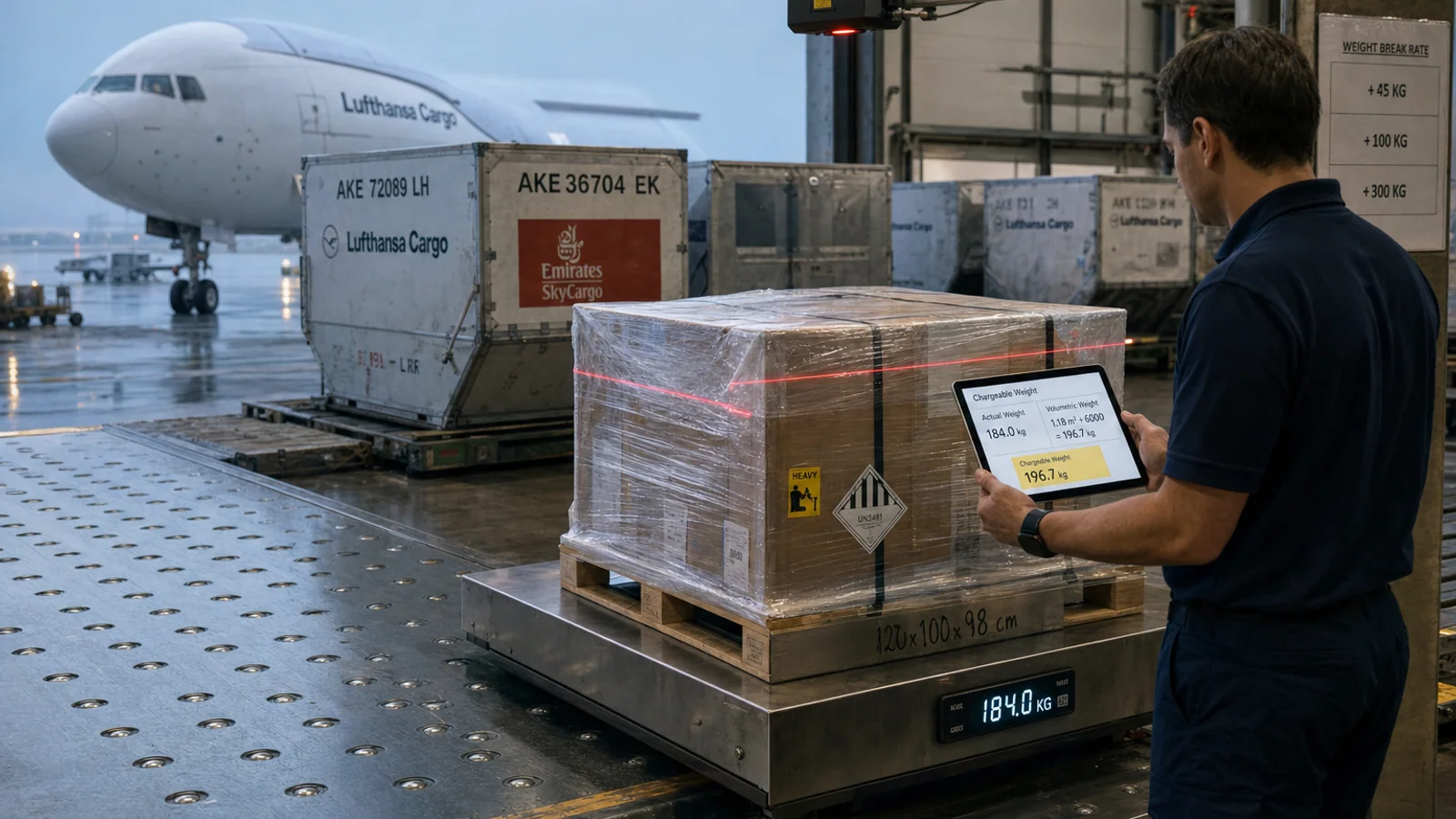
Quick answer Air freight is billed on chargeable weight: volumetric weight (L×W×H in cm ÷ 6000) or actual weight, whichever is higher. The per-kg rate then drops at weight breaks — MIN, +45, +100, +300, +500 and +1000 kg. Enter your cartons in the calculator on this page and see your 2026 air cargo price in seconds.
- Air cargo uses a 6000 cm³/kg dimensional factor; express couriers use 5000, which makes the same carton weigh 20% more.
- A 120 × 80 × 100 cm carton has a volumetric weight of 160 kg — even if it only weighs 60 kg on the scale.
- Weight breaks mean 100 kg can cost less in total than 95 kg: ask to be quoted at the next pivot point.
- The airline rate is often only 50–65% of the invoice; fuel, security, AMS filing, terminal handling, clearance and delivery make up the rest.
This page is a working air freight cost per kg calculator, plus the math behind the number so you can sanity-check any quote. If your cargo is heavy and not urgent, compare it against a sea-air option like the Sea-Air China to Peru Calculator: 2026 Rates on the same screen.
See your price in seconds
Real carrier rates, no signup, no follow-up calls.
How much does air freight cost per kilogram?
Quick answer Air freight per kg depends on lane, chargeable weight, density, season and commodity. Rates fall as volume rises, so the same cargo can price very differently at 45 kg and at 500 kg. There is no single published number that fits every shipment. The calculator on this page prices your exact cartons and route in seconds.
Five variables set every air cargo price per kg:
- Origin airport — PVG and HKG price differently from Delhi or Bogotá on the same day.
- Destination airport, including how far inland the final delivery runs.
- Chargeable weight, which sets the weight break you qualify for.
- Density ratio — kilos per cubic meter of packed cargo.
- Commodity class: general cargo, perishable, pharma, dangerous goods.
Airlines publish TACT tariff rates, but almost nobody pays them. Real pricing comes from forwarder block-space agreements and the spot market, which move weekly with capacity.
That is also why a 30 kg shipment and a 1,000 kg shipment on the same flight have nothing in common economically. The small one pays a minimum charge and flat handling fees; the large one earns the +1000 tier and spreads fixed costs across far more kilos.
Walio returns a real, all-in number from live carrier rates — no quote form that waits for an email and no follow-up sales call. The honest answer to "how much per kg" is your own shipment, priced at #quote-calc.
How do I calculate chargeable weight for air freight?
Quick answer Chargeable weight is the higher of actual weight and volumetric weight. Volumetric weight for air cargo equals length × width × height in centimeters divided by 6000. Measure each carton at its outermost point, including pallet and packaging, round to the nearest half kilo, then total every piece on the same air waybill.
- Measure each packed piece in centimeters, including the pallet base.
- Multiply L × W × H, then divide by 6000. In cubic meters, multiply m³ × 167. In imperial, divide cubic inches by 166.
- Compare the total volumetric weight with the total scale weight and bill the higher of the two.
Example A — dense cargo. One pallet, 120 × 100 × 90 cm, 480 kg actual. Volume is 1,080,000 cm³ ÷ 6000 = 180 kg volumetric. Chargeable weight is 480 kg.
Example B — light cargo. Six cartons, 60 × 50 × 50 cm, 12 kg each. Each is 150,000 cm³ ÷ 6000 = 25 kg volumetric, so 150 kg chargeable, not 72 kg.
Measure the carton, not the product
IATA rounds the shipment up to the next 0.5 kg, and pallet height includes the pallet itself. Measuring the product instead of the packed carton is the number one reason a quote changes at the airport warehouse after re-weighing.
Why is my air freight quote higher than the weight of my shipment?
Quick answer Because carriers sell space, not just mass. Low-density cargo takes more aircraft volume than its weight justifies, so the dimensional factor converts volume into kilos. Air cargo uses 6000 cm³/kg, express couriers use 5000, and imperial quotes use 166 in³/lb — three different answers for one identical box.
| Same carton: 60 × 50 × 40 cm | Divisor | Volumetric weight | Used by |
|---|---|---|---|
| Standard air cargo | 6000 cm³/kg | 20.0 kg | Airlines, forwarders, consolidators |
| Express courier | 5000 cm³/kg | 24.0 kg | Integrators, door-to-door parcel |
| Imperial equivalent | 166 in³/lb | 44.1 lb (20.0 kg) | US domestic air quotes |
The breakeven density is roughly 167 kg per cubic meter. Above it you have weight cargo and pay on the scale; below it you have volume cargo and pay on the dimensions.
Furniture, textiles, empty packaging and plastic housewares almost always price on volume. Cutting 10 cm of headroom from a carton often saves more than any rate negotiation, because it removes chargeable kilos permanently.
What is a weight break and how does it cut your cost per kg?
Quick answer A weight break is the point where the per-kg rate drops to a lower tier. Standard air cargo breaks are MIN, +45, +100, +300, +500 and +1000 kg. Just below a break, declaring the higher weight often lowers the total bill — the pivot point trick most shippers never ask for.
| Weight break | Applies from | Relative per-kg rate (index) | Effect on total |
|---|---|---|---|
| MIN | 0 kg | Flat charge per AWB | Highest effective cost per kg |
| +45 | 45 kg | 100 (baseline) | First real per-kg rate |
| +100 | 100 kg | ~88 | Pivot point below 100 kg |
| +300 | 300 kg | ~78 | Pivot point below 300 kg |
| +500 | 500 kg | ~72 | Pivot point below 500 kg |
| +1000 | 1,000 kg | ~65 | Lowest tier on most lanes |
Index values are illustrative of tier behavior, not a quote. Your lane's actual rates appear in the calculator.
The pivot example. 95 kg chargeable billed at the +45 rate = 95 × 100 = 9,500 index units. The same cargo declared at 100 kg and billed at the +100 rate = 100 × 88 = 8,800 units. More declared weight, smaller invoice.
Ask your forwarder one line: "quote me at my weight and at the next break." Consolidating two small shipments onto one air waybill can also push you across a break. The trick does not work with express courier, which bills per kilo with no tiers.
See your price in seconds
Real carrier rates, no signup, no follow-up calls.
What is the minimum charge for an air freight shipment?
Quick answer The minimum charge (MIN) is the floor a carrier bills no matter how light the cargo. Anything under roughly 45 kg chargeable usually hits the MIN, which is why a 5 kg box and a 40 kg box can cost the same. Below that threshold, express courier is often the better buy.
Below 45 kg chargeable, nearly every air freight shipment falls to the minimum charge, so effective cost per kilo rises sharply as weight falls.
MIN is charged per air waybill, not per carton, so splitting one order into two AWBs doubles the floor. Origin handling and AMS or ISF filing fees sit on top of MIN and are flat, which hurts small shipments most.
Practical cutoff: under about 45–70 kg, compare door-to-door courier against airport-to-airport air plus clearance and delivery. MIN varies by lane and airline, so the calculator quotes yours instead of publishing a flat number.
What does an air freight invoice actually include?
Quick answer The airline rate is only part of the bill. A real invoice adds fuel surcharge, security surcharge, AMS or ENS filing, origin terminal handling, air waybill fee, destination handling, customs entry, duty and VAT, and last-mile delivery. Budgeting on the per-kg airline rate alone understates landed cost every time.
| Line item — 320 kg chargeable, PVG → ORD | Charged on | Paid at |
|---|---|---|
| Airline rate (+300 tier) | Per chargeable kg | Origin or destination |
| Fuel surcharge (FSC) | Per chargeable kg | Origin |
| Security surcharge (SSC) | Per chargeable kg | Origin |
| AMS filing (CBP advance manifest) | Flat per AWB | Origin |
| Origin terminal handling (THC) | Per kg, with a minimum | Origin |
| Air waybill fee | Flat per AWB | Origin |
| Destination handling / breakbulk | Per kg, with a minimum | Destination |
| Customs entry + bond | Flat per entry | Destination |
| Duty (HTS rate) | % of customs value | Importer of record |
| Delivery, ORD to door | Per shipment + waiting time | Destination |
Incoterms 2020 decide who pays which line. EXW puts origin pickup and export clearance on the buyer, FCA splits at the carrier, CIF covers freight to arrival only, and DDP moves import clearance and duty onto the seller.
US importers choose a single-entry or continuous customs bond. A continuous bond usually pays off past roughly four or five entries a year. Confirm bonds, HTS codes and duty with a licensed customs broker — Walio quotes freight, not tax advice.
Authorities that touch the shipment: CBP in the USA, CBSA in Canada, DIAN in Colombia, SUNAT in Peru, SAT in Mexico and Receita Federal in Brazil.
Air freight vs express courier vs sea-air vs ocean LCL
Quick answer Express courier wins under about 70 kg. Air freight wins from roughly 100 kg up when speed matters. Sea-air cuts air cost sharply on Asia lanes with a few extra days. Ocean LCL is cheapest per kg but adds weeks. The right mode changes with weight, density and deadline.
| Mode | Typical transit | Minimum charge | Cost per kg behavior | Best at |
|---|---|---|---|---|
| Express courier | 3–5 days door to door | Per parcel, low | Flat per kg, 5000 divisor, no breaks | 50 kg |
| Air freight | 5–8 days airport to door | MIN per AWB | Falls at each weight break | 200–1,000 kg |
| Sea-air | 18–25 days | Per shipment | Well below pure air | 500–1,000 kg, flexible deadline |
| Ocean LCL | 30–45 days | Per m³, 1 m³ minimum | Lowest; priced per m³ | 1,000 kg+, bulky cargo |
Sea-air moves cargo by ocean to a transshipment hub, then flies the final leg. Transit runs roughly 40–60% of a pure ocean schedule at a fraction of pure air cost. Compare live options on the Sea-Air Hong Kong to Panama Calculator: Rates 2026 and the Sea-Air Vietnam to Panama Calculator: 2026 Rates.
Caribbean and Andean lanes work the same way — see the Sea-Air Hong Kong to Jamaica Calculator: 2026 Rates and the Sea-Air Vietnam to Barbados Calculator: Rates 2026.
One ocean caveat: above roughly 10–15 m³, FCL usually beats LCL per cubic meter, so very bulky cargo should not default to LCL either.
See your price in seconds
Real carrier rates, no signup, no follow-up calls.
What raises your per-kg rate: dangerous goods, batteries and oversize
Quick answer Lithium batteries, aerosols, perishables and oversize pieces carry surcharges and handling rules on top of the per-kg rate. Dangerous goods need IATA DGR-compliant packing, an MSDS and a shipper's declaration. Oversize pieces may not fit a passenger aircraft hold and need a freighter, which changes price and routing.
- Commercial invoice — sets customs value, so it drives duty and VAT.
- Packing list — piece count and dimensions; it verifies chargeable weight.
- Air waybill (AWB) — the contract of carriage and the unit MIN applies to.
- Certificate of origin — unlocks preferential duty under trade agreements.
- MSDS / safety data sheet — mandatory for batteries, chemicals and aerosols, per the IATA Dangerous Goods Regulations.
Batteries and oversize change the booking, not just the rate
UN3480 (loose lithium-ion cells) is restricted on many passenger aircraft; UN3481 (batteries installed in or packed with equipment) moves more easily. Perishables need temperature-controlled handling and shorter free time at destination. Single-piece limits for passenger belly cargo are far tighter than freighter main deck, so project pieces route differently. Confirm HTS classification with a licensed customs broker — a wrong code changes landed cost even when freight is right. US rules are published by CBP.
How do I get an air freight price per kg in seconds?
Quick answer Enter origin, destination, carton dimensions and weight. The calculator computes chargeable weight, applies the right weight break and returns an all-in price from live carrier rates — no form that waits for an email, no sales call. Compare air against sea-air and ocean on the same screen, then book online.
The air freight cost per kg calculator needs seven inputs: pickup city or airport, destination city or airport, piece count, dimensions in cm, gross weight, commodity and whether the cargo is stackable.
Your gateway changes both price and transit. Florida ships through Miami, Texas and the central states through Houston, California and the Southwest through LAX, the Northeast through JFK or Newark, the Southeast through Atlanta, the Midwest through Chicago, the Pacific Northwest through Seattle. In Canada: Ontario through Toronto, Quebec and the Atlantic provinces through Montreal, Western Canada through Vancouver.
The calculator prices your exact origin, not a generic airport pair. Freight, surcharges, filings, handling and clearance are itemized; duties appear as the destination country's published percentage. Dangerous goods, charter and oversize requests go through the same calculator and a Walio specialist follows up — or open the chat.
See your price in seconds
Real carrier rates, no signup, no follow-up calls.
Stop estimating from someone else's rate table. Enter your cartons, route and weight in the calculator above and see your 2026 air cargo price in seconds — no signup, no follow-up calls.
Multiply length × width × height in centimeters and divide by 6000 to get volumetric weight, then compare it with actual scale weight and bill the higher of the two. A 100 × 80 × 60 cm carton gives 80 kg volumetric, so if it weighs 45 kg on the scale you pay for 80 kg. Enter your dimensions in the calculator on this page and it does the math instantly.
Yes, at 100 kg air freight is usually cheaper per kilo than express courier, because courier rates use a 5000 dimensional factor and have no weight breaks. Air freight applies the +100 kg tier and a 6000 factor, which lowers chargeable weight and rate together. The tradeoff is that courier is door-to-door while air freight adds clearance and last-mile delivery.
The minimum charge is the lowest amount a carrier will bill for one air waybill, regardless of how light the cargo is. Shipments under roughly 45 kg chargeable almost always hit the MIN, which is why a 6 kg box and a 40 kg box can cost the same. MIN varies by lane and airline, so the calculator quotes yours rather than publishing a flat figure.
Because carriers charge for the space your cargo occupies, not only its mass. If your cartons are light and bulky, volumetric weight exceeds actual weight and becomes the chargeable weight. Reducing carton height or packing tighter cuts volumetric weight directly, and usually saves more than negotiating the rate.
No, the airline rate per kg covers the flight only. Fuel and security surcharges, AMS or ENS filing, terminal handling, customs entry, duty and VAT, and last-mile delivery are separate lines. Walio shows an all-in itemized price so you see every charge before booking, with duties stated as the destination country's published percentage.