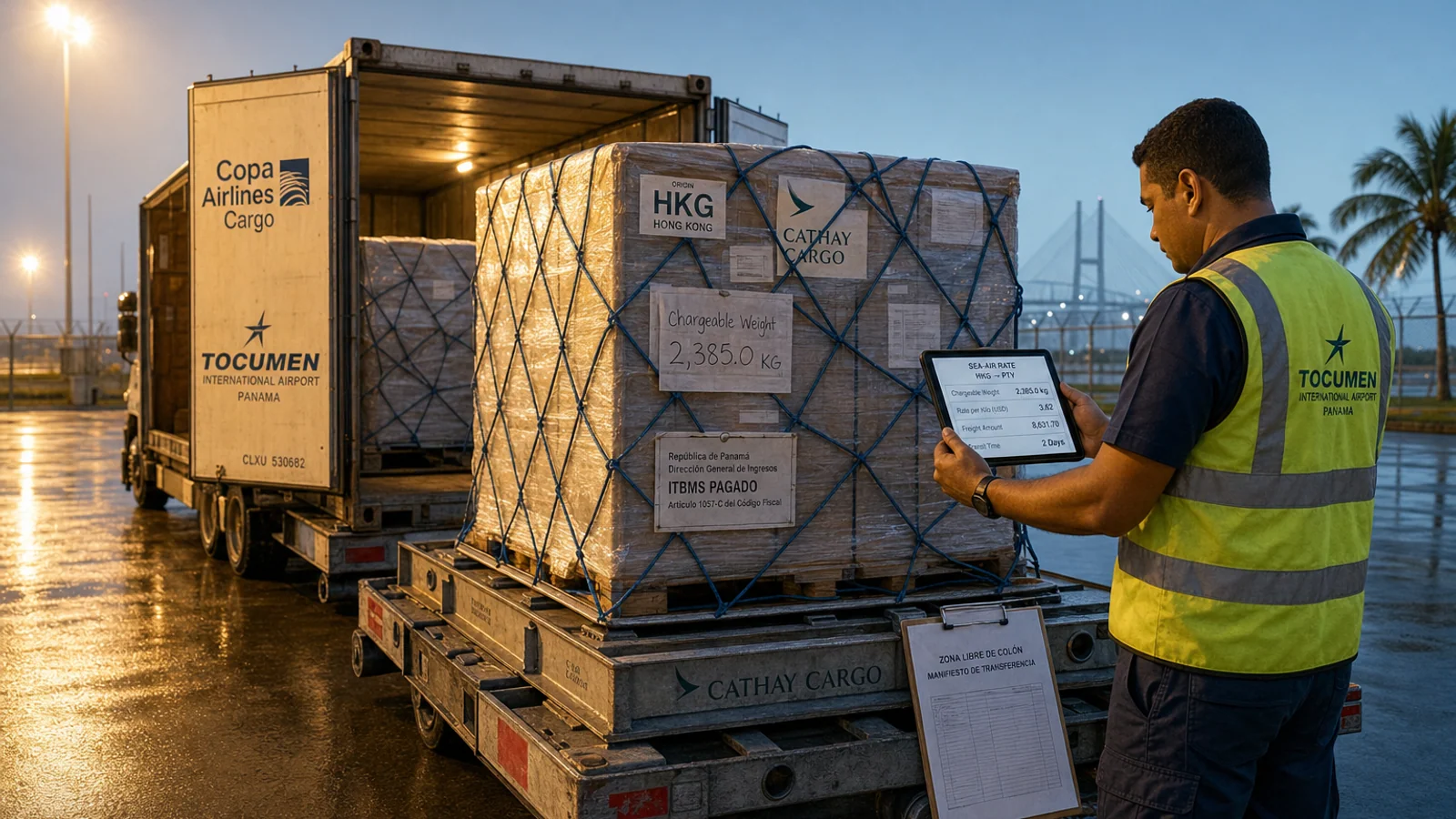
Quick answer Sea-air cargo from Hong Kong and South China to Panama runs 16-25 days door-to-airport and starts from $3.87/kg at 5,000+ kg, from $4.32/kg at 1,000-4,999 kg, port to airport. Cargo sails to Los Angeles, trucks to Miami, then flies to Tocumen (PTY). Minimum billed weight is 300 kg.
- Sea-air from South China ports to Panama City takes 16-25 days total: 12-18 days ocean to Los Angeles, 3-5 days truck to Miami, 1-2 days air to Tocumen (PTY).
- Walio sea-air rates start from $5.91/kg (300-499 kg), $5.00/kg (500-999 kg), $4.32/kg (1,000-4,999 kg) and $3.87/kg (5,000+ kg), port to airport.
- Chargeable weight is the greater of actual weight and volume x 167 kg per m3; the minimum billed weight on this lane is 300 kg.
- Panama applies 7% ITBMS plus import duty on most goods; Colon Free Zone cargo moving in and out for re-export is handled under the zone's own regime.
This guide shows Colon Free Zone traders and Panama City importers how to price a Hong Kong shipment themselves. Every figure below comes from Walio's live multimodal rate table, and the calculator on this page prices your exact port, airport and weight.
See your price in seconds
Real carrier rates, no signup, no follow-up calls.
What is a sea air cargo calculator for Hong Kong to Panama?
Quick answer A sea air cargo calculator prices a shipment that moves by ocean for the long leg, then by air for the final leg. For Hong Kong and South China to Panama, it takes your weight, dimensions, port and airport, then returns a per-kg rate and a transit window in seconds.
Sea-air is one service, not two bookings. The container crosses the Pacific by ship, the cargo transfers to a truck, and the final leg flies. You get one quote, one chargeable weight and one transit window.
Walio's sea-air lane into Panama runs ocean from Dalian, Fuzhou, Guangzhou, Ningbo, Qingdao, Shanghai, Shenzhen, Xiamen or Xingang to Los Angeles. The cargo then trucks to Miami and flies into Tocumen International Airport. This is a multimodal service sold under a single booking, which is why the calculator returns one rate per kilo instead of three.
 Shenzhen(CNSZX)
 Los Angeles(USLAX)Los Angeles(USLAX)Miami(USMIA)Miami(MIA)
 Panama City(PTY)
What makes the quote accurate?
Three inputs decide whether the number you see matches your invoice. Get these right and the quote holds.
- Actual gross weight after packing, including pallets, dunnage and shrink wrap.
- Real carton dimensions in centimeters. A 10 cm error per carton across 40 cartons shifts chargeable weight by dozens of kilos.
- The correct origin port. Shenzhen and Shanghai do not price the same, and neither do the destination airports.
The calculator prices port to airport: you deliver the cargo to the origin port, your consignee collects at Tocumen. Origin and destination handling charges appear as separate lines per shipment, never folded into the per-kg rate.
Ask your supplier for the post-packing carton list, not the product spec sheet. Factories quote product dimensions; carriers bill the outer carton, and the gap is often 8-12% of your cube.
See your price in seconds
Real carrier rates, no signup, no follow-up calls.
How much does it cost to ship from Hong Kong to Panama?
Quick answer Sea-air freight from South China ports to Panama City starts from $5.91/kg for 300-499 kg, from $5.00/kg for 500-999 kg, from $4.32/kg for 1,000-4,999 kg and from $3.87/kg for 5,000+ kg, port to airport. Minimum billed weight is 300 kg. Handling charges are added per shipment.
Rates come from Walio's live multimodal rate table dated October 17, 2026. They are "from" rates for the cheapest port and airport combination on the lane.
| Chargeable weight | Rate from (USD/kg) | Legs covered | Transit |
|---|---|---|---|
| 300-499 kg | $5.91 | Ocean + US truck + air | 16-25 days |
| 500-999 kg | $5.00 | Ocean + US truck + air | 16-25 days |
| 1,000-4,999 kg | $4.32 | Ocean + US truck + air | 16-25 days |
| 5,000 kg and above | $3.87 | Ocean + US truck + air | 16-25 days |
What changes the exact rate?
Your origin port sets the ocean leg cost and the sailing frequency. Shenzhen, Guangzhou, Xiamen, Ningbo, Shanghai, Qingdao, Fuzhou, Dalian and Xingang all feed this service, and each prices differently. The destination airport matters too, so the calculator asks for both.
What is not included in the per-kg rate?
- Origin and destination handling charges, added per shipment in the calculator.
- Panamanian customs clearance and the DUA filing by a licensed broker.
- Import duty and the 7% ITBMS assessed by Panama's customs authority.
- Door delivery from Tocumen into Panama City or Colon, quoted on request.
Door pickup at a factory in China and door delivery in Panama are both available. Submit the request inside the calculator and a Walio specialist follows up with the figure. There is no form that waits for an email.
How does the 300 kg minimum work?
A 180 kg shipment is billed as 300 kg. The effective cost per kilo on that shipment is far higher than the published rate. Consolidating two purchase orders into one booking is the fastest way to fix it.
If one supplier ships 180 kg and another 190 kg from the same province, book them as one shipment. You cross into the 300-499 kg band and stop paying for air you are not using.
See your price in seconds
Real carrier rates, no signup, no follow-up calls.
How do I calculate chargeable weight for air cargo from Hong Kong to Panama?
Quick answer Chargeable weight is the greater of actual gross weight and volumetric weight. On this sea-air lane, volumetric weight equals total cubic meters multiplied by 167 kg per m3. Measure every carton in centimeters, multiply length x width x height, divide by 1,000,000 for CBM, then compare the two numbers.
The formula never changes. Only the divisor does, and the divisor depends on the service you bought.
| Service | Divisor | Density factor | Applies to |
|---|---|---|---|
| Air cargo / sea-air | 1:6000 | 167 kg per m3 | IATA standard air and sea-air bookings |
| Express courier | 1:5000 | 200 kg per m3 | Door-to-door parcel services |
| Ocean LCL | n/a | 1 CBM = 1,000 kg | Revenue ton, whichever is greater |
Worked example 1: light cargo
Twenty cartons measure 60 x 40 x 50 cm each. One carton is 120,000 cm3, so divide by 1,000,000 to get 0.12 CBM. Twenty cartons give 2.4 CBM.
Now apply the density factor: 2.4 x 167 = 400.8 kg volumetric. The scale shows 310 kg actual. You are billed on 401 kg, not 310 kg, which places the shipment in the 300-499 kg band.
Worked example 2: dense cargo
Nine hundred kilos of hardware fits into 1.8 CBM. Volumetric weight is 1.8 x 167 = 301 kg. Actual weight wins, so you are billed on 900 kg and drop into the 500-999 kg band. Dense cargo is where sea-air pays for itself.
Pallets bill on the full cube
The air leg measures the pallet footprint, including overhang and the pallet height. A 120 x 100 cm pallet stacked to 150 cm bills 1.8 CBM even if your cartons only fill 1.4 CBM. Build tight, square stacks and never let cartons hang over the edge.
Enter real post-packing dimensions in the calculator. Supplier spec sheets understate cube almost every time, and the correction lands on the airline's scale in Miami, not on your estimate.
How long does shipping take from Hong Kong to Panama by sea and air?
Quick answer Sea-air takes 16-25 days from South China ports to Panama City. Pure air from HKG to Tocumen takes 2-7 days with a connection. Ocean FCL to Balboa or Manzanillo runs 25-40 days, and LCL 35-50 days once you add consolidation and deconsolidation at both ends.
| Mode | Origin | Destination | Transit days | Frequency |
|---|---|---|---|---|
| Sea-air (Walio) | South China ports | Tocumen (PTY) | 16-25 | Weekly sailings |
| Pure air | Hong Kong (HKG) | Tocumen (PTY) | 2-7 | Daily via hub |
| Ocean FCL | South China ports | Balboa / Manzanillo | 25-40 | Weekly |
| Ocean LCL | South China ports | Balboa / Manzanillo | 35-50 | Weekly consolidation |
What sets the clock?
The port cut-off starts your transit, not the vessel ETD. Cargo that misses the documentation cut-off by hours rolls to the next sailing and loses a full week. For sea-air, the three legs run 12-18 days ocean, 3-5 days truck, 1-2 days air.
Why does pure air need a connection?
There is no daily nonstop freighter from Hong Kong to Tocumen. Cargo connects through Miami, Mexico City or Bogota, and the connection is where the 2-7 day range comes from. A missed truck transfer at the hub adds a day, sometimes two.
What should you add for clearance?
Budget 2-4 working days for customs clearance at Tocumen. Cargo moving on to Colon Free Zone warehouses needs another 1-2 days for the trucking leg and zone intake. Readers comparing Central American gateways should also look at the Sea-Air Hong Kong to Guatemala Calculator: Rates 2026, where the transit profile differs.
See your price in seconds
Real carrier rates, no signup, no follow-up calls.
Is sea freight or air freight cheaper from Hong Kong to Panama?
Quick answer Sea freight is cheaper for dense, high-volume cargo; air wins on small, light, urgent or high-value shipments. Sea-air sits between them: roughly half the transit of ocean LCL and a fraction of pure air cost. The break-even depends on chargeable weight, cubic meters and the carrying cost of your inventory.
Three thresholds decide the answer for most Colon Free Zone buyers.
- Below roughly 300-500 kg chargeable: pure air or express courier usually wins on total landed cost, because LCL minimum charges and destination handling swallow the ocean saving.
- Between roughly 500 kg and 5 CBM: sea-air beats both. You skip the 35-50 day LCL wait and avoid the full air freight bill.
- Above 10-15 CBM: ocean FCL beats LCL on cost per cubic meter. That is the point where a 20 ft container becomes the natural step up.
The 10-15 CBM crossover exists because LCL is priced per revenue ton while FCL is priced per box. Once your cube fills most of a 20 ft container, you stop paying a consolidator's per-CBM margin and pay a flat box rate instead.
When sea-air wins
You are restocking fast-turning SKUs for re-export out of Colon. Thirty extra days on the water ties up cash you need for the next purchase order. Sea-air halves the ocean wait, holds a per-kilo rate well under pure air, and gives a predictable arrival at Tocumen you can promise to your buyer in Bogota or Caracas.
When ocean FCL wins
You are buying a full container of furniture, appliances or packaging and the delivery date sits eight weeks out. Density is low, value per kilo is low, and nobody is waiting. Route it to Manzanillo or Cristobal, accept 25-40 days, and put the saving into volume. Add free time and demurrage risk to the comparison before you book.
| Mode | Cost basis | Transit days | Minimum charge | Best cargo type | CO2 footprint |
|---|---|---|---|---|---|
| Pure air | Per chargeable kg | 2-7 | Carrier minimum, often 45-100 kg | Urgent, light, high value | Highest |
| Sea-air | Per chargeable kg | 16-25 | 300 kg billed minimum | Mid-value restocks, dense cartons | Medium |
| Ocean LCL | Per CBM or revenue ton | 35-50 | 1 CBM typical | Under 10 CBM, non-urgent | Low |
| Ocean FCL | Per container | 25-40 | Full box rate | 10 CBM and above, bulky goods | Lowest per kg |
Inventory carrying cost belongs in this math. If your stock turns in 45 days, a 50-day LCL transit means you reorder before the first shipment lands. The Caribbean version of this trade-off appears in the Sea-Air Hong Kong to Jamaica Calculator: 2026 Rates.
Sea air cargo calculator Hong Kong Panama: how to get your quote
Quick answer Enter your origin port, chargeable weight and carton dimensions in the calculator on this page and the price appears in seconds from live carrier rates. No signup, no sales call. Select Panama City (PTY) as the destination, then compare sea-air against air and ocean on the same screen.
- Pick your origin port from the list: Shenzhen, Guangzhou, Xiamen, Ningbo, Shanghai, Qingdao, Fuzhou, Dalian or Xingang.
- Enter cartons or pallets with real post-packing dimensions in centimeters.
- Enter total gross weight, including pallets and packaging.
- Choose your Incoterm so the quote matches what your supplier already covers.
- Read the per-kg rate and the transit window, then book online.
What does the Incoterm field change?
FOB Hong Kong means your supplier pays origin inland haulage and export clearance. The freight quote starts at the port. EXW puts factory pickup, export documentation and origin charges on you, which raises the quote because Walio adds those legs.
What the quote covers
The per-kg rate covers the ocean leg to Los Angeles, the US trucking leg to Miami and the air leg into Tocumen. Origin and destination handling are added per shipment as separate lines. That is deliberate: a handling charge folded into a per-kg rate hides it.
Any sea-air shipment below 300 kg chargeable is billed as 300 kg on this lane. Consolidate smaller orders before booking.
Oversized pieces, hazardous goods and door delivery into a Colon Free Zone warehouse need a human. Submit the shipment through the calculator and a Walio specialist follows up, or open the chat. For a South American reference lane with a similar structure, see the Sea-Air Hong Kong to Uruguay Calculator: Rates 2026.
See your price in seconds
Real carrier rates, no signup, no follow-up calls.
Which Panama ports and airports should you ship to?
Quick answer Tocumen International (PTY) is the air gateway for sea-air shipments and clears cargo fastest for Panama City consignees. Manzanillo (MIT) and Cristobal serve Colon Free Zone traders on the Atlantic side. Balboa serves the Pacific side and Panama City distribution. Your destination choice changes handling costs and inland trucking.
| Gateway | Coast | Transit from South China | Frequency | Distance to Colon Free Zone |
|---|---|---|---|---|
| Tocumen (PTY) | Pacific side, Panama City | 16-25 days by sea-air | Daily flights from Miami | About 90 km, 1-2 hours by truck |
| Manzanillo (MIT) | Atlantic | 25-40 days FCL | Weekly services | Under 10 km, minutes |
| Cristobal | Atlantic | 25-40 days FCL | Weekly services | Under 10 km, minutes |
| Balboa | Pacific | 25-38 days FCL | Weekly services | About 80 km, 1-2 hours |
Atlantic or Pacific?
Colon Free Zone traders route ocean cargo to MIT or Cristobal. The zone sits minutes from both terminals, and goods enter under the free zone regime rather than national import. Balboa suits Panama City retailers and interior distribution, because the inland haul is shorter.
Sea-air always lands at Tocumen. Colon-bound consignees add a 1-2 hour trucking leg from PTY to the zone. That cost is small against the 15-25 days saved versus LCL.
How does the Panama Canal affect ocean schedules?
The Panama Canal Authority sets daily transit slots and draft limits, and both tighten in dry periods. When slots are auctioned or restricted, carriers reshuffle Pacific-side schedules and arrival dates slip. Sea-air avoids the canal entirely, which is why its timing holds steadier during restriction periods.
What taxes and customs duties do I pay when importing from Hong Kong into Panama?
Quick answer Panama charges import duty based on HS classification plus 7% ITBMS, the national value-added tax, calculated on the CIF value plus duty. Goods entering Colon Free Zone for re-export are not subject to Panamanian import duty or ITBMS while they stay inside the zone. A licensed Panamanian customs broker files the declaration.
Which documents does the entry need?
- Factura Comercial with HS codes, unit values and Incoterm stated.
- Packing list with carton counts, weights and dimensions.
- Air Waybill for the PTY arrival, or Bill of Lading for ocean entries.
- Certificado de Origen where a trade agreement applies to the goods.
- Importer's RUC and the broker's authorization to file.
The declaration is the DUA (Declaracion Unica de Aduanas), filed electronically through the SIGA system. Per Panama's Autoridad Nacional de Aduanas, commercial entries must be filed by a licensed Panamanian customs broker, not by the importer directly.
How does the Colon Free Zone regime work?
Goods stored in the zone for re-export sit outside Panama's national customs territory. Duty and ITBMS apply only when the goods are nationalized into Panama. Re-exports to Colombia, Ecuador or the Caribbean leave the zone without triggering Panamanian import tax.
The charges importers forget
Terminal handling (THC and DTHC), CFS deconsolidation, airport handling at Tocumen, storage after free time expires, and demurrage or detention on ocean containers. These land on the destination invoice, not the freight quote. Classification and tax treatment are questions for a licensed customs broker or tax adviser. Walio is a shipping platform, not legal counsel.
How do Incoterms and surcharges change your Hong Kong to Panama freight cost?
Quick answer Incoterms decide who pays which charge, not how much freight costs overall. FOB Hong Kong puts origin inland and export clearance on the supplier. CIF Balboa adds ocean freight and insurance to the invoice value, which raises your Panamanian duty and ITBMS base. DDP moves import liability onto the seller.
| Charge | EXW | FOB Hong Kong | CIF Balboa | DDP Panama City |
|---|---|---|---|---|
| Factory loading | Buyer | Seller | Seller | Seller |
| Origin inland haulage | Buyer | Seller | Seller | Seller |
| Export clearance | Buyer | Seller | Seller | Seller |
| Main freight leg | Buyer | Buyer | Seller | Seller |
| Cargo insurance | Buyer | Buyer | Seller | Seller |
| Destination handling | Buyer | Buyer | Buyer | Seller |
| Duty + 7% ITBMS | Buyer | Buyer | Buyer | Seller |
| Delivery to consignee | Buyer | Buyer | Buyer | Seller |
The CIF trap for Panama importers
Panama assesses duty and ITBMS on the CIF value. A supplier who inflates the freight and insurance component raises your tax base, even when the goods price stays flat. Buying FOB Hong Kong and controlling the freight yourself keeps that base visible and defensible.
Which surcharges move the rate?
- GRI (general rate increase) on ocean, usually announced mid-month.
- Peak season surcharge in Q4, when South China space tightens.
- BAF (bunker adjustment factor) tracking fuel prices on the ocean leg.
- Security and fuel surcharges on the Miami to Tocumen air leg.
Chinese New Year reshapes the calendar every year. Factories rush shipments out before the holiday, then restart slowly, and the backlog takes three to four weeks to clear. Book 2-3 weeks ahead of the holiday and lock your rate in the calculator instead of waiting for an emailed quote. Traders shipping into the wider region can compare the Sea Air Cargo Hong Kong to Guyana Calculator (2026) and the Sea-Air Hong Kong to Bolivia Calculator: Rates (2026).
Walio compares real carrier rates across the ocean, trucking and air legs, including services operated by carriers such as Maersk, MSC, CMA CGM and Hapag-Lloyd on the Pacific crossing. The sea air cargo calculator Hong Kong Panama tool on this page applies those rates to your exact shipment.
See your price in seconds
Real carrier rates, no signup, no follow-up calls.
Sea-air freight on this lane starts from $5.91/kg for 300-499 kg, from $5.00/kg for 500-999 kg, from $4.32/kg for 1,000-4,999 kg and from $3.87/kg for 5,000+ kg, port to airport. The exact rate depends on your origin port and destination airport. Origin and destination handling charges are added per shipment in the calculator.
Pure air freight from Hong Kong International Airport to Tocumen (PTY) takes 2-7 days, because the cargo needs a hub connection through Miami, Mexico City or Bogota. Walio's sea-air service takes 16-25 days total across three legs. Customs clearance in Panama adds another 2-4 working days.
Chargeable weight is the greater of your actual gross weight and your volumetric weight. Multiply total cubic meters by 167 kg per m3 and compare the result with the scale weight. On this lane the minimum billed weight is 300 kg, so lighter shipments are billed as 300 kg.
Sea freight is cheaper per kilo for dense, high-volume cargo, but it takes 25-50 days. Air is faster and cheaper overall only for small, light or urgent shipments once ocean minimums and destination charges are counted. Sea-air sits between the two at 16-25 days with a per-kg rate well below pure air.
No. Goods held inside Colon Free Zone for re-export stay outside Panama's national customs territory, so import duty and the 7% ITBMS do not apply while they remain in the zone. Tax applies when the goods are nationalized into Panama, and a licensed Panamanian customs broker files the declaration.
You now have the formulas, the rate bands and the transit windows for this lane. The last step takes seconds: enter your origin port, carton dimensions and gross weight in the calculator above, select Panama City (PTY), and see your price in seconds — no signup, no follow-up calls.