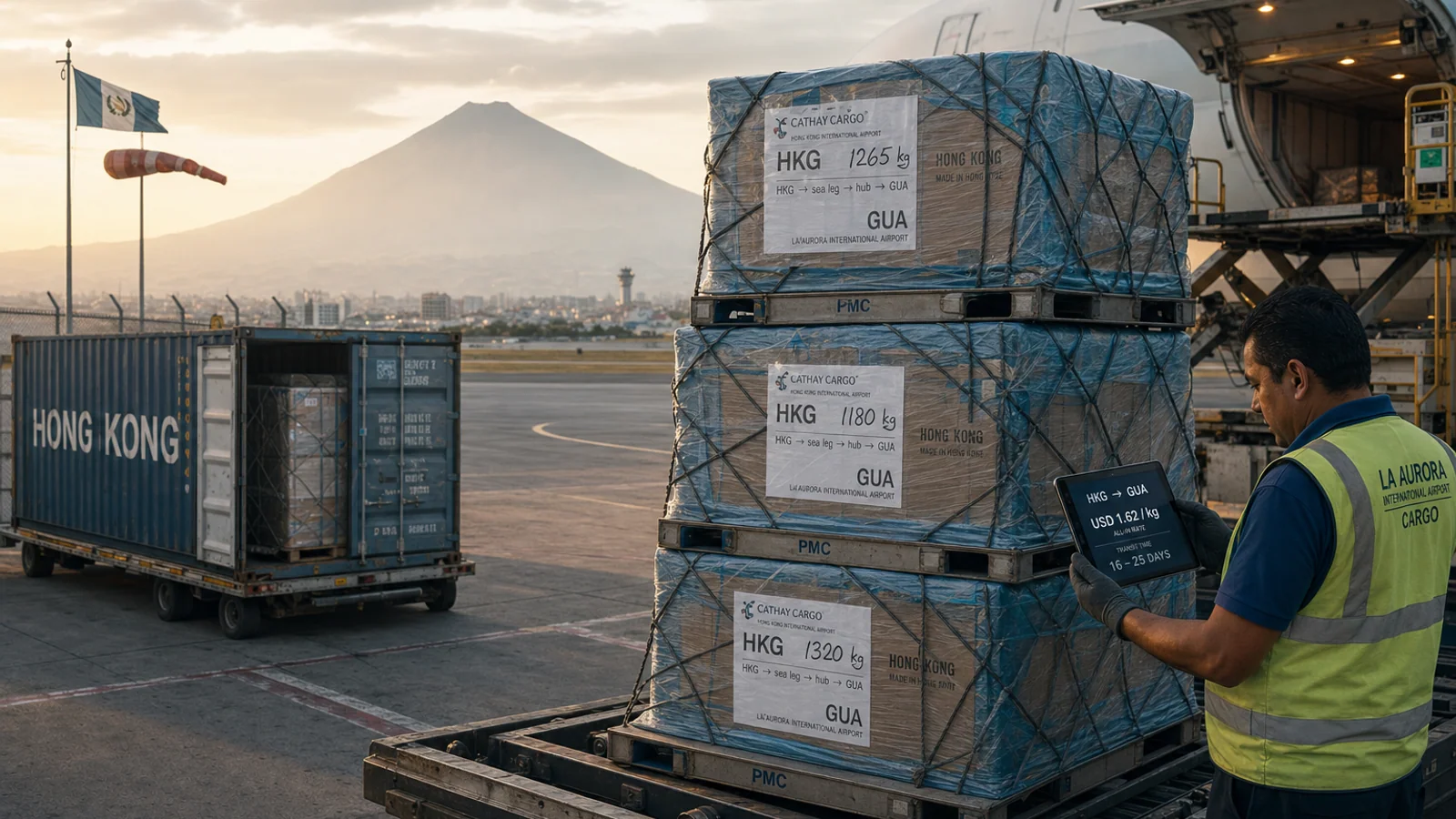
Quick answer Sea-air freight from the Hong Kong–Shenzhen cluster to Guatemala City runs 16–25 days port to airport and starts from $4.18 per chargeable kilo at 1,000–4,999 kg. Minimum billed weight is 300 kg. Chargeable weight is the greater of actual weight or CBM × 167. Price your exact shipment in the calculator.
- Sea-air to Guatemala City takes 16–25 days port to airport: 12–18 days ocean to Los Angeles, 3–5 days truck to Miami, 1–2 days air to GUA.
- Walio sea-air rates start from $5.76/kg at 300–499 kg, $4.86/kg at 500–999 kg, $4.18/kg at 1,000–4,999 kg and $3.72/kg at 5,000+ kg.
- Chargeable weight = the greater of actual gross weight or cubic meters × 167 kg; anything under 300 kg is billed as 300 kg.
- Guatemala charges DAI of 0–15% by HS code plus 12% IVA, both calculated on the CIF value that includes both freight legs.
This guide gives Guatemalan importers the full math behind a Hong Kong sea-air quote: chargeable weight, weight breaks, hub routing, line-item charges and SAT clearance. The calculator on this page prices your exact port, airport and cargo in seconds.
See your price in seconds
Real carrier rates, no signup, no follow-up calls.
What Is Sea-Air Freight From Hong Kong to Guatemala?
Quick answer Sea-air freight is one service that moves cargo by ocean for the long haul, then by air for the final leg. From Hong Kong, cargo consolidates at a CFS, sails to a United States hub, then flies into La Aurora International Airport in Guatemala City under a single booking and a single quote.
Sea-air is one booking, one quote and two legs joined at a transshipment hub. A container ship carries the heavy mileage. An aircraft covers the last stretch, where speed is worth paying for. The service is multimodal by design: the cargo changes mode once, mid-journey, without the importer managing two separate contracts.
Hong Kong is a natural origin for this model. As of 2026 the territory remains a free port with no export duty on general cargo, and the Kwai Tsing container terminals sit inside the same customs territory as Hong Kong International Airport. Consolidators can receive, palletize and ship from one jurisdiction without a bonded transfer.
Factory cargo from Shenzhen, Dongguan and Guangzhou trucks or feeders into the Hong Kong CFS cluster in Kwun Tong and Tsuen Wan for consolidation. The same cargo also loads directly from mainland ports. Walio publishes this lane from Shenzhen, Guangzhou, Xiamen, Ningbo, Shanghai, Qingdao, Fuzhou, Dalian and Xingang, so the supplier's actual loading port drives the rate.
The service exists for one buyer profile: the importer who cannot wait 35–50 days for ocean LCL but cannot absorb full air freight either. Spare parts, apparel seasons, electronics restocks and promotional goods all fit.
Walio prices this lane port to airport. The shipper delivers cargo to the origin port, and the consignee collects at La Aurora (GUA). Door pickup in China and door delivery in Guatemala City are quoted on request through the calculator — submit the shipment and a Walio specialist adds the legs.
 Hong Kong cluster(HKHKG / CNSZX)
 Guatemala City(GUA)
See your price in seconds
Real carrier rates, no signup, no follow-up calls.
How Much Does Sea-Air Freight From Hong Kong to Guatemala Cost Per Kilo?
Quick answer Sea-air freight to Guatemala City starts from $5.76 per chargeable kilo at 300–499 kg, from $4.86 at 500–999 kg, from $4.18 at 1,000–4,999 kg and from $3.72 at 5,000 kg and above. Minimum billed weight is 300 kg. Origin and destination handling charges are added per shipment.
| Weight break | Sea-air rate from (USD/kg) | Billed on | Minimum billed weight |
|---|---|---|---|
| Under 300 kg | from $5.76 | 300 kg flat | 300 kg |
| 300–499 kg | from $5.76 | Chargeable weight | 300 kg |
| 500–999 kg | from $4.86 | Chargeable weight | 300 kg |
| 1,000–4,999 kg | from $4.18 | Chargeable weight | 300 kg |
| 5,000 kg and above | from $3.72 | Chargeable weight | 300 kg |
Every figure above is a "from" rate. The exact number depends on the origin port your supplier loads from and the destination airport you select. A shipment leaving Shenzhen does not price identically to one leaving Dalian, because the ocean leg length and terminal costs differ.
Origin and destination handling are billed per shipment, not per kilo. Walio never folds them into the rate per kilo, because that hides the true cost of small consignments. The calculator itemizes freight, origin handling and destination handling on separate lines, so you can see what each leg costs before you book.
Five things move the number on this lane:
- Chargeable weight — the greater of actual gross weight and volume × 167 kg.
- Density — light, bulky cargo pays on volume and always costs more per real kilo.
- Weight break reached — crossing 500 kg or 1,000 kg drops the rate per kilo into a cheaper band.
- Origin port — the ocean leg from Shenzhen is shorter than from Xingang or Dalian.
- Air capacity into GUA — belly space tightens in Q4 and during peak season, and surcharges follow.
See your price in seconds
Real carrier rates, no signup, no follow-up calls.
How Do I Calculate Chargeable Weight for a Sea-Air Shipment From Hong Kong?
Quick answer Chargeable weight is the greater of actual gross weight and volumetric weight. For sea-air, volumetric weight equals cubic meters multiplied by 167 kg. A 2.4 CBM consignment weighing 380 kg bills at 401 kg, because 2.4 × 167 = 400.8. Shipments under 300 kg bill as 300 kg.
Start with cubic meters. Measure each carton in meters, multiply length × width × height, then multiply by the number of identical cartons. Add the carton groups together for total CBM. Use the outside dimensions of the packed carton, not the product.
- Carton volume = length (m) × width (m) × height (m).
- Line volume = carton volume × number of cartons.
- Shipment CBM = sum of all line volumes.
- Volumetric weight = CBM × 167 kg.
- Chargeable weight = the higher of actual gross weight and volumetric weight, minimum 300 kg.
Worked example: 12 cartons, 2.4 CBM, 380 kg
An importer in Zona 4 buys power tools from a Shenzhen supplier. The packing list shows 12 cartons, 2.4 CBM total and 380 kg gross. Volumetric weight is 2.4 × 167 = 400.8 kg, which rounds to 401 kg. Volumetric wins, so the shipment bills at 401 kg.
That falls in the 300–499 kg band, priced from $5.76 per kilo. Freight therefore starts from about $2,310 before origin and destination handling, which the calculator adds as separate lines. Duties, IVA and broker fees sit outside the freight quote entirely.
Pro tip: the break-point trick
A 499 kg shipment at the 300–499 band can cost more than a 500 kg shipment at the 500–999 band. Before you fix the packing list, check whether one extra carton, a heavier pallet or combining two purchase orders pushes you across 500 kg or 1,000 kg. The cheaper band often more than pays for the added weight.
The density rule explains the rest. Cargo denser than 167 kg per cubic meter — machinery, hardware, tiles, batteries by sea — bills on actual weight. Anything lighter bills on volume, which is why furniture, plastics and packaging are expensive on the air leg.
Declare accurate dimensions. Cargo is re-palletized at the hub for airline build-up, and it is re-weighed and re-measured before it flies. An understated packing list produces a corrected invoice, not a discount.
Sea Air Calculator Hong Kong Guatemala: How Do You Get a Rate in Seconds?
Quick answer Enter the origin port, La Aurora Guatemala City as the destination airport, and your cartons, weights and dimensions in the calculator on this page. It returns a sea-air price from live carrier rates in seconds, with freight and handling lines itemized. No signup, no forms, no follow-up calls.
The sea air calculator Hong Kong Guatemala importers need does four things: it reads your cargo, applies the chargeable weight rule, finds your weight break, and prices the lane. Here is the sequence.
- Select sea-air as the service.
- Choose the origin port your supplier actually loads from — Shenzhen, Guangzhou, Ningbo, Shanghai, Xiamen, Qingdao, Fuzhou, Dalian or Xingang.
- Select Guatemala City (GUA) as the destination airport.
- Add each cargo line: cartons, dimensions in centimeters or meters, gross weight.
- Read the itemized price and book online in the same session.
Read the quote from the top down. It shows the chargeable weight applied, the weight break reached, the freight rate per kilo, origin handling and destination handling at La Aurora. Nothing is averaged into a single opaque figure.
Any sea-air consignment lighter than 300 kg on this lane is billed as 300 kg. A 120 kg box of samples and a 300 kg pallet carry the same freight charge, which is why consolidating two orders usually pays.
What the quote does not include: Guatemalan DAI duty, 12% IVA, your customs broker's fee and inland delivery beyond La Aurora. Those are paid locally, not to the carrier.
Oversized pieces, dangerous goods and temperature-sensitive cargo still go through the calculator. Submit the shipment and a Walio specialist reviews the routing, or open the chat. Importers comparing Central America with the islands can price the same model to Kingston in our Sea-Air Hong Kong to Jamaica Calculator: 2026 Rates guide.
See your price in seconds
Real carrier rates, no signup, no follow-up calls.
Which Transshipment Hub Routes Hong Kong Cargo to Guatemala?
Quick answer A transshipment hub is the port-plus-airport pair where cargo leaves the vessel, is deconsolidated and loaded onto an aircraft. Walio's Hong Kong–Guatemala lane sails to Los Angeles, trucks 3–5 days to Miami, then flies 1–2 days into Guatemala City. Dubai, Singapore and Panama serve other lanes.
Walio's routing is deliberately simple: ocean to Los Angeles/Long Beach in 12–18 days, road from Los Angeles to Miami in 3–5 days, then air from Miami to GUA in 1–2 days. Total 16–25 days port to airport, depending on which Chinese port your supplier uses.
| Hub | Ocean leg from HK cluster | Hub dwell | Onward leg to GUA | Used on this lane? |
|---|---|---|---|---|
| Los Angeles / Long Beach (USLAX) | 12–18 days | 2–4 days | 3–5 days road + 1–2 days air via Miami | Yes — Walio routing |
| Miami (USMIA) | 24–32 days direct ocean | 2–3 days | 1–2 days air | Alternative, slower ocean leg |
| Dubai (DXB) | 14–18 days | 2–4 days | 2–4 days air, connection required | No — Asia–Europe / Africa lanes |
| Singapore (SIN) | 3–5 days | 1–3 days | 3–5 days air, double connection | No — Asia–Europe / South Asia |
| Panama (PTY / Balboa) | 20–26 days | 2–4 days | 1 day air | No — regional redistribution |
Miami is the correct exit point for Guatemala. It carries daily belly and freighter capacity into La Aurora and hosts the deepest Latin America consolidation market in the United States. Rebooking, splitting and same-week re-flights are all realistic there.
Be honest about the alternatives. Dubai and Singapore dominate Asia–Europe and parts of Asia–South America sea-air, but neither shortens a Hong Kong to Guatemala run — both add a connection without saving ocean days. Panama Tocumen works beautifully for regional redistribution inside Central America, yet the ocean leg to Balboa is longer than the leg to Los Angeles.
South American lanes behave differently, because the hub economics change with the destination. Compare our Sea Air Cargo Hong Kong to Guyana Calculator (2026) and the Sea-Air Hong Kong to Peru Calculator: Rates 2026 to see how routing shifts when the final flight leaves from a different gateway.
Is Sea-Air Cheaper Than Air Freight From Hong Kong to Guatemala?
Quick answer Yes. Sea-air costs materially less per kilo than straight air from Hong Kong to Guatemala City, because only the short final leg flies. You trade speed: 16–25 days against roughly 5–8 days door to door by air. Ocean LCL stays cheapest but typically needs 35–50 days.
| Service | Billed on | Transit (port to arrival) | Minimum charge basis | Best use case |
|---|---|---|---|---|
| Ocean LCL | Per m³ or per 1,000 kg, whichever is greater | 35–50 days | 1 m³ typical | Bulky, low-value, no deadline |
| Ocean FCL (20'/40'/40HC) | Flat per container | 32–45 days | One container | 10–15 m³ and above |
| Sea-air (Walio) | Chargeable kg, from $4.18/kg at 1,000–4,999 kg | 16–25 days | 300 kg | Restocks and seasons under 30 days |
| Full air freight | Chargeable kg, volumetric ÷ 6,000 | 5–8 days | 45 kg typical | Under 150–200 kg or true emergencies |
The break-even rule is practical, not theoretical. Sea-air beats pure ocean when you need goods in under 30 days. It beats pure air once a shipment passes roughly 150–200 kg of chargeable weight. Below that, the air minimum charge is small enough that flying the whole way often wins.
Choose sea-air
Your SKU is stocked out, the goods are worth more than roughly $12–15 per kilo, or a selling season closes within six weeks. Electronics, spare parts, apparel and branded accessories all justify the premium, because 20–25 fewer transit days release working capital and recover lost sales.
Choose ocean
Your cargo is bulky and low value with no deadline — furniture, packaging, tiles, plastic housewares. Past 10–15 m³, FCL beats LCL on cost per cubic meter, and sea-air stops competing entirely. Book the vessel early and accept 35–50 days.
Run the carrying cost math before you decide. Twenty-five days of capital tied up in a container is real money, and a stock-out costs margin that freight savings never recover. Importers running the same comparison for other markets can check the Sea-Air Hong Kong to Uruguay Calculator: Rates 2026 and the Sea-Air Hong Kong to Bolivia Calculator: Rates (2026).
See your price in seconds
Real carrier rates, no signup, no follow-up calls.
What Charges Appear on a Hong Kong to Guatemala Sea-Air Quote?
Quick answer A sea-air quote carries three charge groups: Hong Kong origin, hub handling and Guatemala destination. Origin covers CFS receiving, the TDEC export declaration and terminal handling. The hub covers deconsolidation, airline build-up and security screening. Destination covers La Aurora handling and storage after free time expires.
| Charge | Billed by | Leg | What triggers it |
|---|---|---|---|
| CFS receiving and consolidation | Consolidator | Hong Kong origin | Cargo delivered to Kwun Tong or Tsuen Wan warehouse |
| Export declaration (TDEC) | Origin agent | Hong Kong origin | Statutory filing for outbound cargo |
| Terminal handling (THC) | Terminal / carrier | Kwai Tsing or mainland port | Container loading onto the vessel |
| Deconsolidation | Hub CFS | Hub | Container stripped and cargo sorted |
| Re-palletizing and airline build-up | Hub handler | Hub | Cargo rebuilt to air pallet or ULD standard |
| Security screening | Hub handler | Hub | Mandatory screening before the air leg |
| New master air waybill and CASS documentation | Airline / agent | Hub | Ocean document closes, air document opens |
| Terminal handling at La Aurora | Airport handler | Guatemala | Arrival, unloading, warehouse entry |
| Warehouse storage | Airport handler | Guatemala | Free time expires before clearance |
| Delivery order / break-bulk fee | Destination agent | Guatemala | Release of cargo to the consignee |
| Customs broker fee | Licensed broker | Guatemala | DUCA-D filing with SAT |
Hong Kong adds no export duty on general cargo, because the territory operates as a free port. What you pay at origin is handling and documentation, not tax. That is one reason the Hong Kong–Shenzhen cluster remains a low-friction consolidation point for Latin America.
The hub-only charges are the ones pure ocean and pure air quotes never show. Deconsolidation, build-up, screening and a fresh air waybill exist only because the cargo changes mode mid-journey. A quote that omits them is incomplete, not cheap.
Watch for "all-in per kg" quotes
Some forwarders bury origin and destination handling inside an inflated per-kilo rate, which makes small shipments look reasonable and large ones look expensive. Walio shows handling per shipment on separate lines in the calculator. Ask any competing quote to split freight, origin handling and destination handling before you compare.
How Long Does Sea-Air Shipping Take From Hong Kong to Guatemala City?
Quick answer Sea-air takes 16–25 days port to airport: 12–18 days ocean to Los Angeles, 3–5 days by road to Miami, and 1–2 days flying into Guatemala City. Add one to three working days for SAT clearance at La Aurora, plus origin CFS cut-off before the vessel sails.
| Stage | Days | What delays it |
|---|---|---|
| CFS receiving to vessel cut-off | 2–4 | Late packing list, missing export declaration |
| Ocean: HK cluster to Los Angeles | 12–18 | Origin port, blank sailings, berth congestion |
| Los Angeles terminal and deconsolidation | 2–4 | Terminal dwell, chassis and drayage availability |
| Road: Los Angeles to Miami | 3–5 | Driver hours, weather on the southern corridor |
| Air: Miami to Guatemala City | 1–2 | Belly space, offloads in peak weeks |
| SAT clearance at La Aurora | 1–3 working days | Broker filing speed, inspection, document errors |
Understand cut-off versus ETD. Cargo must be received at the Hong Kong CFS two to four days before the vessel sails, not on the sailing date. Missing cut-off by one hour usually means waiting a full week for the next vessel, and the air leg cannot recover that time.
Three windows reliably add days: Chinese New Year, Golden Week in early October and the Q4 pre-Christmas peak. Factories close, CFS space tightens and peak season surcharges hit both the ocean and air legs. Book two to three weeks earlier in those months.
- Book against a confirmed vessel, not an estimated one.
- Freeze the supplier's packing list before cargo leaves the factory.
- Fix the Incoterm before production ends, not after.
- Send documents to your broker while the cargo is still flying.
La Aurora grants limited free storage after arrival. File the DUCA-D fast and the cargo moves out before storage accrues. File late and warehouse charges start running against a shipment you already paid a premium to accelerate.
What Taxes and Documents Does Guatemala Require for Hong Kong Imports?
Quick answer Guatemala applies DAI import duty of 0–15% depending on the HS code, plus 12% IVA calculated on CIF value plus duty. Clearance runs on a DUCA-D declaration filed with SAT by a licensed customs broker. Hong Kong has no free trade agreement with Guatemala, so standard duty rates apply.
The DUCA-D is the Declaración Única Centroamericana for definitive import. A licensed broker files it electronically with SAT using the importer's NIT. Per SAT, the declaration must match the commercial invoice, the packing list and the transport document line for line.
CIF on a sea-air shipment includes both freight legs. The ocean portion and the air portion each enter the customs value, along with insurance. That is why the freight invoice must be itemized clearly — a lump-sum invoice makes the broker's valuation harder to defend if SAT queries it.
- Factura Comercial — commercial invoice with unit values, Incoterm and currency.
- Packing list — cartons, dimensions, gross and net weight per line.
- Ocean bill of lading — surrendered at the hub when the ocean leg closes.
- House air waybill (HAWB) — the document SAT works from at La Aurora.
- Certificado de Origen — only where a preference is claimed; Hong Kong goods carry no preference into Guatemala.
- Importer NIT and broker power of attorney.
The mid-journey document switch surprises first-time sea-air importers. The ocean B/L ends its life at the transshipment hub, and a new master and house air waybill carry the cargo onward. Your broker clears against the AWB, not the B/L, so make sure the consignee details match on both.
On Incoterms 2020: FOB Hong Kong keeps control of the freight with you, the importer, which is where it belongs on this lane. EXW pushes origin handling and export filing onto your account. DAP Guatemala City buries the freight margin inside the supplier's unit price, where you cannot audit it.
Classification is not a guess
DAI rates swing between 0% and 15% on the same product family depending on the HS code. Use a licensed Guatemalan customs broker for classification and any binding ruling, and consult a tax adviser on IVA treatment. Walio prices shipping, not duty, tax or legal matters.
Which Goods Cannot Fly on the Air Leg?
Lithium batteries, aerosols, strong magnets, flammable liquids and certain cosmetics face IATA restrictions or outright refusal on the air leg. Cargo that sails without issue can still be rejected at airline build-up.
Declare dangerous goods before you book. A late declaration strands the shipment at the hub, and the storage, re-handling and re-routing all bill to you. Submit restricted cargo through the calculator and a Walio specialist reviews the routing before anything moves.
How Does Cargo Insurance Work Across Two Legs?
Carrier liability is limited by weight, not by cargo value — Hague-Visby rules govern the ocean leg and the Montreal Convention governs the air leg. Those limits rarely cover the commercial value of electronics or branded goods.
Buy one all-risk cargo policy covering the full journey. A single policy closes the liability gap at the transshipment hub, where two different conventions meet. Insure on CIF value plus 10%, the standard commercial basis Guatemalan brokers expect to see.
See your price in seconds
Real carrier rates, no signup, no follow-up calls.
Price Your Hong Kong to Guatemala Shipment Now
You have the formula, the weight breaks, the routing and the charge list. The only number left is yours. Walio compares live rates from carriers including Maersk, MSC, CMA CGM and Hapag-Lloyd on the ocean leg, then prices the road and air legs into Guatemala City on the same quote.
Enter your route in the calculator above and see your price in seconds — no signup, no follow-up calls. Choose your supplier's port, select GUA, add your cartons, and book online the moment the number works for you.
Sea-air freight to Guatemala City starts from $5.76 per chargeable kilo at 300–499 kg, from $4.86 at 500–999 kg, from $4.18 at 1,000–4,999 kg and from $3.72 at 5,000 kg or more. Minimum billed weight is 300 kg, so lighter shipments are charged as 300 kg. Origin and destination handling are added per shipment and shown separately in the calculator.
Sea-air takes 16–25 days port to airport, depending on the origin port. The route runs 12–18 days by ocean to Los Angeles, 3–5 days by road to Miami, then 1–2 days by air into Guatemala City. Add one to three working days for SAT clearance at La Aurora.
Chargeable weight is the greater of actual gross weight and volumetric weight, where volumetric weight equals cubic meters multiplied by 167 kg. A shipment of 2.4 CBM weighing 380 kg bills at 401 kg, because 2.4 × 167 = 400.8 kg. Anything below 300 kg is billed at the 300 kg minimum.
Cargo arrives at La Aurora International Airport (GUA) in Guatemala City, the country's main air cargo gateway. On this lane the final flight departs Miami after the ocean and road legs. Puerto Quetzal and Santo Tomás de Castilla handle pure ocean freight, not the sea-air air leg.
Guatemala charges DAI import duty of 0–15% based on the HS code, plus 12% IVA calculated on CIF value plus the duty. Both legs of the sea-air freight charge form part of the CIF base. A licensed Guatemalan customs broker files the DUCA-D with SAT and should confirm your classification.