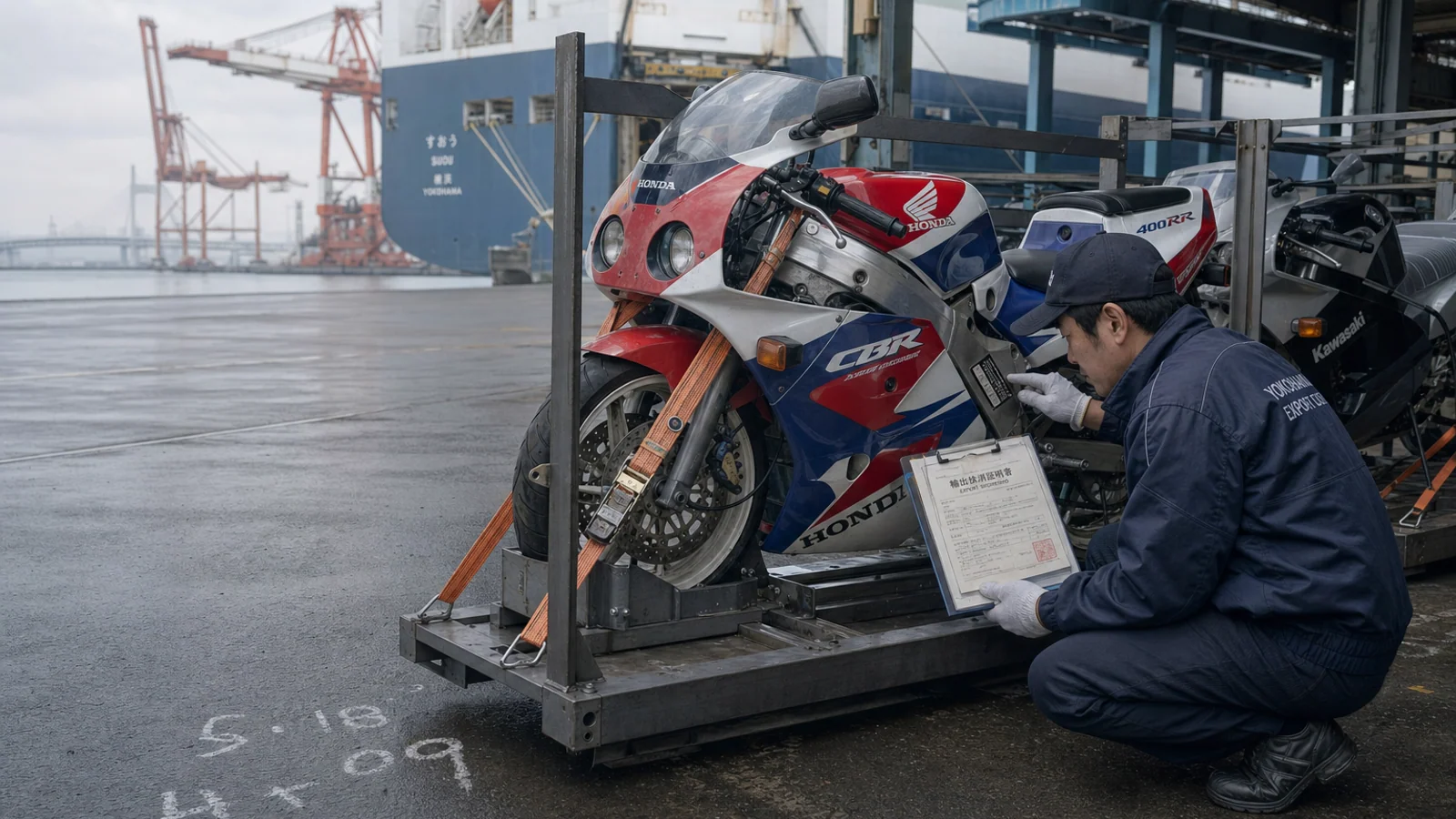
Quick answer Importing a motorcycle from Japan to the USA means a 2.4% HTS 8711 duty on the CIF value, plus CBP's MPF (0.3464%) and HMF (0.125%), customs clearance, and delivery. Walio's US customs clearance starts at $695 for a shared container and $745 for a full container, before duties.
- Most Japanese motorcycles enter under HTS 8711 at a 2.4% duty rate, calculated on the CIF value (price + freight + insurance) converted from JPY at the CBP exchange rate for the export date.
- CBP adds a Merchandise Processing Fee of 0.3464% of customs value (with a published minimum and maximum) and a Harbor Maintenance Fee of 0.125% on ocean shipments only.
- DOT's 25-year rule and EPA's 21-year exemption are different ages: a bike can be EPA-exempt at 21 years but still blocked by DOT until it turns 25.
- Walio's US customs clearance from Japan starts at $695 (LCL/shared container) and $745 (FCL), air from $610 — duties and door delivery are priced by the calculator; a specialist quotes the ocean freight within one business day.
Buyers who search the Spanish term "calculadora importar moto de japon a usa" want one thing: the real landed cost before they bid. This page gives you the US side of that number in seconds, and explains every line that follows it.
See your price in seconds
Real carrier rates, no signup, no follow-up calls.
What does the import moto Japan to USA calculator price?
Quick answer The calculator prices the US side of your motorcycle import in seconds: customs entry, bond, ISF filing, the 2.4% HTS 8711 duty, MPF and HMF, and delivery from the US port to your ZIP code. Ocean freight from Yokohama, Kobe or Nagoya is quoted by a specialist within one business day.
You enter four things and the screen returns a number. The HS code (8711 for motorcycles), the country of origin (Japan), the declared value in USD, and your destination ZIP code. There is no form that waits for an email and no sales call attached to it.
That instant number covers US duties, CBP fees and door delivery from the arrival port. It does not cover the ocean leg from Japan, because sailing space from Yokohama and Kobe is priced per booking. A Walio specialist returns that freight quote within one business day of your request.
Walio's US customs clearance from Japan, USD, from our quoting system on 2026-10-15, before duties and delivery: shared container (LCL) from $695, full container (FCL) from $745, air shipment from $610.
The clearance fee is itemized, not a lump sum with a vague label. Here is what it buys on a motorcycle entry:
- Customs entry — your broker files CBP Form 7501 and transmits the entry to the port of arrival.
- Customs bond — single-entry or continuous, the guarantee CBP requires before it releases cargo.
- ISF (10+2) and AMS filing — transmitted before the vessel loads in Japan, not after it sails.
- Handling and CBP fee minimums — the administrative floor CBP charges on every formal entry.
Run the numbers before the auction closes, not after you win. Importers buying a car rather than a bike should use the JDM Car Import Calculator: Japan to USA Rates (2026), which covers the same corridor for four-wheeled vehicles and the 2.5% passenger-car duty rate.
See your price in seconds
Real carrier rates, no signup, no follow-up calls.
How much does it cost to import a motorcycle from Japan in total?
Quick answer Total landed cost stacks six items: the auction price in JPY, exporter commission, ocean freight from Japan, the 2.4% duty on CIF, CBP's MPF and HMF, US customs clearance and inland delivery, then state title and use tax. Each line moves independently, so only a calculation on your numbers is reliable.
Think in six buckets instead of one big number. Each one is controlled by a different party, and each one moves for a different reason.
- Purchase price in JPY — the hammer price at USS, or the listed price on Goo-Bike, Yahoo Auctions or BE FORWARD.
- Japanese export costs — exporter commission, domestic transport to the port, deregistration and export paperwork.
- Ocean freight from Japan — RoRo, shared container or dedicated container, priced per booking.
- US duty and CBP fees — 2.4% under HTS 8711 plus MPF and HMF.
- US clearance and delivery — entry, bond, ISF, then trucking from the port to your ZIP.
- DMV title and state use tax — charged by your state, not by CBP.
Japanese sellers rarely quote a single all-in figure. An exporter typically charges the hammer price plus a commission, plus a domestic truck leg to Yokohama, Kobe or Nagoya, plus a document fee for the export deregistration. Ask for that breakdown in writing before you wire anything.
Motorcycles have one real advantage over cars on this lane. A crated bike takes a fraction of a container, so consolidation works in your favor in a way it never does for a sedan. Three or four bikes in one 20 ft container cut the per-unit freight sharply.
State use tax is usually the second-largest line after freight. Most DMVs charge it on the purchase price shown on your invoice or Export Certificate, at your local sales tax rate. A $9,000 bike in a 8% state adds roughly $720 at the title counter — budget it from day one and confirm the rate with your state tax authority.
The model table below shows what actually drives the cost difference between popular Japanese bikes: displacement, classification and import eligibility. Freight is not listed because it is quoted per booking by a specialist, never estimated on a blog.
| Model | Displacement | HTS 8711 subheading | Duty rate | DOT 25-year status |
|---|---|---|---|---|
| Honda CB400SF | 399 cc | 8711.30 (251–500 cc) | Free | Eligible if built 2001 or earlier |
| Yamaha SR400 | 399 cc | 8711.30 (251–500 cc) | Free | Eligible if built 2001 or earlier |
| Kawasaki ZX-9R | 899 cc | 8711.50 (over 800 cc) | 2.4% | 1998–2000 models now eligible |
| Suzuki Hayabusa (GSX1300R) | 1,299 cc | 8711.50 (over 800 cc) | 2.4% | 1999–2001 models now eligible |
Note the gap. A CB400SF and a Hayabusa sit in different subheadings with different duty outcomes, even though both ship in the same crate. Verify the subheading with a licensed customs broker before entry.
How are US import taxes on a motorcycle calculated?
Quick answer CBP taxes the CIF value: purchase price plus international freight plus insurance, converted from JPY at the exchange rate in force on the date of export. Duty is 2.4% for most motorcycles over 250cc under HTS 8711, then MPF at 0.3464% of customs value and HMF at 0.125% on ocean cargo.
The formula runs in four steps:
- CIF value = purchase price (converted to USD) + international freight + insurance
- Duty = CIF × the HTS 8711 rate for your displacement
- MPF = customs value × 0.3464%, subject to CBP's published annual minimum and maximum per entry
- HMF = customs value × 0.125%, on ocean arrivals only
A worked example, line by line
Take a ¥1,200,000 bike. The freight and insurance figures below are placeholders used only to demonstrate the arithmetic — they are not Walio quotes, and your specialist freight quote replaces them.
| Line | Basis | Amount (USD) |
|---|---|---|
| Purchase price | ¥1,200,000 at 0.0067 USD/JPY | 8,040.00 |
| Ocean freight (placeholder) | Specialist quote replaces this | 1,100.00 |
| Marine insurance | 1.75% of value | 141.00 |
| CIF value | Price + freight + insurance | 9,281.00 |
| Duty, HTS 8711.50 | 2.4% of CIF | 222.74 |
| MPF | 0.3464%, at CBP minimum | ~32.71 |
| HMF | 0.125% of value | 11.60 |
| Duties and CBP fees | Sum of the three | ~267.05 |
Duty percentages come from the HTSUS and the fee rates come from CBP. They are published US government rates, not Walio prices. The dollar figures above exist to show the math, and the calculator on this page runs the same math on your real value.
Here is the nuance most blogs miss. US customs value is generally transaction value, which is an FOB-style figure. When international freight and insurance are separately itemized on the invoice, they can often be excluded from the dutiable value — unlike CIF countries such as Colombia or Mexico. The CIF method above is the conservative estimate. Ask your licensed customs broker which basis applies to your entry.
Which exchange rate does CBP use?
CBP converts JPY using the rate published for the date of exportation, not the day you paid the seller. Weeks often pass between auction payment and vessel departure. A 3% yen move in that window changes your duty base, so build a currency cushion into your budget.
Air shipments skip the HMF entirely, because the Harbor Maintenance Fee funds ports. Air freight costs far more per kilo, so it only makes sense for rare, high-value machines.
See your price in seconds
Real carrier rates, no signup, no follow-up calls.
What is the HTS 8711 duty rate by engine size?
Quick answer Heading 8711 covers motorcycles with reciprocating internal combustion engines, split by displacement. Rates in the HTSUS run from free on the smallest categories to 2.4% on larger displacements, and the subheading you declare drives both the duty and the EPA/DOT paperwork CBP expects at entry.
| Displacement | HTS subheading | General duty rate | Typical forms at entry |
|---|---|---|---|
| 50 cc or less | 8711.10 | Free | HS-7, EPA 3520-1 |
| 51–250 cc | 8711.20 | Free | HS-7, EPA 3520-1 |
| 251–500 cc | 8711.30 | Free | HS-7, EPA 3520-1 |
| 501–800 cc | 8711.40 | 2.4% | HS-7, EPA 3520-1 |
| Over 800 cc | 8711.50 | 2.4% | HS-7, EPA 3520-1 |
| Electric motorcycles | 8711.60 | Check current HTSUS | HS-7, EPA 3520-1 |
Misclassification is the most common reason a motorcycle entry gets kicked back. A 399 cc CB400SF and a 1,299 cc Hayabusa are not interchangeable on a 7501. Confirm the displacement against the frame plate, not against the listing text.
Electric bikes sit in their own 8711 subheading with its own rate, and the HTSUS revises periodically. Check the current edition before you commit to a purchase.
Japan is not covered by the Section 301 tariffs that apply to Chinese-origin goods. Still, ask your broker whether any Section 232 measure or other trade action touches your specific commodity in the year you import. Readers comparing European machines should see the duty breakdown in Import Car Germany to USA Calculator: 2026 Quotes, which works the same way with a different origin.
Can I import a Japanese motorcycle under 25 years old?
Quick answer No — not freely. DOT blocks non-conforming vehicles, including motorcycles, until they are 25 years old from the month of manufacture, while EPA exempts engines 21 years or older. A 22-year-old bike can clear EPA and still be refused by DOT, so the 25-year date is the one that matters.
Two agencies, two clocks. People mix them up constantly and pay for it at the port.
The DOT clock starts on the manufacture month and year stamped on the frame, not the model year in the auction listing. A bike built in November 2001 is not importable until November 2026.
EPA exempts engines at least 21 years old in original configuration, declared on EPA Form 3520-1 using code E. DOT exempts vehicles at least 25 years old, declared on DOT Form HS-7, box 1. Both forms go in with the entry.
If your bike is younger than 25 years, you have three paths and none of them is cheap:
- Registered Importer (RI) — a DOT-approved company that modifies a non-conforming vehicle to meet FMVSS and certifies it. Conversion costs frequently exceed the value of a motorcycle.
- Show or display — a narrow NHTSA exemption for historically or technologically significant vehicles, with an annual mileage cap. Very few motorcycles qualify.
- Racing or off-road declaration — permitted on HS-7, but it bars the machine from public roads permanently.
CBP does not grant exceptions for money already spent
A motorcycle that fails the 25-year test can be seized, exported at your cost, or destroyed. The auction price, the freight and the broker fee are not refunded, and there is no hardship appeal. Verify the manufacture month on the frame plate and on the Export Certificate before you bid.
What documents do I need to import and title a Japanese bike?
Quick answer You need the Japanese Export Certificate with a certified English translation, the commercial invoice or auction sheet, the Bill of Lading, DOT Form HS-7, EPA Form 3520-1, CBP Form 7501 and an ISF filing. The Export Certificate is what your DMV accepts as proof of ownership in place of a US title.
The Export Certificate (輸出抹消仮登録証明書) is Japan's deregistration document. It proves the machine was removed from the Japanese register and legally exported. Your DMV treats it as the foreign title, which makes it the single most important paper in the file.
| Document | Issued by | Deadline | Used for |
|---|---|---|---|
| Export Certificate + certified translation | Japanese land transport bureau / translator | Before arrival | CBP entry and DMV title |
| Commercial invoice or auction sheet | Exporter / auction house | Before entry | Declared value |
| Bill of Lading (B/L) | Carrier or NVOCC | At booking | Cargo release |
| ISF 10+2 | Your customs broker | 24 h before vessel loading | CBP security filing |
| DOT Form HS-7 | Importer | At entry | 25-year exemption, box 1 |
| EPA Form 3520-1 | Importer | At entry | 21-year exemption, code E |
| CBP Form 7501 | Customs broker | Within 10 working days of release | Entry summary and duty payment |
Order the certified English translation while the bike is still on the water. Many DMVs reject uncertified translations, and some states publish an approved translator list. A bike can clear CBP and still sit untitled for months over one missing page.
What does the timeline look like?
- Auction purchase and payment — 1 to 2 weeks
- Export deregistration and domestic transport to port — 1 to 3 weeks
- Booking, crating and vessel loading — 1 to 2 weeks
- Ocean transit to a West Coast port — roughly 11 to 16 days
- Customs entry, examination and release — 2 to 7 days
- Inland trucking to your ZIP — 2 to 10 days
- DMV title and VIN or frame inspection — 1 to 4 weeks
Total: 6 to 12 weeks door to door, longer in peak season.
RoRo vs shared container vs dedicated container from Japan?
Quick answer RoRo is cheapest per unit but requires a running, drivable vehicle, which rules out most crated motorcycles. A shared container is the standard choice: the bike is crated, strapped and consolidated with other cargo. A dedicated container gives the fastest release and the best protection for a collectible build.
| Method | Relative cost per bike | Added transit | Protection | Japanese ports |
|---|---|---|---|---|
| RoRo | Lowest | Baseline | Low — open deck, no personal items | Yokohama, Kobe, Nagoya |
| Shared container (LCL) | Low to medium | +5 to 10 days (CFS deconsolidation) | High — crated and strapped | Yokohama, Kobe, Nagoya, Osaka, Tokyo |
| Dedicated container (FCL) | Highest solo, lowest for 3–4 bikes | Fastest release | Highest — sealed, sole use | All major ports |
Shared container (LCL)
Your bike is crated at origin, loaded with other cargo, then deconsolidated at a US container freight station. Budget for CFS handling and deconsolidation charges, and expect a few extra days before release. This is the default choice for a single machine and the reason Walio's LCL clearance starts at $695 before duties and delivery.
Dedicated container (FCL)
You book the box, you control the loading, and the container moves straight to a devanning site without waiting for other shippers. A 20 ft container holds several crated motorcycles comfortably, which is why club group buys beat solo shipments on cost per unit. Walio's FCL clearance starts at $745 before duties and delivery.
 Yokohama(JPYOK)
 Long Beach(USLGB)Kobe(JPUKB)Oakland(USOAK)
Walio compares carriers such as Maersk, MSC, CMA CGM, ONE and Hapag-Lloyd on this corridor. For readers weighing faster Asia–US routings, the Sea-Air Cargo China to USA Calculator: 18-Day Transit 2026 shows how a combined sea-air leg compares against pure ocean on time and cost.
See your price in seconds
Real carrier rates, no signup, no follow-up calls.
Which US port should your motorcycle arrive at?
Quick answer Los Angeles/Long Beach and Oakland handle most Japan sailings to the West Coast, with Seattle/Tacoma close behind. East Coast buyers can route to Newark or Jacksonville on a longer transit. Your port choice changes freight, free time, storage exposure and the inland trucking leg to your door.
| Port of entry | Transit from Japan | Typical terminal free time | Best for |
|---|---|---|---|
| Los Angeles / Long Beach | 11–14 days | 4–5 days | California, Southwest, Nevada, Arizona |
| Oakland | 13–17 days | 4–5 days | Northern California |
| Seattle / Tacoma | 10–13 days | 4 days | Pacific Northwest, Idaho, Montana |
| Houston | 25–32 days | 5 days | Texas and the central states |
| Newark (NY/NJ) | 28–35 days | 5 days | Northeast |
| Jacksonville | 30–38 days | 5 days | Florida and the Southeast |
Region usually decides the gateway. California and the Southwest clear through LA/Long Beach. The Pacific Northwest clears through Seattle. Texas and the central states route through Houston, the Northeast through NY/NJ, and the Southeast through Savannah or Jacksonville. The Midwest often pulls a West Coast arrival inland by rail through Chicago.
Clearing at the closest port is not always cheapest. A West Coast entry plus a domestic truck leg frequently beats an all-water East Coast sailing on both cost and calendar, because the ocean leg through the Panama Canal adds two to three weeks.
Free time does not pause for your paperwork
Demurrage starts the moment terminal free time expires. A missing certified translation, a late EPA form or a slow wire transfer keeps the clock running. Have every document ready before the vessel arrives, because storage charges accrue daily and compound fast.
The calculator prices delivery from the arrival port to your exact ZIP code, so you can compare two gateways side by side before booking. Importers weighing an overland route instead should read Import Car Canada to USA Calculator: 2.5% Duty (2026), which covers land-border entries and their different duty treatment.
What mistakes blow up the cost of a Japan motorcycle import?
Quick answer Undervaluing the invoice, buying a bike under 25 years old, missing the ISF deadline and skipping the certified translation are the four errors that turn a clean import into a penalty case. Each one is avoidable with a landed-cost calculation and a document check before you pay the seller.
- Undervaluation. CBP compares your declared value against auction sheets and market data. A low invoice risks penalties, redelivery notices and seizure — and at a 2.4% rate it saves almost nothing.
- Liens and stolen-vehicle flags. Match the frame number on the Export Certificate against the physical frame plate before payment clears.
- Late ISF. The 10+2 filing is due before the vessel loads in Japan. CBP assesses a penalty per shipment and can hold the container on arrival.
- No certified translation. The bike clears CBP, then sits in your garage unregistered while the DMV waits for an acceptable document.
- Forgotten state costs. Use tax and the VIN inspection are DMV charges, not customs charges, and they are never on your broker's invoice.
For your specific duty classification or tax position, speak with a licensed customs broker or a tax adviser. Walio is a shipping platform, not legal counsel.
Plan on 6 to 12 weeks door to door, and add time during the pre-Lunar New Year and late-summer peaks when Trans-Pacific space tightens. Anyone who found this page searching "calculadora importar moto de japon a usa" gets the same answer in English or Spanish: run the numbers first, then bid.
See your price in seconds
Real carrier rates, no signup, no follow-up calls.
Total cost is the auction price plus exporter fees, ocean freight, a 2.4% duty on the CIF value, CBP's MPF and HMF, US customs clearance and inland delivery, then state title and use tax. Walio's US customs clearance from Japan starts at $695 for a shared container and $745 for a full container, before duties and door delivery. Enter your HS code, value and ZIP in the calculator on this page to see your US import cost in seconds.
Most motorcycles over 250cc pay a 2.4% duty under HTS heading 8711, calculated on the CIF value of price plus freight plus insurance. CBP then adds a Merchandise Processing Fee of 0.3464% of customs value, within its published minimum and maximum, and a Harbor Maintenance Fee of 0.125% on ocean arrivals. State sales or use tax is charged separately when you title the bike at your DMV.
No, not for normal street use. DOT requires non-conforming vehicles to be at least 25 years old from the month of manufacture, even though EPA exempts engines 21 years or older under Form 3520-1. A younger bike needs a Registered Importer conversion, a show-or-display exemption, or an off-road declaration that bars it from public roads.
You need the Japanese Export Certificate with a certified English translation, the commercial invoice or auction sheet, the Bill of Lading, DOT Form HS-7, EPA Form 3520-1, CBP Form 7501 and an ISF 10+2 filing made before the vessel loads. The Export Certificate replaces a US title at the DMV, which is why the certified translation matters. Most states also run a VIN or frame-number inspection before issuing the title.
Plan on 6 to 12 weeks door to door, including auction purchase, export deregistration, sailing, customs entry and inland delivery. West Coast ports such as Los Angeles/Long Beach, Oakland and Seattle receive Japan sailings fastest; Newark and Jacksonville add transit time. Peak season and a missing document at the DMV are the two things that stretch the timeline most.
You should know your landed cost before the auction hammer falls, not after the container lands. Enter the HS code, Japan as the country of origin, your declared value and your ZIP in the calculator above, and see your US duties, CBP fees and door delivery in seconds — no signup, no follow-up calls. Submit the freight request at the same time and a Walio specialist returns your Japan–US ocean quote within one business day.