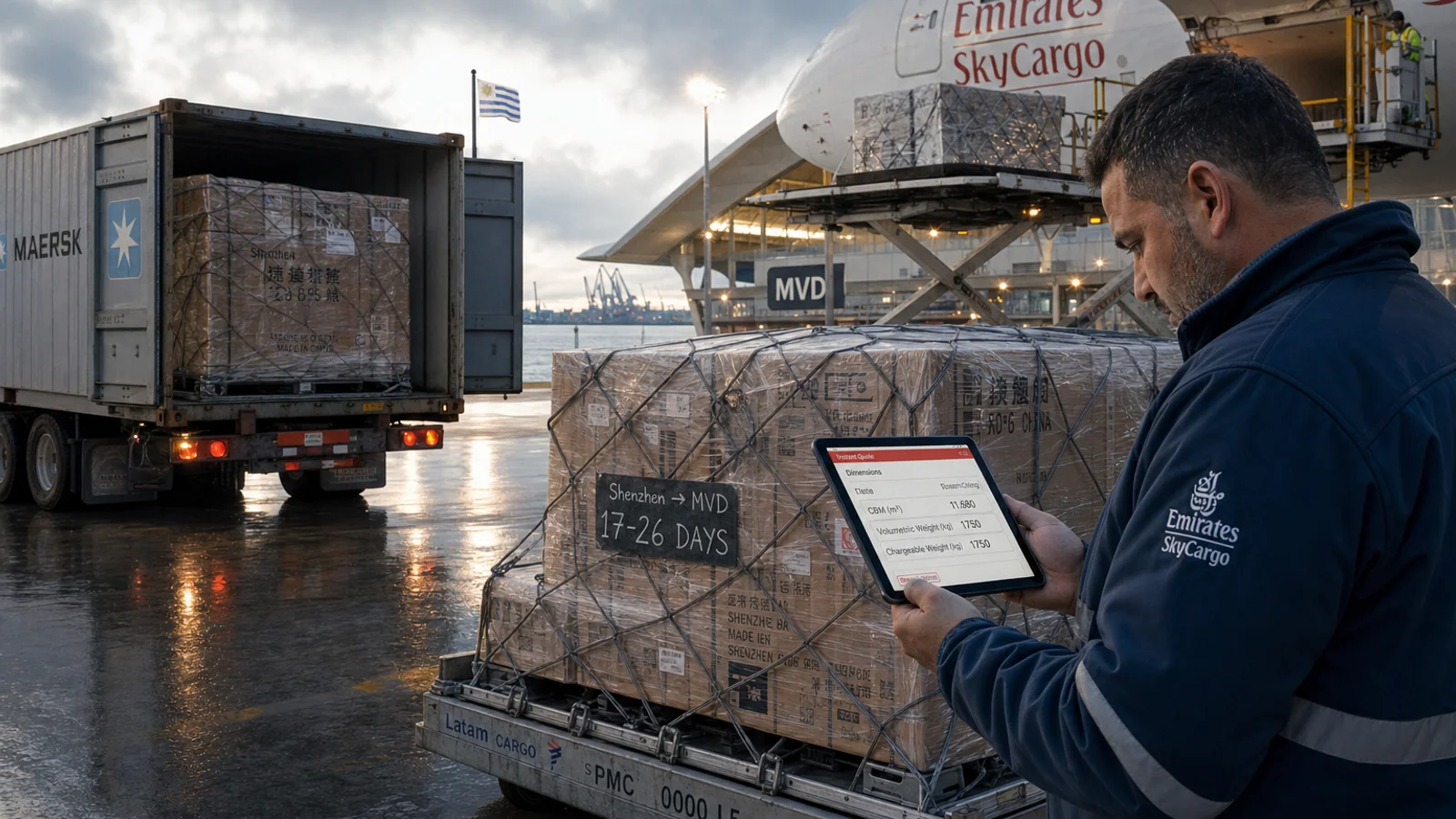
Quick answer Sea-air cargo from China to Uruguay moves ocean to Los Angeles, truck to Miami, then air to Montevideo in 17-26 days total. Walio's rates start from $9.87/kg for 300-499 kg and from $7.83/kg at 5,000+ kg, port to airport. Minimum billed weight is 300 kg. Price your exact shipment in seconds.
- Sea-air China to Uruguay takes 17-26 days from the Chinese port to Carrasco airport, versus 30-45 days for pure ocean to Montevideo.
- Walio sea-air rates start from $9.87/kg (300-499 kg) and fall to from $7.83/kg at 5,000+ kg, port to airport.
- Chargeable weight is the greater of actual kilos and volume × 167 kg per m³; anything under 300 kg bills as 300 kg.
- Uruguay charges 22% IVA on CIF plus duty, calculated by Aduana on the DUA — these are government rates, not freight.
This guide shows you exactly how a sea air cargo calculator China Uruguay works, how to run the math yourself, and where sea-air beats both ocean and air. Every figure below is a live Walio rate or a published government rate.
See your price in seconds
Real carrier rates, no signup, no follow-up calls.
What is a sea air cargo calculator for China to Uruguay?
Quick answer A sea-air cargo calculator prices a multimodal shipment that travels by ocean, then by air, to its final market. For China to Uruguay it combines the ocean leg to Los Angeles, the truck leg to Miami and the flight to Montevideo into one chargeable-weight rate, shown instantly on screen.
Sea-air is one service sold under one rate. You are not booking three separate moves and hoping the handoffs line up. The forwarder controls the ocean carrier, the trucker and the airline, and bills you a single price per chargeable kilo.
That matters for Uruguayan importers. Stitching an ocean booking to Los Angeles together with your own US trucker and your own airline contract means three invoices, three liability gaps and no single party responsible when the box misses the flight.
What is the physical route?
Walio's China to Uruguay sea-air service runs three legs. Each one has a predictable window, which is why total transit stays inside a 17-26 day band rather than the open-ended range you get with ocean transshipment.
 Shanghai(CNSHA)
 Los Angeles(USLAX)Los Angeles(USLAX)Miami(USMIA)Miami(MIA)
 Montevideo(MVD)
What inputs does the calculator actually need?
Three inputs drive the price: your origin port in China, your chargeable weight and the destination airport. Everything else is a refinement. Walio prices nine Chinese origin ports on this lane — Dalian, Fuzhou, Guangzhou, Ningbo, Qingdao, Shanghai, Shenzhen, Xiamen and Xingang.
The quoted scope is port to airport. You deliver the cargo to the Chinese port; your consignee collects it at Carrasco International Airport. Door pickup in China and door delivery in Uruguay are quoted on request through the same calculator.
Sea-air is a multimodal service, so the bill of lading covers the ocean leg and an air waybill covers the Miami-Montevideo flight. Ask for both document numbers at booking. Your despachante in Montevideo will need the AWB, not the ocean B/L, to clear the goods.
If you also import into the United States, the mechanics are identical on that lane. See our Sea-Air Cargo China to USA Calculator: 18-Day Transit 2026 for the ocean-plus-air leg that stops in North America.
See your price in seconds
Real carrier rates, no signup, no follow-up calls.
How do I calculate shipping cost from China to Uruguay?
Quick answer Measure every carton, convert to CBM, multiply CBM by 167 to get volumetric kilos, then compare against actual weight. The higher number is your chargeable weight. Multiply it by the rate band — from $9.87/kg at 300-499 kg down to from $7.83/kg at 5,000+ kg — then add handling.
The math is simple once you know which divisor applies. Most importers get burned because they use the air freight divisor on a sea-air shipment, or they quote scale weight to a supplier and budget on that figure.
- Find your CBM. Length × width × height in metres, per carton, multiplied by the carton count.
- Convert to volumetric kilos. Sea-air uses CBM × 167 kg per cubic metre. Pure air uses /6000 and express courier uses /5000.
- Pick the chargeable weight. Take the greater of gross weight and volumetric weight. Never the average, never the lower one.
- Apply the 300 kg minimum. A 180 kg shipment still bills as 300 kg on this lane.
- Add handling. Origin and destination handling are charged per shipment in the calculator, not folded into the per-kg rate.
A worked example you can copy
You buy 12 CBM of LED fixtures from a factory near Ningbo. The packing list says 1,400 kg gross. Volumetric weight is 12 × 167 = 2,004 kg. The carrier bills 2,004 kg, not 1,400 kg.
That puts the shipment in the 1,000-4,999 kg band, from $8.28/kg port to airport, plus handling. Budgeting on 1,400 kg would have understated the freight by 43% before you even opened a quote.
| Calculation step | Input | Result |
|---|---|---|
| Carton volume | 60 × 40 × 50 cm | 0.12 CBM |
| Total CBM | 100 cartons × 0.12 | 12.00 CBM |
| Volumetric weight | 12 × 167 kg/m³ | 2,004 kg |
| Gross weight | Scale reading | 1,400 kg |
| Chargeable weight | Greater of the two | 2,004 kg |
| Rate band | 1,000-4,999 kg | from $8.28/kg |
What is CBM, volumetric weight and chargeable weight?
Quick answer CBM (cubic metre) is the space a shipment occupies: length × width × height in metres. Volumetric weight converts that space into kilos using a divisor set by the mode. Chargeable weight is whichever is larger — actual or volumetric — and it is the only number carriers bill on.
Take a carton measuring 120 × 80 × 100 cm. In metres that is 1.2 × 0.8 × 1.0 = 0.96 CBM. One carton. If you ship 20 of them, you have 19.2 CBM and 3,206 volumetric kilos.
Why does each mode use a different divisor?
Airlines sell space in a narrow fuselage, so they penalize volume hard. Ocean consolidators sell cubic metres in a container, so they bill on whichever earns more. The divisors below are the industry standards you will see on every quote.
| Mode | Conversion rule | 1 CBM equals | Who it penalizes |
|---|---|---|---|
| Sea-air | CBM × 167 kg/m³ | 167 kg | Light, bulky cargo |
| Air freight | cm³ ÷ 6000 | 167 kg | Light, bulky cargo |
| Express courier | cm³ ÷ 5000 | 200 kg | Light cargo, hardest |
| LCL ocean (W/M) | Revenue ton, greater of | 1,000 kg | Dense, heavy cargo |
| FCL ocean | Per container | No conversion | Neither — flat price |
Which cargo bills on weight and which bills on volume?
Dense goods bill on actual weight. Ceramic tiles, auto parts, fasteners, batteries and liquids all exceed 167 kg per cubic metre, so the scale wins. Light goods bill on volume: apparel, foam, lampshades, plastic housings and retail packaging.
Repacking pays. Cutting void space inside cartons reduces chargeable weight directly, and the invoice follows. Ask your supplier for a revised packing list before the cargo gates in, not after.
Measure the loaded pallet, not the cartons
Pallet height and pallet weight count toward chargeable weight. A standard pallet adds around 15 cm of height and 20-25 kg. Importers who quote carton dimensions only are routinely re-weighed at origin and re-invoiced. Submit pallet dimensions to the calculator for an accurate figure.
How much does sea-air cargo from China to Montevideo cost in 2026?
Quick answer Walio's sea-air rates from China to Montevideo start from $9.87/kg for 300-499 kg, from $8.97/kg for 500-999 kg, from $8.28/kg for 1,000-4,999 kg and from $7.83/kg at 5,000+ kg, port to airport. Origin and destination handling is added per shipment in the calculator.
These are live rates from Walio's multimodal rate table as of October 15, 2026. Each figure is a from price for the cheapest qualifying port and airport combination on the lane.
| Chargeable weight band | Rate per kg (port to airport) | Typical shipment profile |
|---|---|---|
| 300-499 kg | from $9.87/kg | Sample runs, small restock, 2-3 CBM |
| 500-999 kg | from $8.97/kg | Single-SKU replenishment, 3-6 CBM |
| 1,000-4,999 kg | from $8.28/kg | Mixed container-equivalent, 6-30 CBM |
| 5,000+ kg | from $7.83/kg | Distributor volume, 30 CBM and up |
| Under 300 kg | Billed as 300 kg | Minimum billed weight applies |
What moves the rate inside a band?
Two things: your origin port and your destination airport. A booking out of Shenzhen and a booking out of Dalian do not carry the same ocean cost to Los Angeles, and the calculator reflects that gap. The published figures are the floor, not a flat rate.
A 120 kg shipment is invoiced as 300 kg. This is the single biggest surprise for first-time importers on the China-Uruguay sea-air lane, and it changes the per-kilo economics of small test orders entirely.
What the rate does not include
- Origin and destination handling — added per shipment in the calculator, shown as its own line.
- Door pickup in China — quoted on request through the calculator, not included in the port-to-airport rate.
- Door delivery in Uruguay — quoted on request; Carrasco to Montevideo city or interior delivery is a separate leg.
- Uruguayan duties and IVA — government charges collected by Aduana, never part of a freight rate.
- Cargo insurance — optional and priced on declared value.
For the equivalent Pacific-coast lane with its own rate bands, compare our Sea-Air China to Peru Calculator: 2026 Rates.
See your price in seconds
Real carrier rates, no signup, no follow-up calls.
Sea vs air vs sea-air from China to Uruguay: which wins?
Quick answer Pure ocean to Montevideo is cheapest per CBM but runs 30-45 days with transshipment. Straight air reaches Carrasco in about a week at the highest cost per kilo. Sea-air lands in 17-26 days at a fraction of air pricing, which suits restocking, seasonal goods and anything with a deadline.
| Mode | Transit | Minimum | Best-fit volume | Best for |
|---|---|---|---|---|
| FCL ocean | 30-45 days | 1 container | Above 15 CBM | Lowest cost per CBM, no deadline |
| LCL ocean | 35-50 days | 1 CBM | 2-15 CBM | Small volume, price over speed |
| Sea-air | 17-26 days | 300 kg | 300 kg and up | Dense, high-value, deadline cargo |
| Air freight | 6-10 days | 45 kg typical | Under 500 kg | Emergency, spares, launches |
| Express courier | 4-7 days | None | Under 100 kg | Samples, documents, small parcels |
Where are the break-even points?
Around 10-15 CBM a 20GP container usually beats per-CBM LCL pricing on the China-Montevideo lane. LCL adds consolidation at origin CFS, deconsolidation at destination and a per-shipment documentation fee that a full container avoids entirely.
The sea-air crossover is a cash question, not a freight question. If your goods tie up working capital for 40 extra days on the water, compare that cost against the freight difference. Dense, high-value stock usually flips to sea-air.
Choose LCL ocean when
Your cargo is bulky and low value per kilo, the selling season is months away, and you can absorb 35-50 days plus transshipment risk. Furniture, packaging, garden goods and promotional stock all fit here. You pay on the W/M revenue ton, so 1 CBM bills as 1,000 kg.
Choose sea-air when
Your cargo is dense or high value, your chargeable weight clears 300 kg, and a stockout costs more than the freight premium. Electronics, components, medical supplies, branded apparel for a seasonal drop. You land at Carrasco in 17-26 days with a single rate per chargeable kilo.
What about ocean transshipment risk?
There is no direct China-Montevideo ocean string on most carrier networks. Boxes transship at Santos, Buenos Aires, Rotterdam or Singapore. Each transfer adds days and one more chance to miss a connection and roll a week.
Sea-air avoids the Montevideo berth-window problem completely. Your cargo arrives as air freight at Carrasco, clears through the airport terminal, and never queues behind a container vessel. Walio compares Maersk, MSC, CMA CGM and Hapag-Lloyd on the ocean leg so you see the real spread.
Shipping out of Hong Kong instead? Compare rates in our Sea-Air Hong Kong to Uruguay Calculator: Rates 2026.
See your price in seconds
Real carrier rates, no signup, no follow-up calls.
How long does sea-air cargo take from China to Uruguay?
Quick answer Total transit is 17-26 days: 12-18 days ocean from the Chinese port to Los Angeles, 3-5 days by truck to Miami and 2-3 days by air to Montevideo. The origin port sets most of the variance — South China sailings to Los Angeles run faster than northern ports.
Plan backwards from the sailing. If your customer needs stock on a given date, subtract 26 days, then subtract your supplier's production and inland cartage time in China. That is your real purchase order deadline.
| Origin port | Ocean to Los Angeles | LA-Miami-MVD tail | Total transit |
|---|---|---|---|
| Shenzhen (CNSZX) | 12-15 days | 5-8 days | 17-23 days |
| Guangzhou (CNCAN) | 12-15 days | 5-8 days | 17-23 days |
| Xiamen (CNXMN) | 13-16 days | 5-8 days | 18-24 days |
| Fuzhou (CNFOC) | 13-16 days | 5-8 days | 18-24 days |
| Ningbo (CNNGB) | 13-16 days | 5-8 days | 18-24 days |
| Shanghai (CNSHA) | 14-17 days | 5-8 days | 19-25 days |
| Qingdao (CNTAO) | 15-17 days | 5-8 days | 20-25 days |
| Dalian (CNDLC) | 15-18 days | 5-8 days | 20-26 days |
| Xingang (CNTXG) | 15-18 days | 5-8 days | 20-26 days |
Why port cut-off matters more than vessel ETD
The cut-off is the moment the terminal stops accepting cargo for a sailing. It usually falls 2-4 days before the vessel's published ETD. Cargo gated in after cut-off rolls to the next sailing and loses a full week.
Documentation cut-off is earlier still. Your shipping instructions and commercial invoice must reach the carrier before the SI deadline, or the bill of lading is not issued on that voyage.
Chinese New Year distorts everything
As of 2026, factories close for two to three weeks around Chinese New Year, and the pre-holiday rush compresses space in the preceding four weeks. Rates rise, cut-offs tighten and transit stretches. Book your sea-air space at least six weeks before the holiday, or plan to receive nothing for a month afterward.
For the inland-delivery variant into a landlocked Southern Cone market, see our Sea-Air Cargo Vietnam to Paraguay Calculator: Rates 2026.
What surcharges and hidden fees appear on a China-Uruguay quote?
Quick answer Freight is one line. The rest are surcharges: origin THC, BAF, CAF, ISPS, AMS/ENS documentation, GRI and peak season on the ocean leg, plus fuel and security surcharges on the air leg. Walio adds origin and destination handling per shipment inside the calculator so the total is visible before booking.
| Charge | What it is | Leg |
|---|---|---|
| THC / DTHC | Terminal handling at origin / destination port | Ocean |
| BAF | Bunker adjustment factor — fuel price swing | Ocean |
| CAF | Currency adjustment factor — FX swing | Ocean |
| ISPS | Port security levy under the ISPS Code | Ocean |
| AMS | US manifest filing to CBP before loading | Ocean |
| GRI | General rate increase, applied by sailing date | Ocean |
| Peak season surcharge | Capacity premium in high-demand weeks | Ocean / air |
| Fuel surcharge | Airline fuel levy per chargeable kilo | Air |
| Security surcharge | Mandated screening of air cargo | Air |
| Documentation fee | B/L and AWB issuance | Both |
Who pays what under Incoterms 2020?
The Incoterm on your purchase order decides who absorbs each charge. Get it wrong and the supplier's "cheap" price arrives with four invoices attached.
- EXW — you pay inland cartage in China, export clearance and origin THC. The cheapest unit price, the most work.
- FCA — the supplier delivers to a named point and handles export clearance. Cleaner than EXW for sea-air.
- FOB — the supplier covers cartage and origin THC up to the ship's rail. The most common term on this lane.
- CIF — the supplier buys the ocean freight and insurance. You lose control of the forwarder.
- DDP — the seller takes import liability in Uruguay, including duty and IVA. Rare and expensive.
Never compare two all-in quotes side by side. Ask each forwarder to split freight from surcharges and to state the chargeable weight they used. Two quotes that look $400 apart are often $1,200 apart once one of them reveals a destination handling line it left out.
Demurrage, detention and free time
Demurrage is the daily charge for leaving a container inside the terminal past its free time. Detention is the charge for keeping the container outside the terminal past the allowance. Both accrue daily and both escalate.
Sea-air shortens the exposure window sharply. Your cargo leaves the ocean container at Los Angeles and moves to a truck, so the container-day clock stops weeks earlier than on a straight ocean move to Montevideo.
How much is import tax in Uruguay on goods from China?
Quick answer Uruguay applies 22% IVA on the CIF value plus duty, with the Mercosur common external tariff setting the duty rate by HS code. Aduana collects on the DUA, and a consular-type fee may apply. Chinese origin sits outside Mercosur, so no preferential rate applies. Confirm rates with a licensed despachante de aduana.
The landed-cost stack builds in a fixed order. Get the order wrong and you underestimate the tax bill, because IVA applies to the duty-inclusive value, not to CIF alone.
- CIF value — goods value plus freight plus insurance to Montevideo.
- Import duty — set by HS code under the Mercosur common external tariff (AEC). China receives no preference.
- 22% IVA — applied to CIF plus duty, never to CIF alone.
- Tasa Consular — a percentage levy on CIF for most non-Mercosur imports.
- Broker and DGI charges — despachante fee, terminal charges and any advance IRAE withholding.
What is the DUA and who files it?
The DUA (Documento Único Aduanero) is the import declaration filed with Dirección Nacional de Aduanas by your despachante de aduana. Uruguay requires a licensed broker for commercial imports. The broker classifies the goods, files the DUA and pays the duties on your behalf.
- Factura Comercial — commercial invoice with values, Incoterm and currency
- Packing list — cartons, weights and dimensions matching the AWB
- Air waybill (AWB) — the transport document for the Miami-Montevideo leg
- Certificado de Origen — origin certificate, where the HS code or regime requires it
- RUT number — the importer's tax registration with DGI
- HS classification — agreed with your broker before the cargo departs China
Does Zona Franca routing lower the cost?
Zona Franca Montevideo and the Nueva Palmira free zone let you store goods in bond. Duty and IVA are deferred until the goods enter Uruguayan national territory. For a distributor releasing stock in batches, that frees real working capital.
The trade-off is warehouse rent, handling and an extra movement. Free-zone routing pays off on slow-moving stock and re-export flows. It rarely pays on a single shipment you plan to sell within a month.
Walio prices freight, not tax
Duty rates, IVA treatment and free-zone regimes change. The figures above are Uruguay's published rates, not Walio charges, and nothing here is tax or legal advice. Confirm your HS classification and your final duty rate with a licensed despachante de aduana before you place the order.
Get your sea air cargo calculator China Uruguay price in seconds
Quick answer Enter your Chinese origin port, the destination airport, your weight and your dimensions. The calculator returns a sea-air price from real carrier rates in seconds, with handling itemized per shipment. No signup, no forms waiting on an email, no follow-up call. Compare bands and book online.
The sea air cargo calculator China Uruguay tool on this page needs five inputs. Have them ready from your supplier's packing list and the quote takes under a minute.
- Origin port — one of the nine Chinese ports on the lane
- Destination airport — Montevideo (MVD) for Uruguay
- Gross weight — total kilos including pallets
- Dimensions or CBM — loaded pallet dimensions, not carton dimensions
- Cargo value — for insurance and declaration purposes
How to sanity-check a forwarder's quote against yours
Compare in this order. First, the chargeable weight — if two quotes disagree here, nothing else is comparable. Second, the freight per kilo. Third, each surcharge line, one by one.
A forwarder quoting a lower per-kilo rate on a lower chargeable weight is not cheaper. They have simply measured your cargo differently, and the re-weigh at origin will correct it.
Ocean China to Los Angeles, truck to Miami, air to Montevideo. Roughly half the 30-45 days a straight ocean move takes to reach the Port of Montevideo with transshipment at Santos or Buenos Aires.
Why a live calculator beats a static rate list
Ocean rates move weekly. GRIs land on a sailing date, the SCFI and WCI indices swing, Chinese New Year compresses capacity and peak season surcharges appear with two weeks' notice. A 2026 rate PDF is stale the week it is published.
The calculator reads live carrier rates, so the number on screen is the number you book. For oversized cargo, project shipments or dangerous goods, submit the request through the calculator and a Walio specialist follows up — or open the chat on this page.
Door pickup from your factory in Guangdong and door delivery to your warehouse in Montevideo or Canelones are both quoted on request through the same calculator. Select the door option and the quote reflects it.
See your price in seconds
Real carrier rates, no signup, no follow-up calls.
Sea-air prices by chargeable kilo, not by CBM, so one CBM converts to 167 volumetric kilos. Since the minimum billed weight is 300 kg, a single CBM bills at the 300-499 kg band, from $9.87/kg port to airport. Enter your real dimensions in the calculator to see the exact figure for your origin port.
Full container ocean freight is the cheapest per cubic metre, but it takes 30-45 days with transshipment and only pays off above roughly 10-15 CBM. Sea-air costs more per kilo and lands in 17-26 days, which usually wins for dense, high-value or deadline-driven cargo. The calculator compares your options side by side.
The air leg from Miami to Montevideo takes 2-3 days, and the full sea-air routing takes 17-26 days from the Chinese port. Pure air from China to Carrasco is faster but costs several times more per kilo. Transit varies mainly by which of the nine Chinese origin ports you load at.
Around 10-15 CBM a 20GP container usually beats per-CBM LCL pricing to Montevideo, because LCL adds consolidation, CFS and deconsolidation charges that a full container avoids. Below that volume, LCL or sea-air almost always wins. Run both numbers in the calculator before committing to a container.
Yes. The minimum billed weight is 300 kg, so a 120 kg shipment is still invoiced as 300 kg. Chargeable weight is the greater of the actual weight and the volume multiplied by 167 kg per cubic metre, so light bulky cargo often bills far above its scale weight.
Stop waiting on email quotes from forwarders in Montevideo. Enter your Chinese origin port, your destination airport and your cargo dimensions in the calculator above, and see your sea-air price in seconds — no signup, no follow-up calls, and handling itemized before you book.