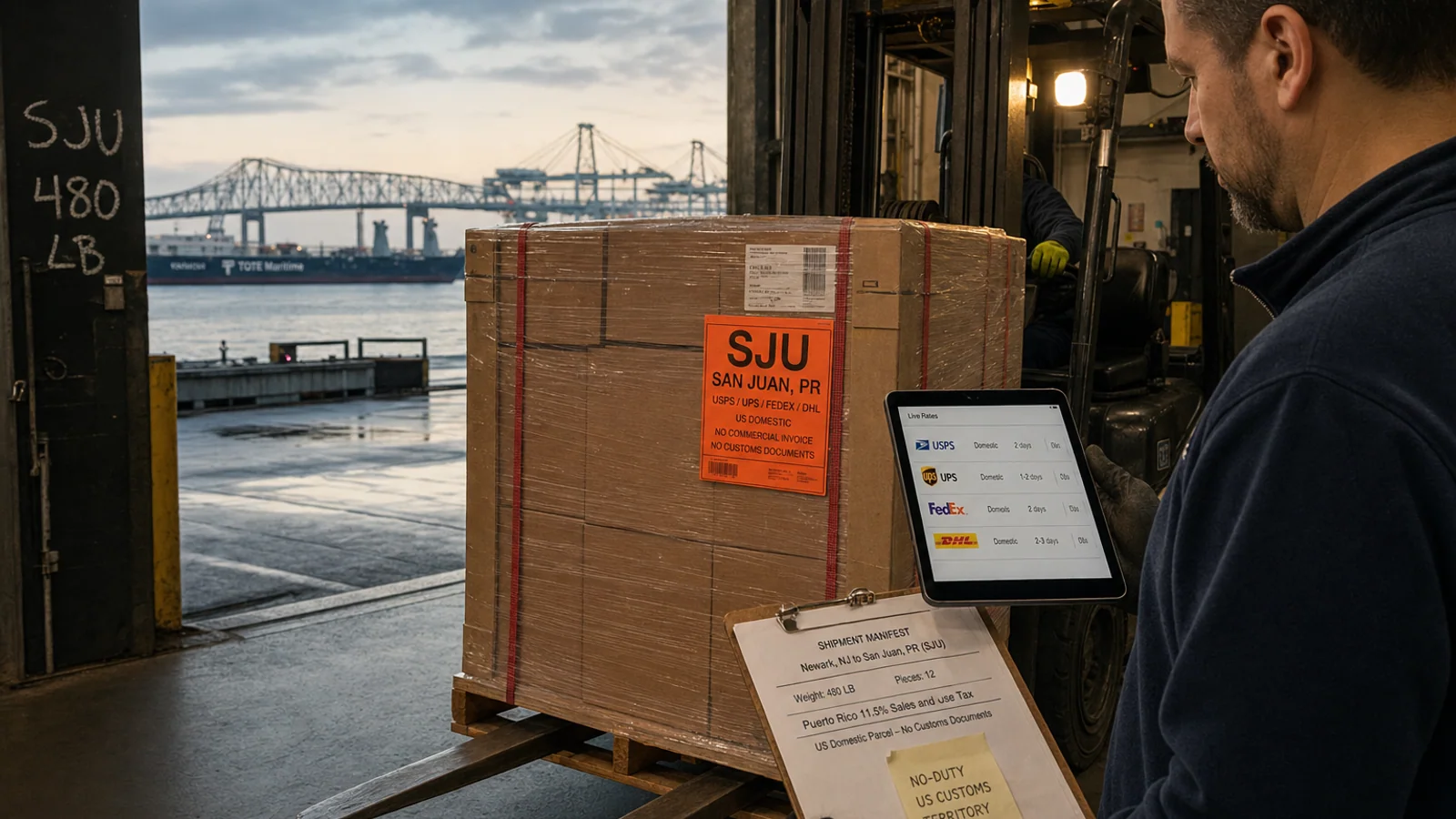
Quick answer Shipping to Puerto Rico is domestic: the island sits inside the US customs territory, so there is no CBP entry and no import duty on mainland goods. You do pay Puerto Rico's 11.5% Sales and Use Tax on arrival. Enter weight, dimensions and ZIP codes in the calculator for an instant price.
- Puerto Rico is inside the US customs territory — no CBP entry, no duty and no commercial invoice for mainland-origin shipments.
- Puerto Rico charges 11.5% Sales and Use Tax (10.5% state + 1% municipal) on arriving goods, declared through Hacienda's SURI portal.
- Parcel courier usually wins under about 70 lb; between 150 lb and a full pallet, ocean LTL plus LCL takes over on cost per pound.
- The Jones Act requires US-flag vessels on mainland-to-PR ocean moves, which is why island ocean rates differ from mainland trucking.
This page answers the money, tax and transit questions in one place, then prices your exact box, pallet or container. The courier to Puerto Rico calculator above reads live carrier rates and returns a number in seconds.
See your price in seconds
Real carrier rates, no signup, no follow-up calls.
How much does it cost to ship a package to Puerto Rico?
Quick answer Cost depends on billable weight, box dimensions, origin ZIP, service speed and the destination municipality. A 40 lb parcel to San Juan prices very differently from the same box to Mayagüez. The calculator on this page reads real carrier rates and returns your exact price in seconds, with no signup and no follow-up calls.
Five inputs move the number more than anything else. Get them right and the quote you see is the quote you pay.
- Billable weight is the greater of actual weight and dimensional weight — length × width × height ÷ the carrier's divisor.
- Origin gateway: the Northeast drays through Philadelphia or NY/NJ, Florida through Port Everglades or Jacksonville, Texas and the central states through Port Houston, the Midwest by rail to Jacksonville.
- Residential and extended-area delivery fees apply across much of the island outside the San Juan–Bayamón–Carolina metro.
- Fuel surcharges and the current-year general rate increases are already baked into the live rates the calculator reads.
- Declared value, which drives insurance and the 11.5% SUT math on arrival.
What the quote covers: freight, fuel and terminal charges, through to delivery. What it does not cover: the 11.5% Sales and Use Tax, which you pay to Hacienda at release. The rate environment on this page was last verified in January 2026.
See your price in seconds
Real carrier rates, no signup, no follow-up calls.
Is shipping to Puerto Rico domestic or international?
Quick answer Domestic. Puerto Rico is a US territory inside the US customs territory, so a shipment from the mainland never clears CBP, never needs a commercial invoice for customs and never pays import duty. Carriers rate it as a domestic move. What changes is the ocean leg, island delivery fees and Puerto Rico's own arrival tax.
Per CBP, goods moving between the mainland and Puerto Rico stay inside the US customs territory. No HTS classification, no ISF filing and no customs bond apply to a mainland-origin parcel. USPS rates the island as domestic, Flat Rate boxes included.
| Item | Mainland shipment | Puerto Rico shipment |
|---|---|---|
| CBP entry | None | None |
| Import duty | 0% | 0% |
| Arrival tax | State/local at point of sale | 11.5% SUT via SURI |
| Documents | BOL or label | BOL/AWB + packing list + SURI declaration |
| Carriers | Any truckload/parcel carrier | Parcel carriers + US-flag ocean lines |
| Typical transit | 1–5 days | 1–3 days air, 2–7 days ocean + delivery |
One exception matters. Goods that originated outside the USA and transship through the island still face normal CBP rules — confirm the treatment with a licensed customs broker.
What is Puerto Rico's 11.5% Sales and Use Tax on arriving goods?
Quick answer Puerto Rico's Sales and Use Tax (SUT, locally IVU) is 11.5% — 10.5% state plus 1% municipal — applied to the value of taxable goods arriving on the island. Importers file a Declaration of Imports in Hacienda's SURI portal. Bonded importers get release first and pay later; non-bonded importers pay before the carrier releases the freight.
10.5% state plus 1% municipal, published by the Departamento de Hacienda and collected at import release — never a Walio charge.
- File the SURI Declaration of Imports before or at arrival for commercial shipments.
- Businesses importing for resale need a Merchant Registration Certificate (Certificado de Registro de Comerciante).
- Bonded importers take release first and settle on their filing cycle; non-bonded importers pay before release.
- Personal effects and certain exempt categories follow different treatment — confirm with a tax adviser.
SUT is not part of your freight quote
Hacienda collects the 11.5% separately from your carrier charges. A non-bonded importer who skips the SURI filing will see the shipment sit at the terminal, and storage accrues daily.
What is the cheapest way to send a box to Puerto Rico?
Quick answer Under about 70 lb, parcel courier is almost always cheapest, and USPS Priority Mail often leads on small dense boxes. Between 150 lb and a full pallet, ocean LTL plus LCL takes over on cost per pound. Above a few cubic meters, a 20 ft container wins. The breakpoint depends on density, not weight alone.
| Shipment weight | Cheapest mode | Billing basis | Typical transit |
|---|---|---|---|
| 10–25 lb | USPS Priority Mail Flat Rate | Flat box, no dim weight | 2–4 days |
| 26–70 lb | UPS/FedEx Ground | Billable weight | 3–6 days |
| 71–150 lb | Ground, multi-piece | Billable weight per piece | 3–6 days |
| 150 lb–1 pallet | LTL to port + ocean LCL | Per 100 lb, then per m³/RT | 7–12 days |
| 1–5 CBM | Ocean LCL | Per m³ or revenue ton | 7–14 days |
| Over 10–15 CBM | FCL, 20 ft | Flat per container | 7–14 days |
Parcel stops winning once you exceed roughly 150 lb or three boxes. LCL bills per cubic meter or revenue ton, so light, bulky freight flips to volume billing fast. One 20 ft container holds about 28–30 m³ and beats LCL around 10–15 m³ — the same math explained in the Nicaragua to USA Container Calculator: Cost 2026.
See your price in seconds
Real carrier rates, no signup, no follow-up calls.
Carrier comparison: USPS, UPS, FedEx, DHL or ocean LCL?
Quick answer For the same 40 lb, 24x18x18 in box, the six options split on speed and liability, not just price. USPS Priority Mail and UPS Ground move slowest and cheapest; FedEx Express and DHL Express move fastest with the highest declared-value limits; ocean LCL only makes sense once the box becomes a pallet.
| Service | Billing basis | Transit to San Juan | Tracking | Included coverage |
|---|---|---|---|---|
| USPS Priority Mail | Weight + zone (Flat Rate ignores dim) | 2–4 days | Scan events | Up to $100 |
| UPS Ground | Billable weight | 3–6 days | Full, with delivery photo | Up to $100 declared |
| UPS 2nd Day Air | Billable weight | 2 days | Full | Up to $100 declared |
| FedEx Express | Billable weight | 1–3 days | Full | Up to $100 declared |
| DHL Express | Billable weight | 1–3 days | Full | Up to $100 declared |
| Ocean LCL | Per m³ / revenue ton | 7–14 days door to door | Milestone only | Cargo insurance optional |
USPS Flat Rate
The only option that ignores dimensional weight. A dense 20 lb box of tools or books in a Large Flat Rate box beats every private carrier on the same lane. Size, not weight, is the limit.
Private carriers
UPS, FedEx and DHL all apply dimensional weight. A light 24x18x18 in box bills well above its scale weight, and extended-area fees hit most municipalities outside the metro. Faster, better tracked, higher declared value available.
Ocean LCL adds requirements parcel does not have: a 48x40 in pallet, shrink wrap and a drayage leg on both ends. Check declared-value limits before shipping electronics or appliances.
How long does it take for a courier to deliver to Puerto Rico?
Quick answer Air courier delivers to San Juan in 1–3 business days from most US gateways. Ocean service runs 2–7 days in transit after the port cut-off, plus island delivery. Sailings are weekly from Jacksonville, Port Everglades, Philadelphia and Houston, so your cut-off day matters more than vessel speed.
| Origin port | To San Juan | Sailings/week | Typical cut-off | Ponce / Mayagüez add |
|---|---|---|---|---|
| Jacksonville, FL | 2–3 days | 2–3 | Tue / Fri | +1–2 days |
| Port Everglades, FL | 2–3 days | 2 | Wed / Fri | +1–2 days |
| Philadelphia, PA | 4–5 days | 1 | Thu | +2–3 days |
| Houston, TX | 6–7 days | 1 | Mon | +2–3 days |
 Jacksonville(USJAX)
 San Juan(PRSJU)
Port cut-off is not vessel ETD. Missing a Friday cut-off in Philadelphia costs a full week, not a day. Jacksonville and Port Everglades carry the highest sailing frequency to San Juan, which is why Midwest freight often rails south instead of sailing from the Northeast.
Worked example: a 480 lb pallet from Newark to San Juan
Quick answer A real shipment is never one number. A 480 lb palletized shipment from Newark, NJ to San Juan carries LTL to the port, an ocean base rate, fuel and bunker surcharge, wharfage and terminal handling, island delivery, and the 11.5% SUT. Here is how those lines stack and which ones the calculator covers.
| Line item | What it pays for | In the calculator price? |
|---|---|---|
| LTL to terminal | Newark pickup to the NY/NJ or Philadelphia terminal | Yes |
| Ocean base rate | US-flag vessel, terminal to San Juan | Yes |
| Fuel / bunker surcharge | Carrier fuel index, adjusted monthly | Yes |
| Wharfage + terminal handling | Port and lift charges both ends | Yes |
| Island delivery | San Juan metro final mile | Yes |
| 11.5% SUT | Hacienda tax on declared value | No — paid at release |
The SUT math: on a $4,000 declared value, 10.5% state ($420) plus 1% municipal ($40) equals $460 paid to Hacienda, separate from freight. That is a published Puerto Rico rate, not a Walio charge.
Build the pallet on a 48x40 in footprint, shrink wrap it tight, add corner boards and keep it under 72 in tall. Over-height or overhanging pallets trigger oversize handling fees at the terminal and get re-stacked at your cost.
See your price in seconds
Real carrier rates, no signup, no follow-up calls.
Documents, restricted items and the courier to Puerto Rico calculator
Quick answer Mainland-to-Puerto-Rico shipments need no customs entry, but they do need a bill of lading or air waybill, a packing list, and a SURI import declaration for commercial goods. USDA APHIS restricts plants, soil and some agricultural items in both directions. Enter your details in the calculator and compare modes in seconds.
- Bill of Lading (B/L) or Air Waybill (AWB)
- Packing list with piece count, weights and dimensions
- Declared value for coverage and SUT calculation
- SURI Declaration of Imports for commercial cargo
- Merchant Registration Certificate for resellers
Restricted and regulated items
USDA APHIS restricts plants, soil, live animals and certain produce moving to and from the island. Lithium batteries, aerosols and alcohol follow carrier-specific hazmat rules — declare them, or the carrier refuses the shipment at the counter.
To price it: enter origin ZIP, destination municipality, weight, dimensions and value at #quote-calc, then compare parcel, LCL and FCL side by side. Oversized or special cargo? The calculator takes the request and a Walio specialist follows up.
- Moving a vehicle too? See the Enclosed Car Shipping Calculator: Instant Rates (2026).
- Foreign-origin vehicles do face CBP entry — compare the Import Car Germany to USA Calculator: 2026 Quotes and the JDM Car Import Calculator: Japan to USA Rates (2026).
- Comparing multimodal pricing logic? Read the Sea-Air Vietnam to Peru Calculator: Instant Quotes 2026.
The courier to Puerto Rico calculator on this page prices your exact box, pallet or container against real carrier rates. Enter your route above and see your price in seconds — no signup, no follow-up calls.
See your price in seconds
Real carrier rates, no signup, no follow-up calls.
No. Puerto Rico sits inside the US customs territory, so a mainland shipment never clears CBP and never pays import duty. You do pay Puerto Rico's 11.5% Sales and Use Tax on arriving taxable goods, declared through Hacienda's SURI portal.
Domestic. USPS, UPS and FedEx all rate Puerto Rico as a domestic destination, with domestic tracking and no commercial invoice for customs. Carriers may still add off-shore or extended-area delivery surcharges, which is why the quoted price differs from a mainland move of the same box.
For small, dense boxes under about 20 lb, USPS Priority Mail Flat Rate is usually cheapest because it ignores dimensional weight. Above roughly 70 lb, ground and ocean options take over, and past 150 lb a palletized ocean LTL/LCL move beats parcel on cost per pound. The calculator compares all of them in seconds.
The Jones Act requires cargo moving between two US points by water to travel on US-built, US-flagged and US-crewed vessels. Mainland-to-Puerto-Rico ocean freight therefore moves on US-flag carriers such as Crowley, TOTE Maritime and Trailer Bridge. That restricted carrier pool is the main reason island ocean rates behave differently from mainland trucking rates.
Air courier reaches San Juan in 1–3 business days from most US gateways. Ocean service runs about 2–7 days in transit after the port cut-off, with weekly sailings from Jacksonville, Port Everglades, Philadelphia and Houston. Delivery to Ponce, Mayagüez or rural municipalities adds 1–3 days.