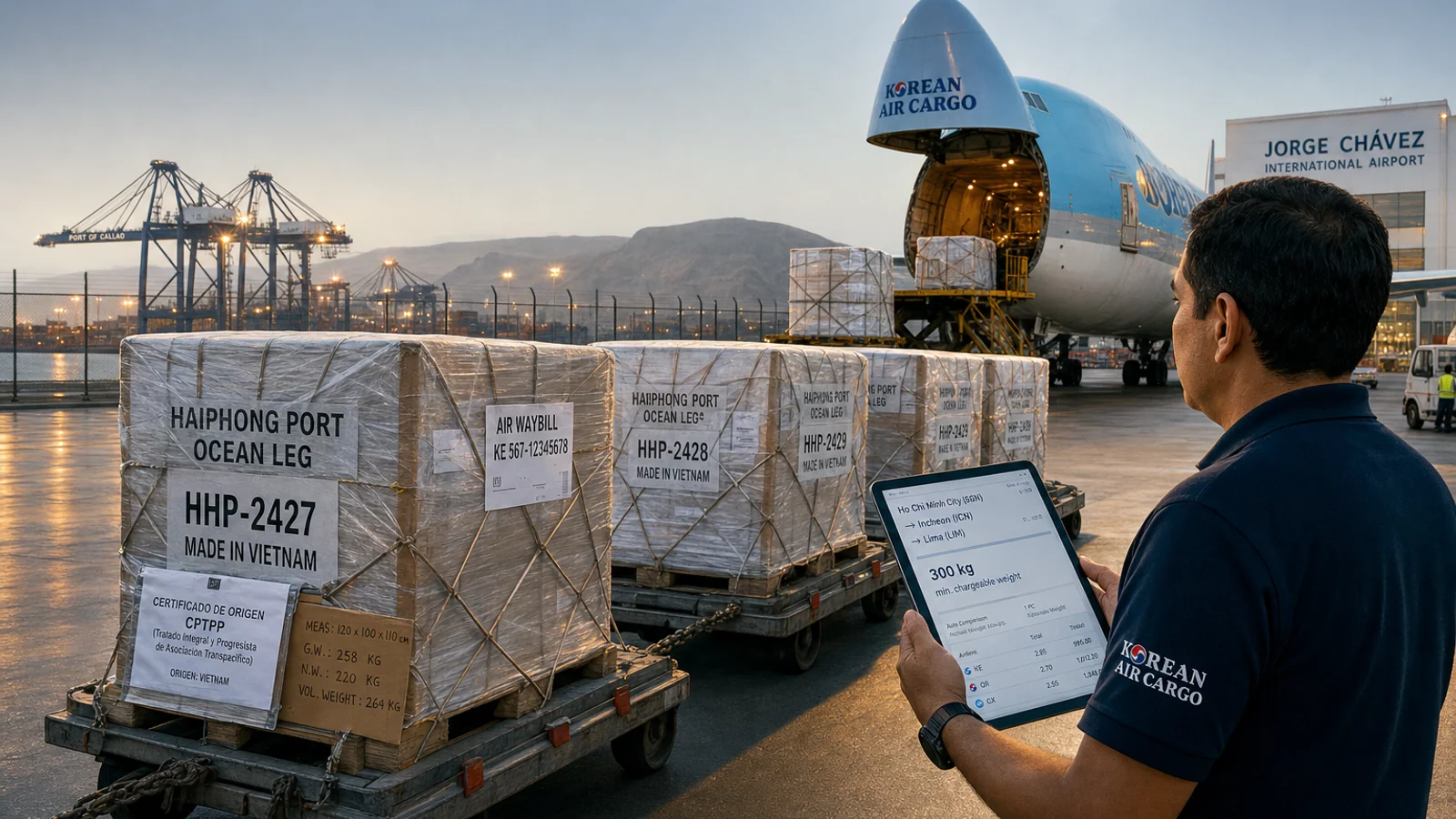
Quick answer Sea-air from Vietnam to Peru moves ocean to a transshipment hub, then air to Lima's Jorge Chávez airport, usually 18-25 days versus 38-50 by full ocean. Chargeable weight is the greater of actual kilos and volume × 167 kg per m³, with a 300 kg minimum billed weight. The calculator prices your exact port, airport and weight in seconds.
- Sea-air Vietnam to Peru runs about 18-25 days, against 38-50 days for FCL and 5-8 days for direct air freight.
- Chargeable weight is the greater of actual kilos and CBM × 167 kg per m³; shipments under 300 kg are billed as 300 kg.
- Walio's published sea-air rates on the China to Peru lane start from $6.39/kg at 300-499 kg and from $4.36/kg at 5,000+ kg, port to airport; Vietnam origin ports price instantly in the calculator.
- Peru charges IGV 16% plus IPM 2% on the CIF value plus duty, and CPTPP origin certification can drop the ad valorem duty on Vietnamese-made goods to 0%.
Peruvian importers are moving orders from Guangdong to Binh Duong, Dong Nai and Bac Ninh, and the Vietnam lane has fewer direct options than the China one. This guide shows how the sea air calculator Vietnam Peru prices that lane, how chargeable weight is built, and what SUNAT charges when the cargo lands.
See your price in seconds
Real carrier rates, no signup, no follow-up calls.
What is sea-air shipping from Vietnam to Peru?
Quick answer Sea-air shipping is one multimodal service that carries cargo by ocean from Vietnam to a transshipment hub, then flies it on to Lima. You pay per chargeable kilo, you get one booking and one set of documents, and transit lands between full ocean and full air freight.
Sea-air is a single service with two legs, not two shipments you coordinate yourself. The ocean leg carries the cargo cheaply across the long distance. The air leg buys back the time on the final stretch into Jorge Chávez.
It differs from plain ocean transshipment in one important way: the mode actually changes at the hub. The container is stripped at a container freight station (CFS), the cargo is re-weighed and re-palletized to airline profile, then tendered to an airline under a master air waybill. In ocean transshipment the box simply moves from one vessel to another.
Why 2026 matters for Peru. Sourcing keeps shifting from Chinese factories to Vietnamese ones in textiles, footwear, furniture, bicycles and electronics assembly. Direct Asia-Lima air capacity is thinner from Vietnam than from China, so routing through a hub is often the only practical fast option. Importers who already run the China lane can compare the two in our Sea-Air China to Peru Calculator: 2026 Rates guide before switching origin.
Documents split across the legs. A house bill of lading (HBL) covers the ocean portion, a master air waybill (MAWB) covers the flight, and one commercial invoice and packing list cover the whole movement for SUNAT.
Ask your supplier to pack to airline pallet profile from the start: cartons under 160 cm stacked height, no overhang, stretch-wrapped. Cargo that arrives at the hub already fly-ready skips a re-palletizing step and cuts one to two days of hub dwell.
How much does it cost to ship cargo by sea-air from Vietnam to Peru?
Quick answer Sea-air price per chargeable kilo depends on the origin port, the hub, the destination airport and your weight break. Walio publishes port-to-airport sea-air rates on the China to Peru lane from $6.39/kg at 300-499 kg, from $5.49/kg at 500-999 kg, from $4.81/kg at 1,000-4,999 kg and from $4.36/kg at 5,000+ kg.
Those published figures sit on the China to Peru lane, port to airport, at the cheapest port and airport combination. They show you how the weight-break ladder behaves. Vietnam origin ports price live in the calculator on this page.
| Chargeable weight band | Walio sea-air rate (China → Peru, port to airport) | Billing note |
|---|---|---|
| Under 300 kg | Billed at the 300 kg minimum | Minimum billed weight applies |
| 300-499 kg | from $6.39/kg | Cheapest port and airport on the lane |
| 500-999 kg | from $5.49/kg | Rate varies by port and airport |
| 1,000-4,999 kg | from $4.81/kg | Rate varies by port and airport |
| 5,000+ kg | from $4.36/kg | Rate varies by port and airport |
Vietnam origins price instantly. Enter Cat Lai or SPITC in Ho Chi Minh City, or Haiphong in the north, and the calculator returns the live per-kilo figure for that exact port and airport pairing. The per-kilo number moves with the port, the hub and the airline capacity that week.
Port to airport means the shipper delivers the cargo to the origin port and the consignee collects it at the destination airport. Door pickup in Vietnam and door delivery in Lima are quoted on request inside the calculator, as separate lines.
What drives your number:
- Chargeable weight band — each break down the ladder lowers the per-kilo rate
- Density of the cargo — light furniture and footwear pay on volume, not on the scale
- Hub routing — Singapore, Busan, Dubai or a US land bridge each price differently
- Season — Tet in Vietnam and the Q4 air peak tighten capacity and lift rates
- Whether the cargo needs CFS handling or arrives already palletized
The minimum is worth planning around. A 180 kg shipment bills as 300 kg, so you pay for kilos you are not using. Consolidating two small orders into one booking almost always beats shipping twice.
Origin and destination handling charges are added per shipment in the calculator. They are never folded into the per-kilo rate, because that is how hidden charges appear later on an invoice.
See your price in seconds
Real carrier rates, no signup, no follow-up calls.
How does the sea air calculator Vietnam Peru work?
Quick answer The sea-air calculator prices your lane from live carrier rates. Enter the origin port, the destination airport, gross weight and carton or pallet dimensions, and it returns a per-kilo rate plus handling in seconds. No forms that wait for an email, no sales call, and no signup before you see the number.
The inputs are short and the output is immediate.
- Origin port: Cat Lai or SPITC (Ho Chi Minh City) or Haiphong
- Destination airport: Jorge Chávez International, Lima (LIM)
- Gross weight in kilograms
- Dimensions per piece, or total CBM if you already have it
- Commodity description and declared value
What comes back on screen is itemized, not an all-in mystery number: the chargeable weight the system applied, the per-kilo sea-air rate, origin handling and destination handling as separate lines, a transit estimate and the booking cut-off.
Quotes move with airline capacity, so book while the quote is live. Port cut-off at Cat Lai sits days before vessel ETD, and missing it rolls you to the next sailing — which also means the next connecting flight out of the hub. One missed cut-off can cost a week.
Compare quotes properly or you compare nothing. Three things must match: the Incoterm, the chargeable weight basis and the inclusions. An FOB quote without destination handling is not comparable to a DAP quote that includes it.
Some shipments need a person. Out-of-gauge pieces, lithium batteries and other dangerous goods, and temperature-sensitive cargo all need review before booking. Submit the shipment through the calculator and a Walio specialist follows up, or open the chat on the page. Importers weighing several South American destinations can run the same exercise with our Vietnam to Argentina Sea-Air Calculator: 2026 Rates.
Run the calculator twice: once with your supplier's stated dimensions and once with 5 cm added per carton side. Suppliers routinely under-report pallet height, and the airline re-measures at acceptance. The second number is the one you should budget.
How do I calculate chargeable weight for a shipment from Vietnam to Peru?
Quick answer Chargeable weight is the greater of actual gross weight and volumetric weight. For sea-air, volumetric weight equals total cubic meters × 167 kg per m³, the same as the airline divisor of 6,000 cm³ per kilo. Shipments under 300 kg are billed at the 300 kg minimum on this lane.
Three terms, kept separate:
- Gross weight — what the scale says, cargo plus packing plus pallet
- CBM — length × width × height in meters, summed across all pieces
- Chargeable weight — the billed figure, whichever of the two is higher
Worked example: light cargo, volume wins
Four pallets of knitted apparel, each 120 × 100 × 150 cm. Volume per pallet is 1.8 m³, so total volume is 7.2 CBM. Volumetric weight is 7.2 × 167 = 1,202 kg. Actual gross weight is 850 kg. You pay on 1,202 kg, which lands in the 1,000-4,999 kg band.
Worked example: dense cargo, the scale wins
Two pallets of ceramic tile, 1.8 CBM total, 1,400 kg actual. Volumetric weight is 1.8 × 167 = 301 kg. Actual weight is far higher, so the importer pays for 1,400 kg. Dense cargo like this is usually the case where FCL deserves a second look.
The sea-air volumetric factor. It is the same rule as the airline's 6,000 cm³ per kilo divisor, written per cubic meter. A quote using ÷6,000 and a quote using ×167 must produce the same chargeable weight — if they do not, one of them measured differently.
Packing choices change the bill directly. Cut carton void so product fills the box. Shrink pallet height to the airline's usable profile instead of stacking an extra half layer. Avoid oversized crates that add volumetric kilos without adding a single sellable unit.
What routes and hubs connect Ho Chi Minh City and Haiphong to Lima?
Quick answer Vietnamese cargo leaves Cat Lai or SPITC in Ho Chi Minh City, or Haiphong in the north, sails to a transshipment hub, then flies to Lima. Common hubs are Singapore, Busan, Dubai, Los Angeles and Miami. Each hub changes the sea leg length, the dwell time and the flight time to Jorge Chávez.
| Hub | Sea leg from Vietnam | Typical hub dwell | Air leg to LIM | Flight frequency | Best-fit cargo |
|---|---|---|---|---|---|
| Singapore | 2-4 days | 2-4 days | 1 stop, 28-36 h | Daily connections | Apparel, footwear, light electronics |
| Busan | 5-8 days | 2-3 days | 1-2 stops, 30-40 h | Several per week | Electronics, components from Haiphong |
| Dubai | 12-16 days | 2-3 days | 1 stop, 26-34 h | Several per week | Higher-value, freighter-friendly cargo |
| Los Angeles | 18-24 days | 1-3 days | Direct or 1 stop, 9-14 h | Daily connections | Volume cargo on a US land bridge |
| Miami | via LA land bridge (3-5 days road) | 1-2 days | Direct, 6-8 h | Daily, belly and freighter | Retail replenishment into Lima |
Walio runs an Americas routing on the parallel China lane: ocean to Los Angeles in 12-18 days, truck Los Angeles to Miami in 3-5 days, then air Miami to Lima in 1-2 days, for a total of 16-25 days depending on the origin port. That combination leans on the deep Miami-Lima belly and freighter capacity rather than on scarce transpacific-to-South-America flights.
 Ho Chi Minh City(Cat Lai)
 Lima(LIM)
North versus south matters more than importers expect. Haiphong feeds Busan and Singapore efficiently and serves factories around Hanoi, Bac Ninh and Hai Duong. Cat Lai and SPITC serve Binh Duong, Dong Nai, Long An and the Mekong Delta. Trucking cargo the length of the country to the "wrong" port burns two days and real money.
Hub dwell is the hidden variable in every quote. Deconsolidation at the CFS, re-weighing, re-palletizing and airline acceptance can add 2-4 days, and that is where almost all schedule variance comes from. Importers routing regional distribution through Central America or Colombia can compare the same mechanics in our Sea-Air Vietnam to Panama Calculator: 2026 Rates and Sea-Air Vietnam to Colombia Calculator: Rates 2026.
See your price in seconds
Real carrier rates, no signup, no follow-up calls.
How long does sea-air freight take from Ho Chi Minh City to Lima?
Quick answer Sea-air from Ho Chi Minh City to Lima normally takes 18-25 days port to airport, against 38-50 days for FCL or LCL and 5-8 days for direct air freight. Hub dwell drives most of the variance. On Walio's China to Peru sea-air routing, published transit is 16-25 days depending on the origin port.
| Mode | Relative cost | Total transit | Schedule reliability | Minimum practical volume | Best-fit cargo |
|---|---|---|---|---|---|
| Sea-air | Middle | 18-25 days | Good, ±3 days on hub dwell | 300 kg chargeable | Apparel, footwear, seasonal retail, spare parts |
| FCL (20'/40'/40HC) | Lowest per m³ | 38-50 days | Good, ±5 days | Around 25 m³ (20') | Furniture, tile, bulk household goods |
| LCL | Low per m³ | 42-55 days | Fair, CFS adds variance | 1 m³ | Small, non-urgent mixed orders |
| Direct air | Highest per kg | 5-8 days | High, ±1 day | Any, minimums apply | Samples, launches, stockout recovery |
Transit variance follows the routing. Singapore and Busan hubs usually hold tighter schedules because the ocean feeder legs are short and frequent. A US land bridge adds trucking days but opens far more flights into Lima, which helps when airline space is tight.
LCL and FCL still win in clear cases. Once you have 10-15 m³ or more of low-value, non-urgent cargo, cost per cubic meter becomes the only metric that matters, and full ocean is the right answer.
Use value density as the decision rule. Cargo worth more than roughly $12-15 per kilo, or cargo tied to a fixed retail launch date, usually justifies sea-air over ocean. Below that, the freight saving from ocean outruns the cost of holding stock longer. Hub choice reshapes transit even more on long island legs — our Sea-Air Vietnam to Barbados Calculator: Rates 2026 shows that effect clearly.
Free time starts the moment the flight lands
Give your agente de aduana the invoice, packing list, MAWB and origin certification before the aircraft arrives. Airport storage at LIM accrues faster than container demurrage at Callao, and a two-day document delay can erase the savings you gained by flying the last leg.
See your price in seconds
Real carrier rates, no signup, no follow-up calls.
Which Peru gateway receives your cargo: Callao, Chancay, Paita or Jorge Chávez?
Quick answer Sea-air shipments from Vietnam land at Jorge Chávez International Airport in Callao, not at a seaport. Callao's DP World and APM terminals, the new Chancay deep-water port and Paita in the north handle containerized ocean cargo only. Airport clearance is normally faster than container clearance, but storage charges start sooner.
| Gateway | Cargo type | Typical clearance | Distance to Lima warehouses | Terminal charges |
|---|---|---|---|---|
| Jorge Chávez (LIM) | Air cargo, sea-air final leg | 1-3 days | 12-15 km | Ground handler terminal + storage, per kg and per day |
| Callao (DP World, APM) | FCL and LCL containers | 3-7 days | 13-18 km | THC, CFS deconsolidation, container demurrage |
| Chancay (Cosco) | FCL, direct Asia sailings | 3-6 days | Around 80 km | THC plus inland drayage to Lima |
| Paita | FCL and reefer, northern Peru | 3-6 days | Around 1,100 km | THC plus long-haul trucking south |
Chancay changes the ocean alternative, not the sea-air math. The Cosco deep-water terminal shortens some direct Asia-Peru sailings and improves FCL economics for heavy, low-value cargo. It handles containers, not aircraft, so your sea-air shipment still clears at Jorge Chávez.
The expanded Jorge Chávez terminal and second runway matter in the other direction. More capacity and a wider schedule into Lima give your forwarder more hub options and more chances to recover a missed connection.
Airport terminal handling, storage and warehouse fees at LIM are charged by the ground handler and sit outside the freight rate. Your Incoterm decides who pays them, so settle that with the supplier before booking.
Northern importers in Piura and Lambayeque often use Paita for ocean cargo. Air freight still clears in Lima and trucks north, which adds inland cost — build that into the comparison before assuming the north is cheaper.
Do I pay import duty in Peru on goods made in Vietnam under CPTPP?
Quick answer Peru applies ad valorem duty of 0%, 6% or 11% depending on the HS code, plus IGV at 16% and IPM at 2% on the CIF value plus duty. Vietnam and Peru are both CPTPP members, so a valid certification of origin can reduce the ad valorem duty to zero on qualifying goods.
The stack applies in a fixed order:
- CIF value — goods plus freight plus insurance to Peru
- Ad valorem duty at 0%, 6% or 11% by HS code
- ISC (selective consumption tax), only on specific products
- IGV 16% plus IPM 2% on the CIF value plus duty
- SUNAT Perception advance, creditable against your future tax
CPTPP certification of origin is not a chamber-stamped form in most cases. Under the agreement, the exporter, producer or importer self-certifies using the required data elements, keeps the certification on file and presents it to SUNAT on request.
Origin rules beat the factory address. Goods assembled in Vietnam from Chinese inputs must still meet the product-specific rule of origin — a tariff shift, a regional value content threshold, or both. A Vietnamese address on the invoice proves nothing by itself.
What SUNAT expects at clearance:
- DAM (Declaración Aduanera de Mercancías), filed by a licensed agente de aduana
- Commercial invoice and packing list
- MAWB for the air leg and HBL for the ocean leg
- CPTPP certification of origin, if you are claiming preference
One HS digit changes everything
Classification drives the duty rate, the Perception rate and whether a permit or restriction applies. Confirm the code with a licensed customs broker before you book, not after the flight lands. Walio prices freight and handling only — duties, IGV, IPM and Perception are paid to SUNAT and sit outside the freight quote.
Which surcharges and seasons change your final invoice?
Quick answer The freight rate is one line among several. Origin terminal handling, hub deconsolidation and handling fees, airline fuel and security surcharges, LIM terminal and storage charges, the customs agent fee and SUNAT system fees all appear on the final invoice. Walio itemizes origin and destination handling in the calculator instead of hiding them.
Accessorials by leg:
- Vietnam: origin THC, export documentation, customs export filing
- Hub: CFS deconsolidation, re-weighing, re-palletizing, airline acceptance
- Air leg: fuel surcharge and security surcharge, both per kilo
- Lima: ground handler terminal charges, storage from the day of arrival, agente de aduana fee, SUNAT ADUANET charges
Buying FOB Ho Chi Minh
You control the freight and the forwarder, and you see every line. You also carry destination handling, clearance and all Peruvian taxes. This is the normal choice for importers who want comparable quotes and no margin buried in the supplier's freight.
Buying DAP Lima
The supplier delivers to Lima, but duty, IGV, IPM and Perception stay with you as importer of record. Under DDP the seller takes on Peruvian import liability, which most Vietnamese suppliers price very defensively. Compare DAP against FOB plus your own freight before accepting it.
Season is predictable, so plan around it. Tet in Vietnam shuts factories and jams hubs for two to three weeks, and Chinese New Year compounds the congestion at Asian transshipment points. Q4 peak season surcharges hit airline rates from October through December.
Committing volume before those windows protects both space and price. Book the pre-Tet sailings early, and lock Q4 bookings before the surcharge announcements land.
The mistakes that inflate invoices are boringly consistent: under-declared dimensions caught at airline acceptance, a wrong HS code at SUNAT, a missing origin certification that kills the CPTPP preference, and slow clearance that triggers airport storage. All four are avoidable with documents prepared before departure.
See your price in seconds
Real carrier rates, no signup, no follow-up calls.
Sea-air from Ho Chi Minh City to Lima normally takes 18-25 days from port to airport, depending on the transshipment hub and the dwell time there. Full ocean on the same lane runs 38-50 days, and direct air freight runs 5-8 days. On Walio's China to Peru sea-air routing, published transit is 16-25 days depending on the origin port.
Sea-air moves your cargo by ocean to a hub and only flies the final leg, so it costs far less per kilo than flying the whole way. Direct air freight is faster at 5-8 days but prices at a premium per kilo. Sea-air suits cargo that needs to beat ocean transit without paying a full airfreight rate.
Chargeable weight is the greater of the actual gross weight and the volumetric weight, which equals total cubic meters multiplied by 167 kg per m³. For example, 7.2 CBM weighing 850 kg bills at 1,202 kg. On this lane the minimum billed weight is 300 kg, so lighter shipments are charged as 300 kg.
Often no ad valorem duty applies, because Vietnam and Peru are both CPTPP members and qualifying goods with a valid certification of origin can enter at 0%. IGV at 16% and IPM at 2% still apply on the CIF value plus duty, along with the SUNAT Perception advance. Confirm your HS code and rule of origin with a licensed customs broker before booking.
No, Chancay does not change the sea-air calculation, because the Cosco deep-water terminal handles containerized ocean cargo and not air freight. Sea-air shipments from Vietnam still land at Jorge Chávez International Airport in Callao. Chancay does shorten some direct Asia-Peru ocean sailings, which makes the FCL alternative more competitive for heavy, low-value cargo.
You now have the formula, the weight breaks, the hub options and the Peruvian tax stack. The only number left is yours. Enter your origin port, Jorge Chávez, your gross weight and your pallet dimensions in the calculator above and see your price in seconds — no signup, no follow-up calls.