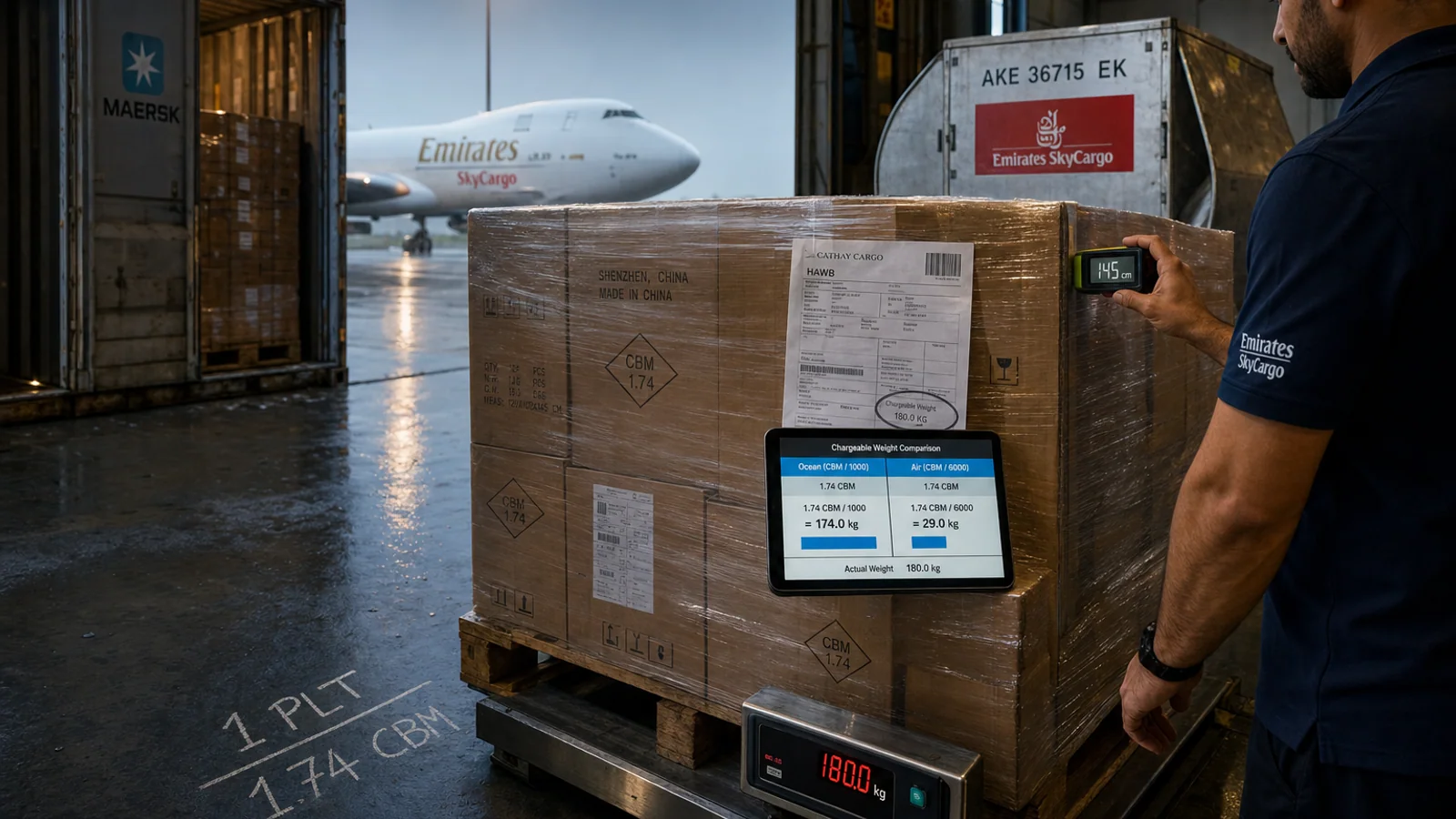
Quick answer Sea-air chargeable weight is the higher of actual gross weight and volumetric weight, and the air leg rules it: length × width × height in cm divided by 6000. One 120 × 100 × 150 cm pallet weighing 180 kg bills as 300 kg. Price your exact cargo in the calculator in seconds.
- Sea-air bills on the air divisor 6000 cm³/kg, not the ocean LCL rule of 1,000 kg per CBM, so volume costs more than importers expect.
- A 120 × 100 × 150 cm pallet is 1.8 CBM: 300 kg volumetric, 1.8 revenue tons by LCL, and 360 kg by express courier at 5000.
- Sea-air pays off between roughly 150 and 250 kg per m³ — denser cargo favors ocean, lighter cargo favors full air only when speed is critical.
- Transit from China to Latin America via Dubai, Singapore, Colombo or Los Angeles runs 16–25 days, against 30–45 days port to port by ocean.
Most importers quoting from Asia discover the gap the hard way: they weigh 180 kg and get invoiced for 300. This guide shows the math, the divisors, the hub rules and the documents, so you can calculate the billable kilos yourself before anyone sends you a quote.
See your price in seconds
Real carrier rates, no signup, no follow-up calls.
What is sea-air chargeable weight?
Quick answer Sea-air chargeable weight is the number of kilos a forwarder actually bills on a multimodal ocean-plus-air shipment. It is the higher of two figures: real gross weight on the scale, and volumetric weight from the cargo dimensions. On sea-air, the air leg divisor of 6000 cm³/kg almost always decides it.
Chargeable weight — peso cargable or peso tasable in Spanish quotes — is the greater of gross weight and volumetric weight. Nothing else. Your invoice never bills "the weight of the goods"; it bills the larger of those two numbers.
Volumetric weight converts space into kilos. The air industry uses a stowage factor of 6000 cubic centimeters per kilo, the standard published through IATA practice (Resolution 502 and the TACT rules). Airlines sell space in a ULD, so a light, bulky box costs them the same slot as a dense one.
This is why sea-air quotes come back in kilos, not cubic meters, even though half the trip happens on a vessel. The forwarder buys the air leg in kilos and resells the whole movement the same way. The ocean leg is folded into a per-kilo rate.
Gross weight means everything that goes on the scale: the product, the carton, the pallet, the shrink wrap, the corner boards and any dunnage. A 15 kg wooden pallet is 15 billable kilos.
A divisor of 6000 cm³/kg equals exactly 167 kg per cubic meter. Below that density, volume wins and you pay for air. Above it, your scale weight wins.
You can run this calculation in two minutes with a tape measure and a scale. Do it before you request anything, and you will know within a few kilos what any honest forwarder should quote on your peso cargable sea-air.
See your price in seconds
Real carrier rates, no signup, no follow-up calls.
How does sea-air shipping from China actually work?
Quick answer Sea-air is a multimodal service: an ocean leg from a Chinese port to a transshipment hub, a deconsolidation and re-manifest at that hub, then an air leg to the destination airport. China to Latin America runs 16–25 days door to airport, roughly half the time of pure ocean at a fraction of full air cost.
The service has three distinct parts, and each one touches your billable kilos.
- Ocean leg. Your cargo loads at Shenzhen, Ningbo, Shanghai or Qingdao as LCL or FCL and sails to the hub under an ocean Bill of Lading or Sea Waybill.
- Hub handling. The container is stripped at a CFS, cargo is deconsolidated, re-weighed and re-measured, then re-manifested for the flight.
- Air leg. Cargo loads into a ULD under a new MAWB, with your HAWB issued by the forwarder, and flies to the destination airport.
The real hubs are Dubai (DXB, fed by Jebel Ali), Singapore, Colombo, Busan and Los Angeles. Westbound routings to Latin America typically run Asia–Dubai–Europe–LatAm, Asia–Singapore–LatAm, or trans-Pacific into Los Angeles with a short air hop south.
The re-measurement at the hub is where surprises appear. Nobody at the factory measured the shrink-wrap bulge. The hub does, and the dimension sheet it produces becomes the billing basis.
 Shenzhen(CNSZX)
 Mexico City(MEX)
Lane detail matters. Our Sea-Air China to Mexico Calculator: 16-25 Days (2026) breaks down the Mexico routing, and the Sea-Air China to Honduras Calculator: 16-25 Days (2026) covers the Central America version through the same hubs.
Ask your supplier to photograph the finished pallet with a tape measure against the tallest point. If the hub later claims 162 cm, you have evidence for the dimension dispute.
How do you calculate sea-air chargeable weight step by step?
Quick answer Measure each piece in centimeters at its widest points, including the pallet. Multiply length × width × height, divide by 6000, and you have volumetric kilos. Weigh the piece on a scale for gross kilos. The higher number is your chargeable weight. Round up to the next 0.5 kg per the carrier rule.
- Measure L × W × H in centimeters per piece. Include pallet height, carton overhang and wrap bulge — measure the silhouette, not the box.
- Convert to volumetric kilos: (L × W × H) ÷ 6000. For cubic meters use (L × W × H) ÷ 1,000,000.
- Weigh each piece gross, with packaging, pallet and dunnage on the scale.
- Compare gross against volumetric and take the higher figure.
- Round up to the next 0.5 kg and check the shipment minimum.
| Step | Formula | Example (120 × 100 × 150 cm) |
|---|---|---|
| Volume in cm³ | L × W × H | 1,800,000 cm³ |
| Volumetric kg (air / sea-air) | cm³ ÷ 6000 | 300 kg |
| Volumetric kg (express courier) | cm³ ÷ 5000 | 360 kg |
| Cubic meters (CBM) | cm³ ÷ 1,000,000 | 1.80 CBM |
| LCL revenue ton (W/M) | greater of CBM or tonnes | 1.80 R/T |
| Gross weight | scale reading | 180 kg |
| Chargeable weight (sea-air) | higher of gross / volumetric | 300 kg |
Note the last two rows. The LCL formula (1 CBM = 1,000 kg, the W/M rule) and the air formula answer the same question with different arithmetic. That single difference explains almost every quote dispute on peso cargable sea-air.
Which volumetric divisor applies in sea-air, 6000 or 1000?
Quick answer The 6000 divisor applies. Sea-air is sold as an air product with an ocean first leg, so the forwarder bills on the IATA air standard of 6000 cm³ per kilo. The ocean LCL rule of 1,000 kg per cubic meter only governs pure LCL. Express courier uses a harsher 5000 divisor.
| Mode | Billing basis | Divisor / rule | Density equivalence |
|---|---|---|---|
| FCL ocean | Per container (20', 40', 40HC) | None — flat per box | Up to payload limit |
| LCL ocean | Revenue ton (W/M) | 1 CBM = 1,000 kg | 1,000 kg/m³ |
| Sea-air | Chargeable kilos | 6000 cm³/kg | 167 kg/m³ |
| Pure air freight | Chargeable kilos | 6000 cm³/kg | 167 kg/m³ |
| Express courier | Chargeable kilos | 5000 cm³/kg | 200 kg/m³ |
Read the right-hand column slowly. LCL only charges you on volume when your cargo is lighter than 1,000 kg per cubic meter. Sea-air charges you on volume the moment you drop below 167 kg per cubic meter. That is the equivalence trap.
Some forwarders quote the ocean portion in CBM and the air portion in kilos, then combine them. Ask one question before you accept: which basis appears on the final invoice? If the answer is kilos, the 6000 divisor governs the whole move.
Incoterms 2020 decide who pays that freight, not how it is calculated. Under FOB and FCA the buyer pays the sea-air charge; under CIF, DAP and DDP the seller carries it, and under DDP the seller also carries import clearance and duty liability. The chargeable weight math is identical in every case.
For a mode-versus-mode view on a South American lane, see Sea-Air vs Air China–Chile Calculator: 17-26 Days 2026.
See your price in seconds
Real carrier rates, no signup, no follow-up calls.
Worked example: one pallet, four transport modes
Quick answer Take a standard pallet of 120 × 100 × 150 cm with 180 kg gross. Volume is 1.8 CBM. Volumetric weight at 6000 is 300 kg, so sea-air and pure air both bill 300 kg. LCL bills 1.8 revenue tons. Express courier at 5000 bills 360 kg.
The arithmetic, line by line: 120 × 100 × 150 = 1,800,000 cm³. Divide by 6000 → 300 volumetric kilos. Divide by 1,000,000 → 1.80 CBM. Gross on the scale is 180 kg, so 300 kg wins.
| Mode | Gross weight | Volume | Chargeable basis | Typical transit (China → LatAm) |
|---|---|---|---|---|
| Sea-air | 180 kg | 1.80 CBM | 300 kg | 16–25 days |
| Pure air | 180 kg | 1.80 CBM | 300 kg | 5–9 days |
| LCL ocean | 180 kg | 1.80 CBM | 1.80 R/T | 30–45 days port to port |
| Express courier | 180 kg | 1.80 CBM | 360 kg | 4–7 days |
Now flip the density. Same 1.8 CBM pallet, but loaded with hardware at 450 kg gross. Volumetric is still 300 kg, so gross weight wins and sea-air bills 450 kg instead of 300. Density is 450 ÷ 1.8 = 250 kg/m³.
The light pallet sits at 180 ÷ 1.8 = 100 kg/m³ — well under the 167 kg/m³ break-even, so you are paying for 120 kilos of air. That is the single most useful number in any sea-air negotiation.
For the same exercise on a specific lane with hub routings and airport options, read Sea-Air China to Colombia Calculator: Rates in Seconds.
See your price in seconds
Real carrier rates, no signup, no follow-up calls.
When does sea-air beat pure air or pure ocean by density?
Quick answer Cargo between roughly 150 and 250 kg per cubic meter is the sweet spot for sea-air. Below 150 kg/m³ you pay for air you are not using, and consolidated ocean usually wins on cost. Above 250 kg/m³ gross weight dominates and FCL or LCL is cheaper per kilo.
- Under 150 kg/m³ — textiles, foam, packaging, empty bottles, lampshades. Volumetric weight dominates; ship LCL unless the deadline is immovable.
- 150–250 kg/m³ — spare parts, hardware, small appliances, electronics in retail packaging. This is the sea-air band.
- Above 250 kg/m³ — tiles, liquids, fasteners, motors, stone. Gross weight dominates; FCL or LCL wins per kilo.
| Factor | Sea-air | Pure air | Ocean (LCL/FCL) |
|---|---|---|---|
| Transit China → LatAm | 16–25 days | 5–9 days | 30–45 days |
| Relative cost per kg | Medium | Highest | Lowest |
| CO₂ footprint | Medium | Highest | Lowest |
| Re-measurement risk | High (hub re-weigh) | Medium (origin only) | Low |
| Ideal density | 150–250 kg/m³ | Any, if urgent | Above 250 kg/m³ |
| Handling touches | 3+ (load, strip, ULD) | 1–2 | 1–2 |
Choose sea-air
Your cargo sits in the 150–250 kg/m³ band, the goods are replenishment stock rather than a one-off, and two or three weeks of saved transit cuts your inventory carrying cost more than the freight premium. Cartons are sturdy and can survive deconsolidation at a hub CFS.
Choose ocean or pure air
Dense, heavy cargo belongs in an FCL container where freight is flat per box. A hard retail deadline or a production line down in Lima belongs on a direct flight. Sea-air sits between them and wins only when neither extreme fits.
Sea-air is wrong regardless of density in three cases: dangerous goods restricted on the air leg, pieces taller than the ULD envelope, and fragile cargo that cannot survive re-handling. The Sea-Air China to Peru Calculator: 2026 Rates covers how those exclusions play out on the Callao–Lima lane.
See your price in seconds
Real carrier rates, no signup, no follow-up calls.
How do hub rules, rounding and minimums change your billable kilos?
Quick answer Every transshipment hub re-weighs and re-measures before loading. Rounding to the next 0.5 kg, billable minimums per shipment and rate break points at 45, 100, 300, 500 and 1,000 kg all move the final number. A 299 kg shipment often costs more than the same cargo billed at 300 kg.
| Hub | Divisor | Typical ULD height limit | Re-measurement practice |
|---|---|---|---|
| Dubai (DXB / Jebel Ali) | 6000 cm³/kg | 160 cm lower deck | Automated dimensioner at CFS |
| Singapore (SIN) | 6000 cm³/kg | 160 cm lower deck | Automated dimensioner, photo record |
| Colombo (CMB) | 6000 cm³/kg | 160 cm lower deck | Manual tape and scale |
| Los Angeles (LAX) | 6000 cm³/kg | 244 cm main deck | Automated dimensioner |
Rate break points are the easy win. Air tariffs step down at 45, 100, 300, 500 and 1,000 kg. If you calculate 285 chargeable kilos, ask the forwarder to quote at 300 kg — the higher band often produces a lower total.
Height is the other lever. A 150 cm pallet fits a lower-deck ULD; a 172 cm pallet does not, so the hub re-stacks it, and re-stacking changes your dimensions and your invoice.
- Cut pallet height before you cut carton count — height drives volumetric kilos fastest.
- Eliminate overhang; a 3 cm lip on each side adds real cubic centimeters.
- Nest and stack cartons rather than shipping loose pieces.
- Use lighter crating — plywood instead of solid timber where the cargo allows.
- Consolidate loose cartons onto one pallet instead of three part-filled ones.
Never accept a revised invoice blind
If the hub bills more kilos than you calculated, request three documents before paying: the weighing ticket, the dimension sheet and the ULD build photo. A forwarder who cannot produce them cannot defend the re-measurement.
Where does chargeable weight appear on the HAWB, MAWB and B/L?
Quick answer The HAWB shows gross weight, dimensions and the chargeable weight the forwarder bills you. The MAWB shows what the airline bills the forwarder. The ocean Bill of Lading or Sea Waybill for the first leg shows gross weight and CBM instead. Compare all three before you pay.
- No. of Pieces — count must match your packing list exactly.
- Gross Weight — scale reading at the hub, in kilos.
- Chargeable Weight — the billed figure; this is your peso cargable sea-air.
- Rate Class — "Q" for quantity rates, "M" for the shipment minimum.
- Dimensions — L × W × H per piece, the basis of any volumetric claim.
Your HAWB kilos and the MAWB kilos will not match, and that is normal. Consolidation means your shipment is one line inside a bigger ULD covered by a single master air waybill.
Reconcile three documents side by side: the hub weighing ticket, the HAWB and the forwarder invoice. All three must show the same chargeable kilos. The ocean B/L for the first leg will show gross weight and CBM, not chargeable kilos — that is expected, not an error.
The 6000 divisor itself is published through IATA Resolution 502 and the TACT rules, which is the authority to cite when a quote disputes your math.
Import duties are assessed on customs value and HS classification, not on chargeable weight. Confirm your rate with a licensed customs broker against DIAN, SUNAT, SAT, ANAM or Receita Federal before you build your landed-cost model.
What drives your sea-air price and how do you get it in seconds?
Quick answer Chargeable weight, origin city in China, hub routing, destination airport and cargo type drive the sea-air price. Add hub handling, deconsolidation, airline security screening and destination terminal charges. The calculator on this page prices your exact shipment from real carrier rates — no signup, no follow-up calls.
Cost drivers in order of impact: chargeable weight first, then which rate break point you reach, then your origin gateway (Shenzhen, Ningbo, Shanghai or Qingdao), then the hub routing, then the destination airport.
- Origin THC and export handling at the Chinese port
- Hub handling, deconsolidation and re-manifest at the CFS
- Airline security screening on the air leg
- Fuel and security surcharges, quoted per chargeable kilo
- Destination terminal charges and deconsolidation fees at the arrival airport
Under FOB and FCA you pay the freight and the destination charges. Under CIF the seller covers main carriage only. Under DAP the seller delivers but you clear; under DDP the seller carries clearance and duty liability into your country.
Duties and taxes are never a Walio charge. They are the importing country's published rates applied to your customs value and HS code, collected by DIAN, SUNAT, SAT, ANAM or Receita Federal.
Sea-air cuts roughly half the ocean transit. Walio compares real rates across carriers including Maersk, MSC, CMA CGM and Hapag-Lloyd on the ocean leg.
Oversize pieces above ULD height, dangerous goods and project cargo cannot be auto-priced. Submit them through the calculator and a Walio specialist follows up. For a lane-specific worked example, see the Sea-Air China to Mexico Calculator: 16-25 Days (2026).
See your price in seconds
Real carrier rates, no signup, no follow-up calls.
Chargeable weight on sea-air is the higher of gross weight and volumetric weight, where volumetric weight equals length × width × height in centimeters divided by 6000. A 120 × 100 × 150 cm pallet gives 300 volumetric kilos, so a 180 kg pallet bills at 300 kg. Enter your dimensions in the calculator above and see the billable kilos and the price in seconds.
The 6000 divisor is used. Sea-air is priced as an air product, so the IATA standard of 6000 cm³ per kilo applies to the whole shipment, even though the first leg travels by vessel. The 1,000 kg per CBM rule belongs to pure LCL ocean freight, and express courier uses an even tighter 5000 divisor.
Gross weight is what the scale reads, including pallet and packaging. Volumetric weight is the space the cargo occupies, converted to kilos by dividing cubic centimeters by 6000. Chargeable weight is simply the larger of the two, and it is the number that appears on your HAWB and your invoice.
Sea-air works best for cargo between roughly 150 and 250 kg per cubic meter that needs to arrive in 16–25 days. Lighter cargo usually ships cheaper by consolidated ocean, and very dense cargo is cheaper per kilo in an FCL container. Compare all three modes for your exact cargo in the calculator above.
Because the hub re-measured your cargo and the volumetric weight came out higher than the gross weight. Pallet height, shrink-wrap bulge and overhang all count, and the result is rounded up to the next 0.5 kg. Ask for the hub weighing ticket and the dimension sheet before you accept the revised invoice.
Run your own numbers first, then check them against a live quote. Enter your dimensions, gross weight, Chinese origin and destination airport in the calculator above and see your chargeable kilos and your price in seconds — no signup, no follow-up calls.