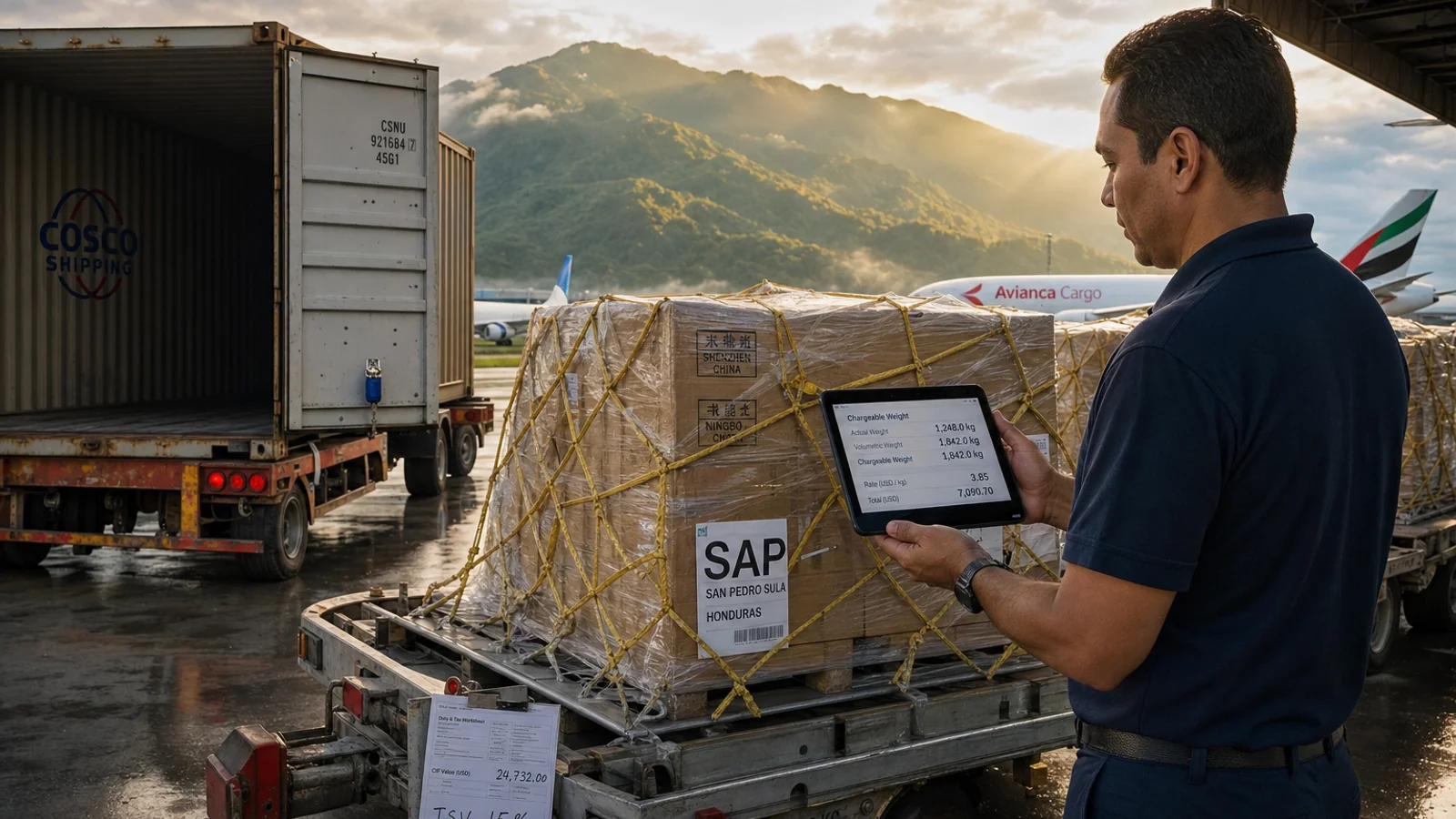
Quick answer Sea-air freight from China to Honduras moves ocean to Los Angeles (12–18 days), truck to Miami (3–5 days), then air to San Pedro Sula or Tegucigalpa (1–2 days) — 16–25 days total. Rates start from $5.95/kg at 300–499 kg and from $3.92/kg above 5,000 kg, port to airport.
- Total transit is 16–25 days port to airport, depending on the Chinese origin port: ocean to Los Angeles, truck to Miami, air to SAP or TGU.
- Sea-air rates on this lane start from $5.95/kg (300–499 kg) and from $3.92/kg (5,000+ kg), with a 300 kg minimum billed weight.
- Chargeable weight is the greater of actual kilos and volume × 167 kg per cubic meter — the same divisor used for standard air cargo.
- Honduras charges import duty (DAI) under the Central American tariff plus 15% ISV on the CIF value, collected by ANAM at clearance.
This guide shows how the lane is built, how chargeable weight is calculated, and what each bracket costs. Use the sea air calculator china honduras on this page to price your exact cartons.
See your price in seconds
Real carrier rates, no signup, no follow-up calls.
What is a sea-air shipment from China to Honduras?
Quick answer A sea-air shipment is one booking that combines ocean freight for the long leg with air freight for the final leg. From China it sails to Los Angeles, trucks to Miami, then flies to San Pedro Sula or Tegucigalpa. One multimodal service, one rate per chargeable kilo, 16–25 days.
Sea-air uses the ocean for distance and the aircraft for speed. The Pacific crossing carries the cost, and the short flight from Miami carries the urgency. You buy it as one service with a single rate per chargeable kilogram, not as three separate bookings you have to stitch together.
The physical route is fixed and repeatable. Your cargo loads at a Chinese port and sails to Los Angeles/Long Beach. It is then deconsolidated and moved by line-haul truck across the United States to Miami. From Miami International, it flies to San Pedro Sula (SAP) or Tegucigalpa (TGU) on a regular freighter or belly service.
What does "port to airport" include?
The service priced here is port to airport. The shipper delivers the cargo to the origin port in China, and the consignee collects it at the destination airport in Honduras. That scope keeps the per-kilo rate clean and comparable between quotes.
Door pickup at your supplier's factory and door delivery in Honduras are both available. They are quoted on request inside the calculator, because the price depends on the province, the distance and the number of pallets. Walio never publishes a flat figure for a leg it has not measured.
Sea-air is the only word that matters in English search; "multimodal" is the technical term for the same thing — one contract covering ocean, road and air legs. Ask suppliers for the FOB port name, not the city name, so the calculator matches the right sailing.
Shipping to South America instead? The same structure applies on longer lanes — see our Sea-Air China to Argentina Calculator: 17-26 Days (2026) for a side-by-side on a 17–26 day route.
See your price in seconds
Real carrier rates, no signup, no follow-up calls.
How do you calculate sea-air freight cost from China to Honduras?
Quick answer Measure each carton, convert to cubic meters, then multiply total volume by 167 kg per cubic meter. Compare that figure with the actual gross weight and bill the greater one. Shipments under 300 kg chargeable are billed as 300 kg. Multiply chargeable kilos by the bracket rate.
Three steps give you the number. Get them right and your invoice matches your estimate.
- Calculate CBM. CBM = length (m) × width (m) × height (m) × number of cartons. The cubic meter is the volume unit every freight quote uses.
- Convert volume to weight. Volumetric weight = CBM × 167 kg. That is the same ratio as the 6,000 cm³ per kilo air cargo divisor used by IATA members.
- Pick the higher number, then the bracket. Chargeable weight is the greater of gross and volumetric. Apply the 300 kg minimum, then read the rate bracket.
Worked example: when density decides the invoice
Take 8 m³ of consumer goods weighing 900 kg gross. Volumetric weight is 8 × 167 = 1,336 kg. You pay on 1,336 kg, not 900 kg, because the cargo is light for its size. Dense cargo behaves the opposite way.
| Shipment | Volume (m³) | Gross weight (kg) | Volumetric (CBM × 167) | Chargeable weight (kg) |
|---|---|---|---|---|
| Light consumer goods | 8.0 | 900 | 1,336 | 1,336 |
| Machine parts | 3.0 | 1,400 | 501 | 1,400 |
| Textiles, bagged | 6.0 | 700 | 1,002 | 1,002 |
| Small sample order | 1.2 | 180 | 200 | 300 (minimum) |
How is LCL ocean math different?
LCL ocean uses the W/M rule — weight or measure. The carrier bills per cubic meter or per 1,000 kg, whichever produces more revenue. That favors dense cargo far more than the 167 kg air standard does.
So a 3 m³, 2,800 kg pallet of hardware bills as 3 revenue tons on LCL. The same pallet bills 2,800 kg on sea-air. Dense cargo belongs on the water; light cargo is where sea-air competes hardest.
Walio's calculator runs all three steps on your real carton list in seconds. Enter dimensions, enter weights, and it returns the chargeable weight and the bracket price together.
Sea air calculator china honduras: what are the 2026 prices?
Quick answer Walio's live rate table for October 9, 2026 prices this lane from $5.95/kg at 300–499 kg, from $5.05/kg at 500–999 kg, from $4.37/kg at 1,000–4,999 kg and from $3.92/kg at 5,000 kg and above, port to airport. Origin and destination handling is added per shipment.
| Chargeable weight bracket | Rate per kg (USD) | Service scope | Transit |
|---|---|---|---|
| 300–499 kg | from $5.95 | Port to airport | 16–25 days |
| 500–999 kg | from $5.05 | Port to airport | 16–25 days |
| 1,000–4,999 kg | from $4.37 | Port to airport | 16–25 days |
| 5,000 kg and above | from $3.92 | Port to airport | 16–25 days |
Each figure is a "from" rate on the cheapest port and airport pairing on the lane. A sailing from Shenzhen into SAP and a sailing from Dalian into TGU will not price identically. The calculator resolves the exact combination.
What does the per-kilo rate cover?
- The ocean leg from your Chinese port to Los Angeles/Long Beach
- The line-haul truck movement from Los Angeles to Miami
- The air leg from Miami to San Pedro Sula or Tegucigalpa
- Carriage documentation across all three legs under one booking
What is added separately?
- Origin handling at the Chinese port, charged per shipment
- Destination handling at SAP or TGU, charged per shipment
- Import duty (DAI) and 15% ISV in Honduras, collected by ANAM
- Cargo insurance, optional and priced on declared CIF value
- Door pickup in China or door delivery in Honduras, quoted on request
The cost drivers are simple: the weight bracket, the origin port, the destination airport, cargo density, the season, and whether you add door legs. Peak weeks before Chinese New Year push air capacity prices up across every Asia lane.
Comparing neighboring markets? Our Sea-Air China to Peru Calculator: 2026 Rates and Sea-Air China to Mexico Calculator: 2026 Rates break down the same bracket structure on two other Latin American lanes.
See your price in seconds
Real carrier rates, no signup, no follow-up calls.
China to Honduras shipping time: how many days by sea-air?
Quick answer Total transit is 16–25 days port to airport. The ocean leg from Dalian, Fuzhou, Guangzhou, Ningbo, Qingdao, Shanghai, Shenzhen, Xiamen or Xingang to Los Angeles runs 12–18 days, the Los Angeles–Miami truck 3–5 days, and the Miami flight to San Pedro Sula or Tegucigalpa 1–2 days.
| Leg | Mode | Route | Days |
|---|---|---|---|
| 1 | Ocean | China port → Los Angeles/Long Beach | 12–18 |
| 2 | Truck | Los Angeles → Miami | 3–5 |
| 3 | Air | Miami → SAP or TGU | 1–2 |
| Total | Sea-air | China → Honduras, port to airport | 16–25 |
South China ports usually land at the fast end. Shenzhen, Guangzhou and Xiamen sailings reach Los Angeles nearer 12–14 days. North China ports — Dalian, Xingang, Qingdao — generally sit closer to 16–18 days on the water.
 Shenzhen(CNSZX)
 San Pedro Sula(SAP)Qingdao(CNTAO)Tegucigalpa(TGU)
Why the port cut-off matters more than the ETD
Your clock starts at the terminal cut-off, not the vessel's ETD. Cargo must be gated in and documented several days before the ship sails. Miss the cut-off by hours and you roll to the next sailing, usually a week later.
Ask your supplier for the cargo-ready date, then book backwards from the cut-off. A missed cut-off costs more days than any carrier delay on this lane.
How does it compare with pure ocean and pure air?
Pure ocean to Puerto Cortés transships through Panama or Manzanillo and typically takes 32–45 days from South China. Full air freight from Shanghai or Guangzhou to SAP, routed through a US or Mexican hub, lands in roughly 5–9 days. Sea-air sits between them at 16–25 days.
Two real delay points
Los Angeles terminal congestion can add days before the truck leg starts, and Miami airline space tightens during peak weeks and around holidays. Build a buffer of three to five days into any production or restock plan that depends on a fixed arrival date.
Mexico runs on a near-identical structure and timetable — see the Sea-Air China to Mexico Calculator: 16-25 Days (2026) for the closest regional transit benchmark.
Is it cheaper to ship by sea or air from China to Honduras?
Quick answer Ocean freight is cheapest per kilo and slowest; air freight is fastest and most expensive. Sea-air sits between them, usually beating air on price and ocean on speed by two to five weeks. Dense, low-value cargo favors FCL; urgent, higher-value or mid-weight cargo favors sea-air.
| Mode | Transit to Honduras | Pricing unit | Minimum charge basis | Best for |
|---|---|---|---|---|
| FCL (20GP/40HQ) | 32–45 days | Per container | One full container | Dense, high-volume, non-urgent cargo |
| LCL | 35–50 days | Per m³ or 1,000 kg (W/M) | 1 revenue ton | 1–15 m³ of non-urgent cargo |
| Sea-air | 16–25 days | Per chargeable kg | 300 kg | Mid-weight restocks and components |
| Air freight | 5–9 days | Per chargeable kg | 45–100 kg | Urgent, high-value, low-weight cargo |
| Express courier | 3–6 days | Per chargeable kg (÷5000) | 0.5 kg | Samples and parcels under 70 kg |
Where is the crossover point?
Volume decides the ocean question first. Under roughly 10–15 m³, LCL usually beats paying for a 20GP. Above that, price a full container, because a 20GP loads about 28–30 m³ in practice and the per-cubic-meter cost falls sharply once it is full.
| Container | Internal volume (m³) | Typical loaded volume (m³) | Max payload (kg) | Standard pallets |
|---|---|---|---|---|
| 20GP | 33 | 28–30 | ~28,000 | 10–11 |
| 40GP | 67 | 58–62 | ~26,500 | 20–21 |
| 40HQ | 76 | 68–72 | ~26,500 | 20–21 |
| 45HQ | 86 | 76–80 | ~26,000 | 24–26 |
When sea-air wins
Pick sea-air when three to five saved weeks are worth more than the per-kilo gap with ocean. A maquila buyer in the Sula Valley restocking 1,200 kg of components prices in the 1,000–4,999 kg bracket, from $4.37/kg. The cargo arrives in under a month instead of six weeks, keeping a line running.
When ocean wins
Pick FCL or LCL when the cargo is dense, low in value per kilo and ordered on a planned cycle. Tiles, hardware, bulk packaging and furniture frames rarely justify an air leg. Forecast earlier, book a container, and spend the saving on inventory instead of freight.
For a full mode-by-mode cost comparison worked out on a neighboring lane, read our Sea-Air vs Air China–Chile Calculator: 17-26 Days 2026.
See your price in seconds
Real carrier rates, no signup, no follow-up calls.
Which Chinese ports and Honduran airports does this lane serve?
Quick answer Walio prices sea-air from Dalian, Fuzhou, Guangzhou, Ningbo, Qingdao, Shanghai, Shenzhen, Xiamen and Xingang into Los Angeles, then by air from Miami to San Pedro Sula (SAP) and Tegucigalpa (TGU). Your factory's province decides the origin port, and the destination airport decides the final rate.
Match your supplier's province to the right port before you quote:
- Guangdong (Dongguan, Foshan, Zhongshan) → Shenzhen or Guangzhou
- Zhejiang and Jiangsu (Yiwu, Suzhou, Wenzhou) → Ningbo or Shanghai
- Fujian (Quanzhou, Jinjiang) → Xiamen or Fuzhou
- Shandong and the north (Jinan, Tianjin, Liaoning) → Qingdao, Xingang or Dalian
On the Honduran side, San Pedro Sula air cargo from China serves the Sula Valley maquila corridor and most industrial importers. Tegucigalpa suits the capital region and the south. Clearing at the airport closest to your warehouse removes a domestic trucking leg and a day of handling.
Puerto Cortés does not appear in a sea-air quote
The final leg is a flight, so customs clearance happens at the airport, not the seaport. Puerto Cortés, Puerto Castilla and San Lorenzo handle pure ocean cargo and project moves — useful lanes, but a different service. If a quote mixes a flight with a seaport clearance, question it.
What surcharges does a sea-air quote add on top of the rate?
Quick answer Freight is the base; surcharges sit on top. Expect origin and destination handling, documentation and AMS/ISF filing on the ocean leg, fuel and security fees on the air leg, and terminal and chassis costs in Los Angeles. Walio itemizes each one in the quote instead of hiding it.
The surcharge glossary, in plain words
- BAF / CAF — bunker and currency adjustment factors on the ocean leg
- PSS / GRI — peak season surcharge and general rate increase, applied by sailing date
- THC / DTHC — terminal handling at origin and destination
- AMS — the advance manifest filing US Customs requires before loading
- ISF ("10+2") — the importer security filing CBP requires 24 hours before vessel loading
- DO fee — delivery order issuance at destination
- Chassis — the trailer rented under the container in Los Angeles
- Demurrage and detention — penalties after free time expires, counted in days
According to US Customs and Border Protection, the ISF must be filed at least 24 hours before cargo is loaded onto the vessel at the foreign port. A late ISF carries liquidated damages, and it is the one filing importers most often leave to the last minute.
What appears on the Miami–SAP/TGU sector?
Air legs carry their own line items: fuel surcharge, security surcharge, the AWB (Air Waybill) issuance fee, and terminal handling at the Honduran airport. On arrival, expect airport handling, warehouse storage after the free days, and your broker's fee. The consignee pays these unless the Incoterm moves them to the seller.
A checklist to run against any competing quote
- Are origin and destination handling itemized, or buried in the kilo rate?
- Does the quote name the origin port and the destination airport?
- Is the minimum billed weight stated — here it is 300 kg?
- Are ISF and AMS included or billed separately?
- How many free days before storage and demurrage start?
How do I calculate import duty and ISV tax in Honduras?
Quick answer Honduras charges import duty (DAI) under the Central American tariff schedule, usually 0% to 15% by HS code, plus 15% ISV sales tax. Both are assessed on the CIF value — goods plus freight plus insurance. ANAM collects them at clearance, and the importer needs an active RTN.
Honduras applies a 15% sales tax (ISV) on imported goods, calculated on the CIF value plus the import duty already assessed. It is a published national rate, not a Walio charge.
Landed cost, step by step
- Start with the CIF value: invoice value + freight + insurance.
- Apply the DAI rate for your SAC/HS code, commonly 0%–15%.
- Apply 15% ISV on CIF plus duty.
- Add broker fees, airport handling and domestic delivery.
- The sum is your total landed cost per unit — the only figure worth comparing against local supply.
What documents does clearance need?
- Factura Comercial (commercial invoice) with HS codes and values
- Packing list with carton counts, dimensions and gross weights
- Air Waybill (AWB) for the Miami–SAP/TGU leg
- Certificado de Origen, where a preferential rate is claimed
- The importer's RTN, active and matching the consignee name
ANAM is the customs authority that administers Honduran imports, taking over the functions formerly handled by the DEI. A licensed Honduran customs broker files the declaration. Classification decides whether you pay 0% or 15%, so confirm the SAC code with your broker before the cargo flies.
Restricted goods on the air leg
Lithium batteries, aerosols, paints and other dangerous goods face strict air rules and can be refused outright. Declare them before booking. Duty and tax figures here are Honduras published rates, not Walio prices — classification and tax questions belong to a licensed customs broker or tax adviser.
How to ship things to Honduras from China: booking step by step
Quick answer Confirm your Incoterm with the supplier, get final carton dimensions and weights, price the shipment in the calculator, book online, then hand the cargo to the origin port. Walio issues the documents, moves the three legs, and your broker clears the cargo at SAP or TGU.
Step 1: agree the Incoterm
FOB puts the cargo at the Chinese port with export clearance done — the cleanest starting point for sea-air. EXW means you arrange the factory pickup and export formalities. DDP moves import liability onto the seller, which few Chinese suppliers handle well in Honduras.
| Incoterm 2020 | Export clearance | Main freight | Import duty & ISV | Destination delivery |
|---|---|---|---|---|
| EXW | Buyer | Buyer | Buyer | Buyer |
| FOB | Seller | Buyer | Buyer | Buyer |
| CIF | Seller | Seller | Buyer | Buyer |
| DAP | Seller | Seller | Buyer | Seller |
| DDP | Seller | Seller | Seller | Seller |
Steps 2 to 5
- Collect real carton data. Guessed volume is the top cause of a revised invoice.
- Decide on cargo insurance. It is priced as a small percentage of CIF value and must be bought before departure, never after.
- Validate the estimate. Check the origin port, destination airport, weight bracket and whether door legs are included.
- Appoint your Honduran broker early, so the RTN and HS codes are ready before the flight lands.
Walio compares real carrier rates across the lane — ocean capacity from operators such as Maersk, MSC, CMA CGM and Hapag-Lloyd, plus the US trucking and Miami air legs — and prices them as one booking. Oversized, dangerous or project cargo goes through the calculator too, and a Walio specialist follows up; you can also open the chat on this page.
See your price in seconds
Real carrier rates, no signup, no follow-up calls.
You now have the math, the brackets, the transit legs and the duty structure. The last step is your actual cargo. Enter your origin port, your destination airport and your carton list in the calculator above and see your price in seconds — no signup, no follow-up calls.
A 20 ft container is pure ocean freight, not sea-air, so it is priced per container rather than per kilo and takes roughly five to seven weeks to Puerto Cortés with transshipment. Sea-air on this lane is priced per chargeable kilo, from $5.95/kg at 300–499 kg down to from $3.92/kg above 5,000 kg. Enter your cargo in the calculator above to see both options for your exact origin.
Chargeable weight is the greater of your actual gross weight and your volume multiplied by 167 kg per cubic meter. For example, 6 m³ weighing 700 kg bills as 1,002 kg because the volumetric figure is higher. Shipments below 300 kg chargeable are billed at the 300 kg minimum on this lane.
Pure ocean from Shenzhen to Puerto Cortés typically runs about 32 to 45 days with a transshipment in Panama or Manzanillo. Sea-air from the same port reaches San Pedro Sula in 16 to 25 days by sailing to Los Angeles, trucking to Miami and flying the last leg. The calculator shows the day range for your exact port.
A 40 ft high cube holds about 76 m³ of internal space and loads roughly 68 to 72 m³ in practice once pallets and void space are counted. A standard 40GP loads about 58 to 62 m³ and a 20GP about 28 to 30 m³. Below 10 to 15 m³, LCL or sea-air usually costs less than a full container.
Sea freight is cheaper per kilo on every comparison, and air freight is the most expensive but the fastest. Sea-air sits in between: it undercuts straight air freight while cutting two to five weeks off ocean transit, arriving in 16 to 25 days. Compare all three for your cargo in the calculator above in seconds.