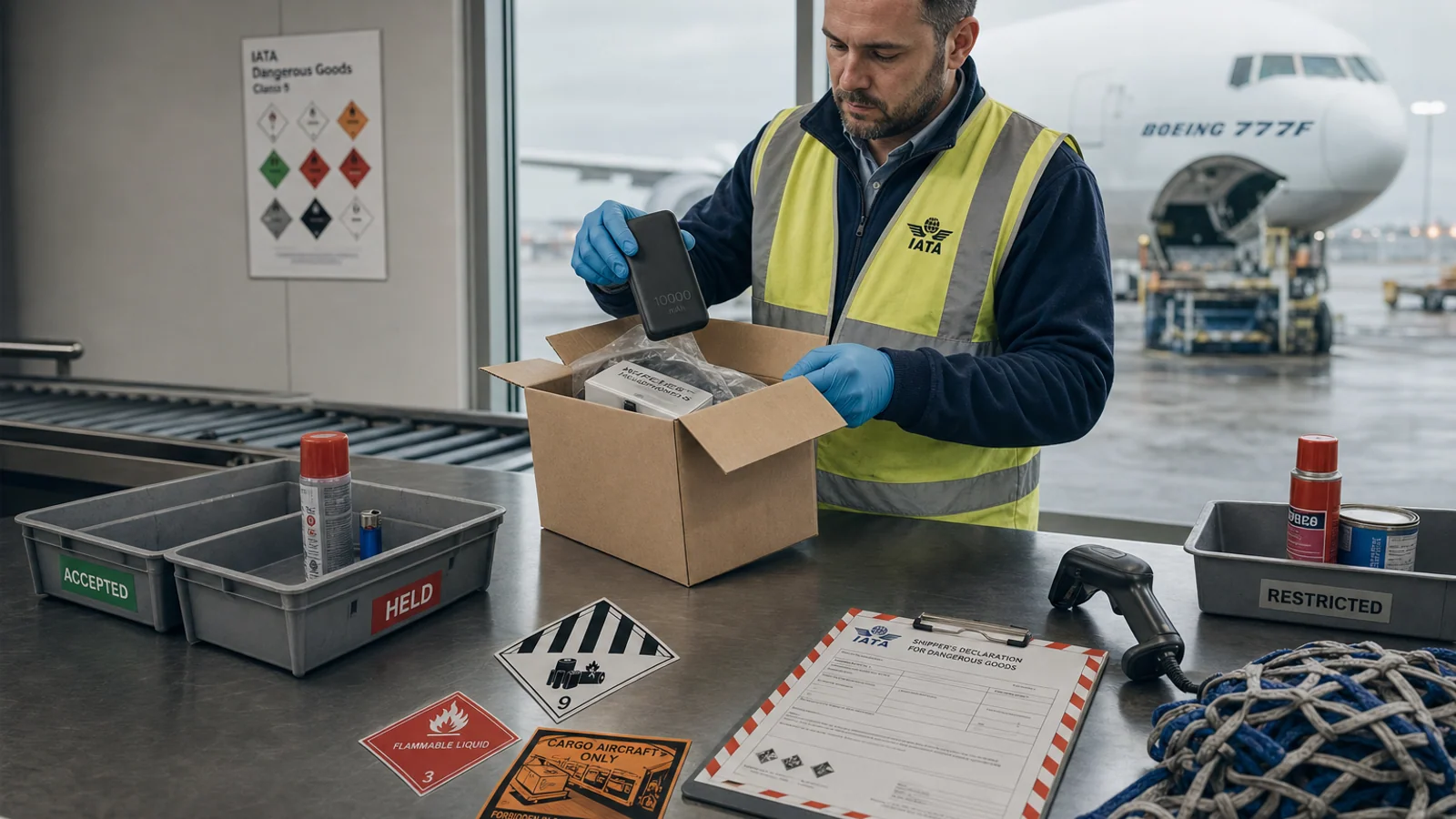
Quick answer Air freight bans explosives, flammable gases, flammable liquids above flashpoint limits, oxidizers, toxic and infectious substances, radioactive material and corrosives unless they are declared, UN-packed and accepted under IATA rules. Loose lithium batteries ship at 30% state of charge or less. Many items fly only on cargo aircraft.
- IATA sorts every hazardous item into 9 Dangerous Goods Classes; nothing in those classes flies without a Shipper's Declaration, UN-spec packaging and hazard labels.
- Standalone lithium-ion batteries (UN3480) are forbidden on passenger aircraft and must ship at 30% state of charge or less under PI 965 Section IA/IB.
- Undeclared dangerous goods carry civil penalties up to $175,000 per violation in the United States, plus full shipment seizure.
- Perfume, nail polish, aerosols, drones, e-bikes, vapes and used car parts are hidden dangerous goods — restricted, not banned, if declared correctly.
Most cargo that gets stopped at an airline warehouse was never truly forbidden — it was simply never declared. This guide separates what can never fly from what flies under conditions, and shows you how to price the compliant route.
See your price in seconds
Real carrier rates, no signup, no follow-up calls.
What items are not allowed in air freight?
Quick answer Air freight forbids explosives, fireworks, flammable gases and aerosols, flammable liquids, flammable solids, oxidizers and organic peroxides, toxic and infectious substances, radioactive material, corrosives, lithium batteries and magnetized material unless each one is classified, packed to UN specification, labeled and declared. Undeclared, all of them are prohibited.
The items not allowed in air freight fall into three stacked layers. The first layer is the IATA Dangerous Goods Regulations, which apply to every airline on earth. The second is the individual carrier's own embargo list. The third is the destination country's import law.
A small group of goods is forbidden in all circumstances. These carry a "Forbidden" entry in the IATA dangerous goods list and no paperwork makes them acceptable.
- Mass-detonating explosives in Division 1.1 and 1.2, including blasting agents and military ordnance
- Certain organic peroxides and self-reactive substances that require temperature control below their accepted limits
- Damaged, defective or recalled lithium cells and batteries
- Any dangerous goods offered as general cargo without a declaration
Then come the country and carrier layers. Customs authorities add their own bans: bulk currency, ivory, counterfeit goods, cannabis products and live animals without CITES permits are refused on many lanes regardless of IATA. Major integrators publish their own prohibited lists that go further than the regulations require.
| Category | Example | Status | Who sets the rule |
|---|---|---|---|
| Forbidden entry | Blasting explosive UN0081 | Never flies | IATA / ICAO |
| Damaged batteries | Recalled lithium cell | Never flies | IATA / ICAO |
| Undeclared hazmat | Perfume in a parcel | Rejected on screening | Carrier / FAA |
| Carrier embargo | Loose banknotes | Refused by most airlines | Airline |
| Country ban | Used clothing into some markets | Seized at import | Customs authority |
| Declared DG | Paint UN1263 PG III | Flies with full documentation | IATA DGR |
One point confuses almost every first-time shipper. Passenger baggage rules from the TSA and FAA are a separate legal regime from air cargo rules under the IATA DGR. A lighter you may carry in your pocket is not a lighter you may ship in a box.
See your price in seconds
Real carrier rates, no signup, no follow-up calls.
What are dangerous goods in air freight?
Quick answer Dangerous goods are articles or substances that can harm health, safety, property or the aircraft when carried by air. IATA's Dangerous Goods Regulations sort them into 9 classes with divisions, each identified by a four-digit UN number and, for most, a packing group that signals high, medium or low danger.
The IATA Dangerous Goods Regulations (DGR) are the airline industry's field manual. IATA builds the DGR on the ICAO Technical Instructions and reissues it every January, so a 2025 edition is not valid in 2026. Airlines accept or reject cargo against the current edition, not the one your supplier printed two years ago.
| Class | Hazard | Real cargo example | UN number |
|---|---|---|---|
| 1 | Explosives | Consumer fireworks | UN0336 |
| 2.1 | Flammable gas | Butane canisters | UN1011 |
| 2.2 / 2.3 | Non-flammable / toxic gas | Nitrogen / chlorine | UN1066 / UN1017 |
| 3 | Flammable liquid | Paint and solvents | UN1263 |
| 4.1 | Flammable solid | Safety matches | UN1944 |
| 5.1 | Oxidizer | Calcium hypochlorite (pool shock) | UN1748 |
| 6.1 | Toxic substance | Pesticide, liquid | UN2902 |
| 6.2 | Infectious substance | Diagnostic specimens | UN3373 |
| 7 | Radioactive | Radioactive material, excepted package | UN2910 |
| 8 | Corrosive | Sulfuric acid | UN1830 |
| 9 | Miscellaneous | Lithium-ion batteries | UN3480 |
Most classes also carry a packing group. PG I means high danger, PG II medium and PG III low. PG I substances rarely fly at all because quantity limits per package are tiny and airline acceptance teams avoid them.
The UN number controls acceptance, not the product name. "Hand sanitizer" means nothing to an airline; UN1170 ethanol solution, Class 3, PG II means a specific packing instruction and a specific quantity limit. If your shipment cannot fly, compare the alternatives in Air Freight vs Ocean Freight: Which One Wins? before you rebook.
What is the difference between prohibited and restricted air cargo?
Quick answer Prohibited items can never fly, in any quantity, with any paperwork. Restricted items fly only under conditions: limited quantity, specific packing instruction, hazard labels, a Shipper's Declaration and sometimes cargo aircraft only. Most everyday problem cargo is restricted, not prohibited — the shipment fails because it was not declared.
| Status | Definition | Examples | Documents required | Consequence of non-compliance |
|---|---|---|---|---|
| Prohibited | Never acceptable by air | UN "Forbidden" entries, Division 1.1 explosives, damaged lithium cells | None accepted | Refusal, seizure, referral to regulator |
| Restricted | Flies only under stated conditions | Perfume UN1266, aerosols UN1950, dry ice UN1845, magnets UN2807 | Shipper's Declaration, UN packaging, hazard labels, AWB entries | Offload, fines up to $175,000 per violation |
| Permitted with conditions | Not dangerous goods, but controlled | Pharmaceuticals, temperature-controlled perishables, firearm parts | Export license, phytosanitary or health certificate, temperature log | Customs hold, destruction of spoiled cargo |
The failure pattern repeats on every lane. A shipper books perfume or power banks as general cargo to avoid the paperwork and the surcharge. The freight passes through the airline's screening or a canine check, a label or an SDS surfaces inside the carton, and the pallet is pulled at the cargo terminal.
From there the clock runs against the shipper. The cargo sits in a hold area until a compliant declaration and correct packaging arrive, which usually means the goods come back to the warehouse and start over.
"It shipped last time" is not a defense
An undeclared shipment that slipped through once does not establish precedent. Airlines screen a percentage of cargo, not all of it, and acceptance standards tighten after every industry incident. Declare the goods correctly every time.
See your price in seconds
Real carrier rates, no signup, no follow-up calls.
Can you ship lithium batteries by air freight?
Quick answer Yes, but under the strictest rules in air cargo. Standalone lithium-ion batteries (UN3480) are banned from passenger aircraft and must ship at 30% state of charge or less under Packing Instruction 965. Batteries packed with or contained in equipment (UN3481) have wider routing options and a lighter documentation burden.
Lithium batteries sit in Class 9, and IATA splits them across four UN numbers. The difference between them is simply whether the battery travels alone, beside its device, or inside it.
| UN number | What it covers | Packing instruction | Energy limit (Section II) | State of charge | Passenger aircraft |
|---|---|---|---|---|---|
| UN3480 | Lithium-ion batteries alone | PI 965 | No Section II | 30% maximum | Forbidden — CAO only |
| UN3481 | Lithium-ion with or in equipment | PI 966 / 967 | 100 Wh per cell/battery | No limit | Permitted |
| UN3090 | Lithium metal batteries alone | PI 968 | No Section II | Not applicable | Forbidden — CAO only |
| UN3091 | Lithium metal with or in equipment | PI 969 / 970 | 2 g lithium per cell | Not applicable | Permitted |
Each packing instruction divides into sections. Section IA covers larger cells and demands full dangerous goods treatment: UN-spec packaging, Class 9 lithium label, Shipper's Declaration and trained staff. Section IB covers smaller cells in larger quantities and still requires a declaration. Section II, where it exists, drops the declaration but still requires the lithium battery mark and a handling document on the air waybill.
Watt-hours decide everything. The math is volts × amp-hours ÷ 1000. A laptop cell at 11.1 V and 5.4 Ah is 60 Wh and travels easily inside equipment. An e-bike pack at 48 V and 10.4 Ah is roughly 500 Wh, far above the 100 Wh Section II ceiling, so it needs full Section I treatment.
Per the IATA Dangerous Goods Regulations, standalone lithium-ion batteries shipped under UN3480 must be at or below 30% of rated capacity. Airlines spot-check with a voltmeter at acceptance.
Damaged, defective or recalled cells are forbidden by air in all circumstances — no exception, no packing instruction, no carrier variation. In practice, e-bikes, scooters, portable power stations and drone spare packs almost always move by ocean, where IMDG rules allow full containers of Class 9 batteries under a simpler regime.
What is a Cargo Aircraft Only (CAO) shipment?
Quick answer A Cargo Aircraft Only shipment carries goods that regulators allow on freighters but ban from aircraft carrying passengers. The package wears the orange CAO label, and the booking must route through a freighter service. CAO cargo moves on fewer flights, so transit is longer and capacity is tighter than belly cargo.
Most lift between the United States and Latin America is belly cargo — freight in the hold of a passenger aircraft. Miami alone feeds dozens of daily passenger flights to Bogotá, San José, Guatemala City, Santo Domingo and Lima. Freighter rotations are far thinner, and that gap drives both transit time and price.
| Factor | Passenger aircraft (belly) | Cargo Aircraft Only (CAO) |
|---|---|---|
| Allowed hazard classes | Limited quantities of Class 2.2, 3, 6.1, 8, 9 | Wider range, including UN3480, UN3090, some Class 2.3 |
| Net quantity per package | Lower (passenger column of the DGR) | Higher (cargo aircraft column) |
| Required label | Hazard diamond only | Hazard diamond plus orange CAO label |
| Flight frequency, US–Latin America | Daily on most lanes | Several per week on main lanes only |
| Typical door-to-door transit | 2–4 days | 4–8 days |
Belly cargo on a passenger flight
Fast, frequent and cheap per kilo because the aircraft flies anyway. Works for general cargo and small quantities of lower-risk dangerous goods. Space shrinks when passenger bags fill the hold, so peak holiday weeks squeeze freight first.
Freighter service for CAO cargo
Accepts the hazard classes passengers aircraft refuse and takes larger net quantities per package. Fewer rotations mean longer waits for a slot, especially on thin lanes. Acceptance cut-offs run earlier because the DG check takes longer.
 Miami(MIA)
 Guatemala City(GUA)Houston(IAH)
 Bogotá(BOG)
An insider note on timing: airline embargoes tighten on dangerous goods before they tighten on general cargo. From October through December, acceptance desks on Miami and Houston lanes routinely stop taking new DG bookings while still selling general cargo space.
See your price in seconds
Real carrier rates, no signup, no follow-up calls.
What are hidden dangerous goods in air freight?
Quick answer Hidden dangerous goods are ordinary shipments that contain regulated material the shipper did not recognize. Perfume, nail polish, aerosol deodorant, paint, camping stoves, drones, vapes, airbag modules and used engine parts all trigger IATA rules. Screening finds them, and the shipment stops at the airline warehouse until documentation appears.
These are the most common items not allowed in air freight as general cargo, listed with the class they actually belong to:
- Perfume and cologne — Class 3 flammable liquid, usually UN1266
- Nail polish and remover — Class 3, UN1263 or UN1993
- Aerosols — hair spray, deodorant, spray paint, Class 2.1 UN1950
- Vapes and power banks — Class 9 lithium-ion, UN3481
- Drones — batteries inside or packed with the airframe, UN3481
- E-bikes and scooters — large packs well above 100 Wh, Section I treatment
- Used car parts — fuel pumps, carburetors and tanks with residue, Class 3
- Airbag modules and seatbelt pretensioners — Class 9, UN3268
- Camping gear — stoves and butane canisters, Class 2.1
- Vaccines and diagnostic samples — Class 6.2, often with dry ice UN1845
- Pool chemicals — chlorine tablets and shock, Class 5.1 UN1748
- Loudspeakers and electric motors — magnetized material, UN2807
Household goods and personal effects are the single largest source of hidden dangerous goods. A packed garage holds paint thinner, propane, pesticide and a car battery. A kitchen cabinet holds aerosol cleaners and lighter fluid.
Vague descriptions invite rejection
Describing cargo as "samples", "machinery parts" or "personal effects" on the air waybill is a red flag to acceptance staff and screening teams. Write exactly what is inside. Used machinery must be drained of fuel and oil and accompanied by a certificate stating it is free of residue before it flies.
When declaring is impractical, a different mode usually is. Mixed household loads move by ocean under IMDG rules, and time-sensitive electronics can take the hybrid route explained in What Is Sea Air Shipping and When Does It Win?.
How do you check whether your item can fly?
Quick answer Run a five-step check: classify the item against the IATA DGR, get the Safety Data Sheet from the manufacturer, confirm the packing instruction and quantity limit, buy UN-specification packaging with the right labels, then issue a Shipper's Declaration for Dangerous Goods signed by trained staff. Confirm the airline and destination accept it.
- Classify the item. Section 14 of the Safety Data Sheet gives the transport classification directly: UN number, proper shipping name, class and packing group. Request the SDS from the manufacturer before you book.
- Check the limits. Look up the packing instruction in the current DGR edition. Confirm the net quantity allowed per package and whether the entry is passenger-eligible or cargo aircraft only.
- Package and label. Use UN-specification boxes or drums marked with the UN performance code. Apply the hazard diamond, orientation arrows where required, and overpack marks if you consolidate several inner boxes.
- Prepare the paperwork. The Shipper's Declaration for Dangerous Goods is the signed document declaring class, UN number, packing group, net quantity per package and packing instruction. The air waybill carries matching DG entries, and the carrier builds a NOTOC for the flight crew.
- Confirm acceptance. Check the airline's own variation list, the destination country's import rules, and any export control or sanctions screening that applies to the commodity.
Only IATA-trained personnel may sign a Shipper's Declaration, and the training must be current. If nobody on your team holds that certification, ask your forwarder to prepare the declaration on your behalf and price the service into the booking — it is cheaper than a rejected pallet.
What happens if you ship dangerous goods without declaring them?
Quick answer The shipment is pulled, offloaded and held, and the shipper pays. US civil penalties for undeclared hazmat reach $175,000 per violation, with criminal exposure for willful violations. Carriers also bill offload, repack, storage and return freight, and many blacklist repeat shippers. Insurance will not cover an undeclared load.
Liability follows the signature. The shipper signs the declaration, so the shipper — not the forwarder, not the airline — owns the violation. Per PHMSA and the FAA, enforcement runs against the party that offered the goods for transport.
The penalty is rarely the largest number on the invoice. The real bill stacks up like this:
- Offload and handling fee at the cargo terminal
- Dangerous goods repack into UN-specification packaging
- Storage at the CFS while the declaration is prepared
- Return freight to the origin warehouse
- Lost production or missed delivery window at destination
- Airline embargo on the shipper account, sometimes permanent
If your cargo is rejected, work the recovery in order. Request the written rejection notice from the airline, obtain the SDS for every item in the load, repack to the correct packing instruction, re-declare with a signed Shipper's Declaration and rebook — or switch the load to ocean or ground and keep the schedule.
Never let a supplier relabel lithium cells
Suppliers sometimes offer to mark lithium batteries as "spare parts", "electronic components" or "accessories" to clear screening faster. That is a deliberate undeclared hazmat shipment, and the liability lands on the importer of record as well. Refuse it in writing.
What does it cost to move cargo that can't fly, and how fast can I price it?
Quick answer Price is driven by chargeable weight, hazard class surcharges, packing instruction, routing on a freighter instead of belly cargo, and destination handling. When an item cannot fly, ocean FCL or LCL and ground LTL usually carry it legally at a fraction of air cost. Walio's calculator prices the compliant option instantly.
Air pricing starts with chargeable weight. Airlines compare actual kilos against volumetric kilos using a divisor of 6000, then bill the higher figure. On top of that sit the dangerous goods handling fee, the CAO routing premium, and the gateway you depart from — Miami for Florida, Houston for Texas and the central states, LA/Long Beach for the Southwest, New York/New Jersey for the Northeast, Savannah for the Southeast, and Toronto, Montreal or Vancouver from Canada.
| Mode | Hazard classes accepted | Governing rules | Typical US–Latin America transit | Relative cost per kg |
|---|---|---|---|---|
| Air (passenger belly) | Limited quantities, Classes 2.2, 3, 6.1, 8, 9 | IATA DGR | 2–4 days | Highest |
| Air (CAO freighter) | Most classes including UN3480 | IATA DGR, cargo column | 4–8 days | Very high |
| Ocean LCL | Most classes, per container restrictions | IMDG Code | 8–20 days | Low |
| Ocean FCL | Nearly all classes, full container | IMDG Code | 5–18 days | Lowest |
| Ground LTL/FTL | Most classes within North America | US DOT 49 CFR | 2–7 days | Low |
Ocean carriers such as Maersk, MSC, CMA CGM and Hapag-Lloyd move dangerous goods daily under the IMDG Code, which accepts hazard classes that air refuses outright. A full container of Class 9 lithium batteries from PortMiami to Cartagena is routine freight. The same batteries by air need a freighter, a CAO label and a 30% charge check.
If speed still matters, compare the hybrid options in Sea-Air Cargo China to USA Calculator: 18-Day Transit 2026 and Sea Air Cargo Hong Kong to Guyana Calculator (2026), or weigh the straight trade-off in Air Freight vs Ocean Freight: Which One Wins?.
Dangerous goods, oversized loads and project cargo are quoted on request. Enter the shipment in the calculator and a Walio specialist follows up with the compliant routing — no phone call needed. Duties and taxes at destination are published national rates set by DIAN, SAT, SUNAT or ANAM, not Walio charges; ask a licensed customs broker for a classification ruling on anything borderline.
See your price in seconds
Real carrier rates, no signup, no follow-up calls.
Check your commodity against the nine classes, pull the SDS, and then price the lane that actually accepts it. Enter your route in the calculator above and see your price in seconds — no signup, no follow-up calls.
Explosives, flammable gases and aerosols, flammable liquids, flammable solids, oxidizers, toxic and infectious substances, radioactive material, corrosives and miscellaneous dangerous goods such as lithium batteries and magnetized material are not allowed as general air freight. Most of these can still fly if they are classified, UN-packed, labeled and declared under the IATA Dangerous Goods Regulations. A small group, including mass-detonating explosives and damaged lithium cells, is forbidden in all circumstances.
Yes, but standalone lithium-ion batteries under UN3480 are banned from passenger aircraft and must ship at a state of charge of 30% or less on a cargo aircraft. Batteries packed with or contained in equipment (UN3481) have more routing options and lighter documentation. Damaged, defective or recalled cells cannot fly at all.
Yes, perfume and aerosols can fly, but they are restricted dangerous goods, not general cargo. Perfume is usually UN1266 Class 3 flammable liquid and aerosols are UN1950 Class 2.1, so both need UN-specification packaging, hazard labels and a Shipper's Declaration. Shipping them as ordinary parcels is the most common cause of rejected air cargo.
Prohibited cargo can never fly, in any quantity, with any paperwork — a damaged lithium battery is an example. Restricted cargo can fly under conditions: quantity limits, a specific packing instruction, hazard labels and a signed Shipper's Declaration. Most shipments that get stopped are restricted items that were simply never declared.
The airline offloads and holds the shipment, and the shipper pays the fines and the handling costs. United States civil penalties for undeclared hazardous materials reach $175,000 per violation, with criminal exposure for willful violations. Carriers may also ban the account, and cargo insurance will not cover an undeclared dangerous goods loss.