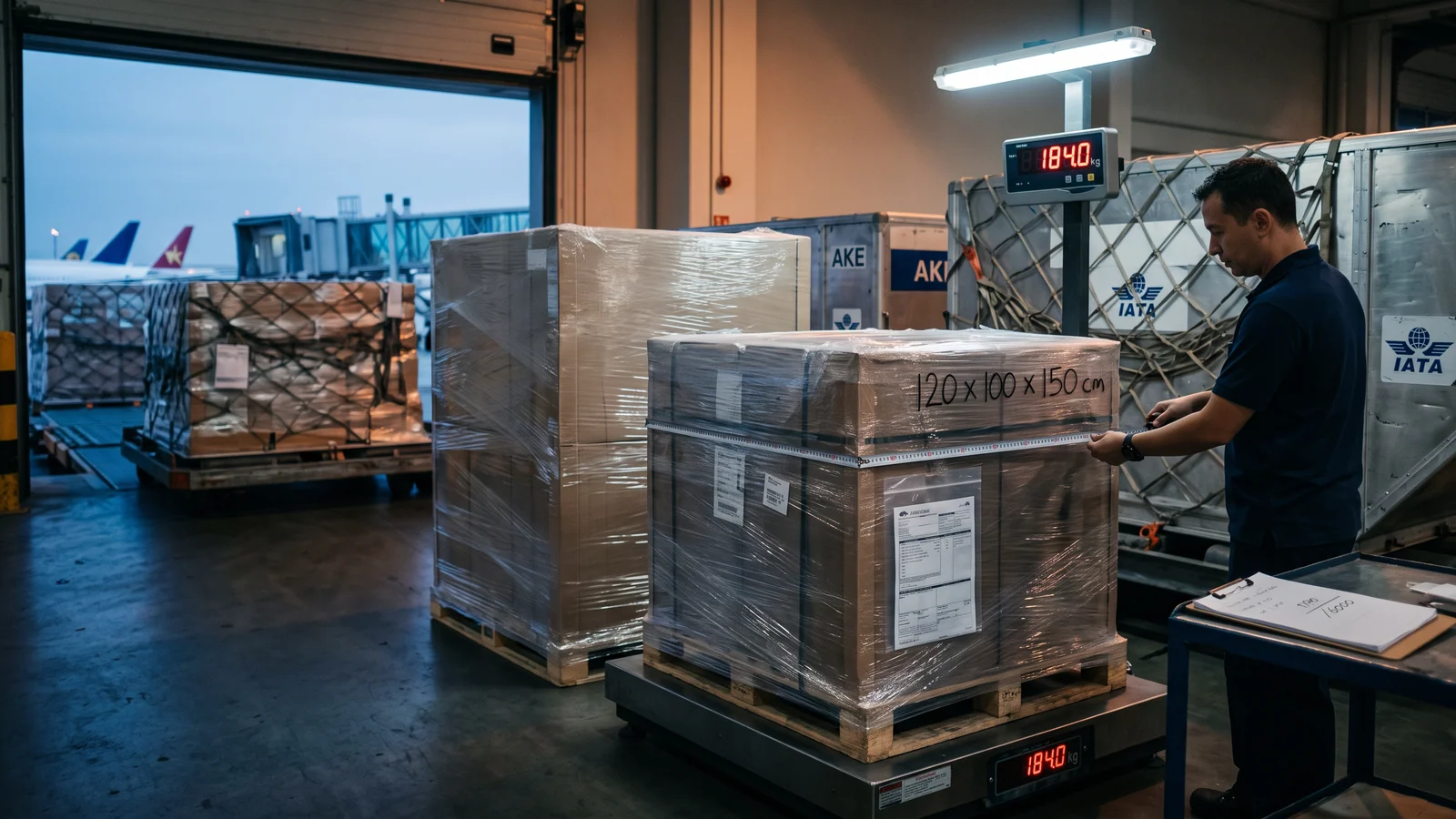
Quick Answer: Chargeable weight is the higher of a shipment's actual gross weight and its volumetric weight. For air freight, divide length × width × height in centimeters by 6,000 to get volumetric kilos; express couriers use 5,000. Ocean LCL bills the greater of 1 cubic meter or 1,000 kilos. The higher number sets your freight charge.
- Chargeable weight = the greater of actual gross weight and volumetric weight, never the sum of the two.
- Air freight uses the IATA divisor 6,000 (cm³/kg); FedEx, UPS and DHL express use 5,000 metric or 139 imperial.
- Air cargo's density break-even is 167 kg per cubic meter — below that, volume bills; above it, the scale bills.
- Ocean LCL bills weight or measure (W/M) at 1 cubic meter = 1,000 kg, so the break-even jumps to 1,000 kg/m³.
The chargeable weight meaning is simple once you see the math, but it decides most of what you pay on an air waybill or an LCL booking. This guide gives you the formulas, the divisors, the rounding rules and three worked examples you can copy at the warehouse.
What Does Chargeable Weight Mean in Shipping?
Quick Answer: Chargeable weight is the weight a carrier bills you for: the greater of your shipment's actual gross weight on the scale and its volumetric weight calculated from dimensions. Carriers sell both payload and space, so the figure that consumes more of the aircraft or container governs the rate. It is never the two added together.
Chargeable weight is the billable weight. A carrier weighs your freight, measures it, converts the volume into kilos, then charges on whichever number is bigger.
The commercial logic is physical. A Boeing 777F runs out of cubic meters long before it runs out of kilos, and an LCL consolidator fills a 40 ft container the same way. Volumetric weight protects the space the carrier sells, so a pallet of pillows cannot ride for the price of a pallet of bolts.
You will see three abbreviations on paperwork. GW is gross weight, VW or DIM is volumetric or dimensional weight, and CW is chargeable weight — the one the rate per kilo multiplies against.
That multiplication matters more than most importers expect. Chargeable weight also drives fuel and security surcharges, screening fees and many handling charges, so a single mismeasured carton inflates four lines on the invoice at once. Sea-air services behave the same way on the flight leg, which is why lane pages like our Sea-Air Hong Kong to Jamaica Calculator: 2026 Rates ask for dimensions, not just kilos.
Mini-glossary you will need
- Net weight — the product alone, no packaging.
- Gross weight (GW) — product plus cartons, dunnage and pallet.
- Tare weight — the packaging and pallet by themselves.
- Volume (CBM) — cubic meters occupied, measured at the outside faces.
- Density — kilos per cubic meter; it decides which weight wins.
- Dimensional factor (divisor) — the number you divide cubic centimeters by, such as 6,000 for IATA air freight.
- Weight break — the quantity at which the rate per kilo steps down.
- W/M — weight or measure, the ocean LCL rule.
Pro tip
Ask for your quote per chargeable kilo and the dimensional factor used. Two forwarders quoting the same rate per kilo are not quoting the same price if one applies 6,000 and the other 5,000.
How Do I Calculate Chargeable Weight for an Air Freight Shipment?
Quick Answer: Weigh the shipment, then measure length, width and height of every piece. Multiply the three dimensions in centimeters, divide by 6,000, and add the pieces together for total volumetric kilos. Compare that total with the actual gross weight in kilos. The larger of the two is your chargeable weight for the air waybill.
- Weigh every piece on a calibrated scale and total the gross weight in kilos.
- Measure each piece at its longest, widest and tallest points in centimeters.
- For each piece, calculate L × W × H ÷ 6,000 = volumetric kilos.
- Add the volumetric kilos of all pieces into one total.
- Compare the two totals and take the higher figure as chargeable weight.
- Round up to the next 0.5 kg, as IATA tariff rules require.
The imperial version uses the same logic with different numbers. Multiply inches, then divide by 166 for air freight or 139 for express carriers to get volumetric pounds.
There is a shortcut if you already know your cubic meters. Total CBM × 167 gives volumetric kilos, because a 6,000 divisor is just another way of writing 167 kg per cubic meter. This is the fastest form of the dimensional weight formula for pallet-level planning.
Compare totals, not pieces
Never pick the higher weight piece by piece. One consignment gets one gross total and one volumetric total, and the comparison happens once. Mixing the methods on a multi-carton shipment can overstate chargeable weight by 10–20% on mixed pallets.
Chargeable Weight vs Gross Weight vs Volumetric vs Dimensional Weight?
Quick Answer: Gross weight is what the scale reads, including packaging and pallets. Volumetric weight converts cargo volume into a weight using a divisor. Dimensional weight is the same concept under the courier industry's name. Chargeable weight is whichever of actual and volumetric weight is higher — the figure that actually appears on your invoice.
| Term | Abbrev. | Definition | How it is measured | Where it is used |
|---|---|---|---|---|
| Net weight | NW | Product only | Scale, packaging excluded | Commercial invoice, customs value checks |
| Actual / gross weight | GW | Product + packaging + pallet | Calibrated scale | Packing list, AWB box 24, B/L |
| Volumetric weight | VW | Volume converted to kilos | L × W × H ÷ divisor | Air freight, consolidations |
| Dimensional weight | DIM | Same math, courier wording | L × W × H ÷ 5,000 or 139 | FedEx, UPS, DHL parcels |
| Chargeable weight | CW | Higher of GW and VW | Comparison, then round up | Rate per kilo, surcharges, invoice |
Keep net and gross separate on your paperwork. Customs authorities including CBP, DIAN and SAT expect both on the packing list, and pallet tare belongs in gross weight, not net.
Volumetric and dimensional weight are not different ideas. They are the same calculation with different divisors set by different carrier groups, which is why the chargeable weight meaning does not change when you switch from air cargo to a courier.
Chargeable weight and gross weight only diverge for low-density cargo. Dense freight — machinery, tiles, liquids, fasteners — bills on the scale every time.
What Divisor Do Airlines Use for Volumetric Weight?
Quick Answer: Airlines use the IATA divisor 6,000 cubic centimeters per kilo, equal to 167 kilos per cubic meter. Express couriers such as FedEx, UPS and DHL use 5,000 metric or 139 imperial. Some charter and project carriers apply 4,000. Road freight uses 3,000 to 4,000 or NMFC freight class instead.
| Divisor | Units | Who applies it | Density equivalent |
|---|---|---|---|
| 6,000 | cm³ per kg | IATA air freight (standard) | 167 kg/m³ |
| 5,000 | cm³ per kg | FedEx, UPS, DHL express | 200 kg/m³ |
| 4,000 | cm³ per kg | Some charters and consolidators | 250 kg/m³ |
| 166 | in³ per lb | Air freight, imperial tariffs | 10.4 lb/ft³ |
| 139 | in³ per lb | Express couriers, imperial | 12.4 lb/ft³ |
| 366 | in³ per lb | Legacy US courier tariffs | 4.7 lb/ft³ |
| 3,000–4,000 | cm³ per kg | Road LTL, cross-border trucking | 250–333 kg/m³ |
A smaller divisor always costs you more. Dividing by 5,000 instead of 6,000 turns the same cubic meter into 200 billable kilos instead of 167 — a 20% increase on identical cargo.
Contract terms can override the published figure. As of 2026, IATA's TACT rules still set 6,000 as the air standard, but forwarder tariffs and some all-in lane rates quote 5,000. Confirm the dimensional factor in writing before you accept a quote.
Air freight's break-even density. Above 167 kg/m³ the scale bills; below it, the tape measure bills.
How Does Chargeable Weight Change Across Air, LCL, Express and LTL?
Quick Answer: Air freight bills the greater of gross weight or volume ÷ 6,000. Express parcels use 5,000 or 139. Ocean LCL bills weight or measure, where 1 cubic meter equals 1,000 kilos, so volume usually wins. Road LTL uses a dimensional factor or NMFC freight class and density, not a simple divisor.
| Mode | Unit billed | Rule | Break-even density | Usually governs |
|---|---|---|---|---|
| Air freight | Chargeable kg | GW vs CBM ÷ 0.006 | 167 kg/m³ | Volume |
| Express parcel | Chargeable kg/lb per piece | 5,000 metric / 139 imperial | 200 kg/m³ | Volume |
| Ocean LCL | Revenue ton (W/M) | 1 CBM = 1,000 kg, 1 CBM minimum | 1,000 kg/m³ | Volume |
| Ocean FCL | Per container | Payload and cube limits only | n/a | Container count |
| Road LTL | Weight + class | NMFC class, density, linear feet | 6–12 lb/ft³ | Class and pallet count |
LCL deserves a closer look. Consolidators bill revenue tons, and almost all mixed consumer cargo is lighter than 1,000 kg/m³, so cubic meters set the LCL price. Once your cargo passes roughly 10–15 m³, a 20 ft FCL usually costs less per cubic meter.
Express parcels calculate DIM weight per piece, not per consignment, and then stack oversize and additional-handling surcharges on top. A 130 cm carton can trigger a large-package fee even when its chargeable weight is modest.
Sea-air services price the ocean leg per cubic meter and the flight leg on air chargeable weight. You can see the structure on the Sea-Air China to Mexico Calculator: 2026 Rates and the Sea-Air China to Colombia Calculator: Rates in Seconds.
Your gateway matters too. Miami, Houston, Los Angeles/Long Beach, New York/New Jersey, Savannah and Vancouver all run different air and LCL consolidations, so the same 2 m³ can price differently from Dallas than from Newark.
 Miami(MIA)
 Bogotá(BOG)Miami(USMIA)Cartagena(COCTG)
Worked Examples: Dense, Mixed and Light Cargo
Quick Answer: Three shipments show the rule in action. Dense machinery at 480 kg in 1.2 m³ bills on actual weight. Mixed consumer goods at 180 kg in 1.5 m³ bills on volumetric weight of 250 kg. Foam packaging at 60 kg in 4 m³ bills 668 volumetric kilos — eleven times the scale reading.
Example 1 — dense machinery (metric)
One crate, 120 × 100 × 100 cm, 480 kg gross. Volume is 1.2 m³, so volumetric weight is 1,200,000 ÷ 6,000 = 200 kg. Gross weight wins: chargeable weight is 480 kg, and density sits at 400 kg/m³.
Example 2 — mixed cartons (imperial)
Four cartons, each 24 × 18 × 20 in at 42 lb. Actual weight is 168 lb. Each carton is 8,640 in³.
- Air divisor 166: 8,640 ÷ 166 = 52.1 lb per carton, 208.2 lb total chargeable.
- Express divisor 139: 8,640 ÷ 139 = 62.2 lb per carton, 248.6 lb total chargeable.
- Gap: the courier method bills 40 lb more — about 19% above the air calculation on identical cargo.
Example 3 — light bulky foam
Six cartons totalling 4 m³ at 60 kg gross. Volumetric weight is 4,000,000 ÷ 6,000 = 666.7 kg, rounded up. Using the density shortcut, 4 × 167 = 668 kg. Either way, the scale reading is irrelevant — volume governs by more than eleven to one.
For mixed pallets, add every piece's volumetric kilos into one figure, then compare that single total against the single gross total. That is the only comparison the air waybill recognizes.
| Shipment | Volume | Gross weight | Volumetric weight | Chargeable weight | Bills on |
|---|---|---|---|---|---|
| Dense machinery | 1.2 m³ | 480 kg | 200 kg | 480 kg | Scale |
| Mixed consumer goods | 1.5 m³ | 180 kg | 250 kg | 250 kg | Volume |
| Foam packaging | 4.0 m³ | 60 kg | 668 kg | 668 kg | Volume |
What Are the Rounding Rules and Airline Weight Breaks?
Quick Answer: Air carriers round chargeable weight up to the next 0.5 kilo, and many consolidators round to the next full kilo. Rates then step down at published weight breaks: minimum, under 45 kg, then 45, 100, 300, 500 and 1,000 kg. Declaring a higher weight at the next break can lower the total charge.
Rounding is small but consistent. IATA tariffs round to the next 0.5 kg, some express tariffs use 0.1 kg, and many consolidated air tariffs round to the next full kilo per shipment.
| Code | Meaning | Applies from |
|---|---|---|
| M | Minimum charge | Any weight below the minimum |
| N | Normal rate | Under 45 kg |
| Q45 | Quantity rate | 45 kg and up |
| Q100 | Quantity rate | 100 kg and up |
| Q300 | Quantity rate | 300 kg and up |
| Q500 | Quantity rate | 500 kg and up |
| Q1000 | Quantity rate | 1,000 kg and up |
Weight breaks create a trick worth knowing. Say your chargeable weight is 92 kg. Index the Q45 rate at 1.00 per kilo and the Q100 rate at 0.85 per kilo.
- 92 kg × 1.00 = 92.0 index units at the actual weight.
- 100 kg × 0.85 = 85.0 index units at the next break.
- Declaring 100 kg costs 7.6% less than declaring 92 kg.
Pro tip
This is called rating down. Airlines permit it because you pay for more weight at a lower rate — the cargo itself is unchanged. LCL has no equivalent: it rounds to two decimals of a cubic meter and applies a 1 CBM minimum, so a 0.3 m³ shipment still pays a full revenue ton.
How Do You Measure, Declare and Dispute Chargeable Weight?
Quick Answer: Measure the widest and tallest points, including bulges, shrink wrap, pallet runners and any overhang. Declare gross weight with the pallet tare included. If a carrier re-weighs and re-measures, request the weigh ticket and dimensioner printout, then file a correction against the air waybill within the carrier's claim window.
Measure what the dimensioner will see, not what the carton says. Strapping, wrap, domed tops and cargo hanging over the deck boards all count, and every dimension rounds up to the next centimeter.
Pallets add more than people expect. A standard wooden pallet adds roughly 15 kg of tare and about 14 cm of height, and overhang is measured as part of the footprint, so a 5 cm lip on each side changes your volumetric weight.
Documents that must agree
- Commercial invoice — net weight, gross weight, piece count.
- Packing list — dimensions per piece plus pallet tare.
- Air waybill — gross weight, chargeable weight, rate class and rate per kilo.
- Bill of lading or sea waybill — gross weight and measurement in CBM.
- ISF filing for US imports — consistent with the B/L figures.
If the carrier re-weighs your freight
- Request the certified scale ticket and the laser dimensioner printout.
- Compare both against your own packing list and warehouse photos.
- Check whether pallet tare or overhang explains the difference.
- Submit a correction advice through your forwarder or NVOCC inside the claim window.
- Keep the corrected AWB copy for your customs file.
Real reductions come from packing, not paperwork. Right-size cartons, knock down and nest goods, vacuum-pack textiles, consolidate onto fewer pallets, and pick a lighter pallet. These moves cut chargeable weight on every lane, including sea-air routings like the Sea-Air Hong Kong to Ecuador Calculator: Rates 2026.
Never understate weight or dimensions
Carriers re-weigh at the CFS and charge correction fees plus the difference. Mismatched weights between the invoice, packing list and B/L also invite questions from CBP, DIAN or SUNAT. For classification and duty issues, use a licensed customs broker.
What Drives the Cost, and How Do You Price It in Seconds?
Quick Answer: Chargeable weight is only the first input. Your total also reflects lane and gateway, service level, fuel and security surcharges, terminal handling, customs clearance and last-mile delivery. Walio's calculator takes your dimensions and weight, applies the correct divisor for the mode, and prices your exact shipment on screen in seconds.
What chargeable weight controls
The freight rate per kilo or per revenue ton, plus fuel and security surcharges that are also assessed per kilo. Get the dimensions right and these three lines fall into place together.
What it does not control
Terminal handling (THC/DTHC), customs clearance, drayage and last-mile delivery, and destination duties and taxes. Those follow the lane, the port and each country's published tariff rates.
Which gateway will your cargo use?
- Florida → Miami; Texas and the central states → Houston.
- California and the Southwest → Los Angeles/Long Beach.
- The Northeast → New York/New Jersey; the Southeast → Savannah.
- The Midwest → rail via Chicago; the Pacific Northwest → Seattle.
- Ontario → Toronto; Quebec and the Atlantic provinces → Montreal; Western Canada → Vancouver.
The calculator does the divisor work for you. It applies 6,000 for air, 5,000 for express, W/M for LCL, and shows the governing weight before you book — so you see whether the scale or the tape measure is billing.
Ocean LCL's break-even density under the weight-or-measure rule. Very little consolidated cargo reaches it, so volume almost always bills.
Duties and destination taxes are not Walio charges. They follow each country's published rates, and a licensed customs broker should handle HS classification. Oversized, project, flat-rack or dangerous-goods cargo goes to a Walio specialist after the calculator takes the request — the same path used for complex sea-air bookings such as the Sea-Air Vietnam to Colombia Calculator: Rates 2026.
Walio compares real carrier rates from lines and airlines including Maersk, MSC, CMA CGM and Hapag-Lloyd, so the chargeable weight meaning stops being theoretical and becomes a number you can book.
Enter your dimensions, weight and route in the calculator above and see your price in seconds — compare air, LCL and express chargeable weight for the same cargo, then book online. No signup, no follow-up calls.
Chargeable weight means the weight your carrier actually bills, which is the greater of the shipment's actual gross weight and its volumetric weight. Carriers compare the two because cargo can run out of space before it runs out of payload. The two numbers are never added together.
Your cargo is light for its size, so volumetric weight governs instead of actual weight. Air freight converts volume to kilos by dividing cubic centimeters by 6,000, which means anything under 167 kilos per cubic meter bills on volume. Repacking into smaller cartons is usually the fastest fix.
Actual weight is the physical reading on the scale, including packaging and pallets. Chargeable weight is the higher of that actual weight and the volumetric weight calculated from dimensions. For dense cargo the two are identical; for bulky cargo the chargeable weight can be several times the scale reading.
Airlines use the IATA divisor of 6,000 cubic centimeters per kilo, which equals 167 kilos per cubic meter. Express couriers such as FedEx, UPS and DHL apply 5,000 metric or 139 imperial, and a few consolidators and charter operators use 4,000. Always confirm the divisor written into your quote.
Ocean LCL bills on weight or measure, where one cubic meter counts as 1,000 kilos, with a one cubic meter minimum. Volume usually governs because most consolidated cargo is lighter than 1,000 kilos per cubic meter. Once a shipment passes roughly 10 to 15 cubic meters, a 20 ft container often costs less.