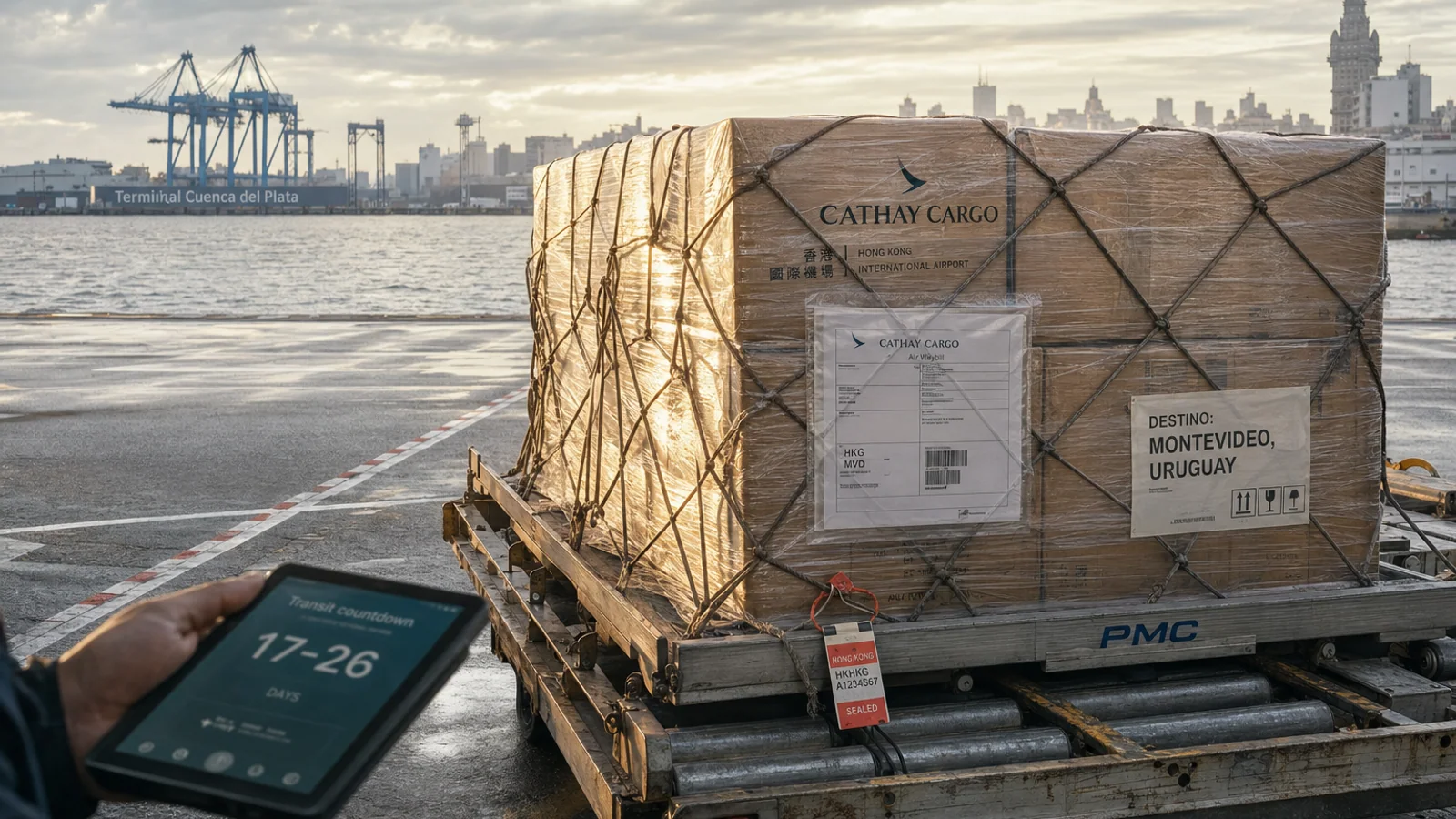
Quick Answer: Sea air cargo Hong Kong to Uruguay runs 17-26 days door-free: 12-18 days ocean to Los Angeles, 3-5 days truck to Miami, then 2-3 days air to Montevideo (MVD). Rates start from $9.87/kg at 300-499 kg, port to airport. The calculator prices your exact port, airport and weight in seconds.
- Total sea-air transit Hong Kong/South China to Montevideo is 17-26 days, versus 35-45 days all-water via a transshipment hub.
- The route has three legs: ocean to Los Angeles (12-18 days), truck LA to Miami (3-5 days), air Miami to MVD (2-3 days).
- Sea-air freight starts from $9.87/kg at 300-499 kg and from $7.83/kg at 5,000+ kg, port to airport, with a 300 kg minimum billed weight.
- Chargeable weight is the greater of actual kilos and volume x 167 kg per m³ — the air leg sets the density rule for the whole move.
Uruguayan importers use this lane when ocean is too slow and a full airfreight booking is too expensive. Below is how the 17-26 days are built, which dates control them, and what moves your cargo to the fast end of the range.
How long does sea air cargo Hong Kong to Uruguay take?
Quick Answer: Sea-air from Hong Kong and South China to Montevideo takes 17-26 days port to airport. The ocean leg to Los Angeles runs 12-18 days, the truck leg from Los Angeles to Miami 3-5 days, and the air leg from Miami to MVD 2-3 days. Your origin port decides where you land in that range.
The window is wide because the Pacific crossing is the variable part. Cargo loaded in Shenzhen, Guangzhou or the Hong Kong area sits at the fast end, often clearing Los Angeles in 12-14 days. North China ports — Dalian, Qingdao and Xingang — add days through extra port calls and longer sailing distance.
Walio prices sea-air from nine origin ports on this lane:
- South China: Shenzhen, Guangzhou, Xiamen, Fuzhou — the shortest Pacific leg on the lane
- East China: Shanghai, Ningbo
- North China: Qingdao, Dalian, Xingang
Sea-air is a multimodal service: one booking, three carriers, one chargeable weight. You do not negotiate an ocean rate, a trucking rate and an air rate separately. The freight travels under a Sea Waybill or Bill of Lading on the water and an Air Waybill (AWB) on the final leg, but the commercial contract stays single.
| Service | Transit (days) | Routing | Cost position |
|---|---|---|---|
| Pure airfreight | 5-8 | HKG/CAN direct or via a hub to MVD | Highest |
| Sea-air (this lane) | 17-26 | Ocean to LA, truck to Miami, air to MVD | Middle |
| All-water LCL/FCL | 35-45 | Transshipment hub to Montevideo | Lowest |
One detail that catches first-time users: transit is counted from vessel departure, not from the day your cargo reaches the CFS in China. Consolidation, cargo receipt and loading happen before the clock starts. Build those days into your plan. For a full rate breakdown by weight band, see our Sea-Air Hong Kong to Uruguay Calculator: Rates 2026.
What happens on each leg of the route?
Quick Answer: Leg one is ocean freight from a South China or North China port to Los Angeles/Long Beach. Leg two is a truck move across the United States from LA to Miami. Leg three is airfreight from Miami International to Carrasco (MVD). Each leg has its own handover, its own paperwork and its own cutoff.
Leg 1: ocean, China to Los Angeles (12-18 days)
Your supplier delivers to the origin CFS (container freight station), where a consolidator loads the cargo as LCL or books it as FCL. Walio compares sailings from carriers such as Maersk, MSC, CMA CGM and Hapag-Lloyd on the trans-Pacific. The vessel sails to Los Angeles/Long Beach under a Sea Waybill or Bill of Lading.
The handover at arrival is where the schedule bends. The container is discharged, moved by drayage out of the terminal, and deconsolidated at a Los Angeles CFS. Most hidden days on this lane hide in LA deconsolidation and drayage, not on the water.
Leg 2: truck, Los Angeles to Miami (3-5 days)
The cargo crosses the United States by road, 3-5 days depending on volume. Smaller shipments ride as LTL on a scheduled linehaul. Larger consolidations run as a dedicated load, which is faster and more predictable.
Leg 3: air, Miami to Montevideo (2-3 days)
At Miami the freight goes to the airline warehouse for build-up onto pallets or containers. The Air Waybill is issued at that point. The flight itself is short, so the 2-3 days cover build-up and uplift waiting time, not flying hours.
 Miami(MIA)
 Montevideo(MVD)
Pro tip
The cargo crosses the United States in-bond. It never formally enters US commerce, so you file no CBP consumption entry and need no US importer bond or ISF "10+2" filing as the Uruguayan buyer. Your single customs entry is the Uruguayan one at Carrasco.
One chargeable weight follows the shipment across all three legs. It is calculated once, at the air standard, and billed once. That is why a light, bulky pallet costs the same on the ocean leg as it does in the air.
Which cutoffs and schedule dates actually control your delivery?
Quick Answer: Four dates control a sea-air booking: the origin CFS cargo cutoff, the port documentation cutoff, the vessel ETD, and the Miami air uplift cutoff. Missing the CFS cutoff by one hour pushes the shipment to the next sailing, which usually costs seven days — far more than the hour you lost.
Cargo cutoff and vessel ETD are different dates, and importers confuse them constantly. The CFS cargo cutoff usually falls 2-4 days before departure, and the documentation cutoff falls earlier still. A factory that ships "the day before the vessel leaves" has already missed the booking.
- Documentation cutoff — Commercial Invoice, packing list and shipping instructions lodged with the consolidator.
- CFS cargo cutoff — physical delivery to the origin warehouse, 2-4 days before ETD.
- Vessel ETD — the day the transit clock starts.
- Miami air uplift cutoff — cargo that misses build-up waits for the next available flight.
Sailings on this service are weekly. A missed cutoff therefore costs a full week, not a day. Plan backwards from your required arrival date in Montevideo rather than forwards from the factory ready date, and leave a three-day buffer at origin.
Peak seasons compress both legs
Chinese New Year, Golden Week in early October and the pre-Christmas peak squeeze ocean space in China and air space out of Miami at the same time. Book two to three weeks earlier than usual in those windows, or expect rolled bookings on both ends.
The same cutoff logic applies on every West Coast-routed sea-air service. If you also import into the Pacific side of South America, compare the dates on our Sea-Air Hong Kong to Ecuador Calculator: Rates 2026.
What causes delays on the Hong Kong to Montevideo sea-air route?
Quick Answer: Most delays happen at the two handovers, not at sea. Los Angeles deconsolidation queues, drayage appointment shortages and Miami air space constraints add the majority of lost days. Weather, port congestion and incomplete documentation account for the rest. The air leg itself rarely slips more than a day.
The gap between 17 days and 26 days is mostly decided in Los Angeles. Terminal congestion at LA/Long Beach, CFS deconsolidation backlogs, drayage appointment windows and chassis availability all stack on top of each other. A container that waits three days for a drayage appointment loses three days of your transit.
| Delay cause | Where it happens | Typical days lost | Who controls it |
|---|---|---|---|
| Missed CFS cargo cutoff | Origin port, China | 7 | Shipper |
| Terminal congestion / CFS backlog | Los Angeles | 2-5 | Terminal and CFS |
| Drayage appointment or chassis shortage | Los Angeles | 1-3 | Trucker |
| Winter road conditions | US interstate corridor | 1-2 | Weather |
| Air space constraint / bumped cargo | Miami | 1-3 | Airline |
| Red channel inspection | Carrasco, Montevideo | 1-4 | Aduanas |
Documentation errors are the avoidable category. A Commercial Invoice that does not match the packing list, a questionable HS classification, or a missing Certificate of Origin for a preferential claim will slow the Uruguayan entry. Fix those before the cargo leaves China, not after it lands.
At Carrasco, the Dirección Nacional de Aduanas assigns a channel at entry. Red channel means physical inspection, and it is triggered more often by new importers, high-risk HS codes, undervalued declarations and inconsistent paperwork. Clean, consistent documents are the cheapest delay insurance you can buy.
One thing this routing avoids: the Panama Canal. The cargo crosses the United States by road, so canal transit restrictions and draft limits do not touch your schedule. Pacific weather and US winter trucking do.
How much does sea-air to Uruguay cost and how do I get the price now?
Quick Answer: Sea-air freight Hong Kong to Uruguay starts from $9.87/kg for 300-499 kg, $8.97/kg for 500-999 kg, $8.28/kg for 1,000-4,999 kg and $7.83/kg for 5,000+ kg, port to airport. Minimum billed weight is 300 kg. Origin and destination handling are added per shipment in the calculator.
Rates fall as weight rises. Every figure below is a "from" rate — the exact number depends on your specific origin port and destination airport, which is what the calculator resolves.
| Chargeable weight | Sea-air rate (from, USD/kg) | Scope |
|---|---|---|
| 300-499 kg | $9.87 | Port to airport |
| 500-999 kg | $8.97 | Port to airport |
| 1,000-4,999 kg | $8.28 | Port to airport |
| 5,000+ kg | $7.83 | Port to airport |
Rates from Walio's live multimodal rate table, October 6, 2026, cheapest port and airport on the lane.
Chargeable weight is the greater of actual kilos and volume × 167 kg per m³. The air leg sets the density rule for the whole move, so a light, bulky pallet pays on volume, not on the scale.
The 300 kg minimum changes how you should book. A 180 kg shipment is billed as 300 kg, which means the last 120 kg travel for free. Many Uruguayan distributors combine two supplier orders into a single booking to use that minimum fully.
Ship 180 kg alone
You pay the 300 kg minimum anyway. The freight cost per real kilo is inflated, and you still carry the full handling charge for one shipment. This only makes sense when the goods are urgent and cannot wait.
Consolidate to 320 kg
Two supplier orders ship on one booking, one Air Waybill and one customs entry in Montevideo. You pay roughly the same freight and split one set of handling charges across twice the goods.
The quoted scope is port to airport. The shipper delivers the cargo to the origin port, and the consignee collects it at Carrasco. Door pickup in China and door delivery in Uruguay are quoted on request — enter the addresses in the calculator and a Walio specialist follows up with the figure.
Uruguayan import duties, IVA and Dirección Nacional de Aduanas charges are not Walio charges and are not included in the freight rate. Uruguay applies the Mercosur common external tariff, plus IVA at the published national rate, assessed on the customs value. Your HS classification drives the duty, so work with a licensed despachante de aduana before you book; Walio is a shipping platform, not a customs or tax adviser.
Shipping into more than one Latin American market? The same routing logic and weight bands apply on our Sea-Air Hong Kong to Dominican Republic Calculator: 2026, the Sea-Air Hong Kong to Costa Rica Calculator: 2026 Rates and the Sea-Air Hong Kong to Bolivia Calculator: Rates (2026).
What should you do before you book?
Quick Answer: Confirm your origin port, calculate chargeable weight from the supplier's carton dimensions, check the CFS cargo cutoff against the factory ready date, and have your Commercial Invoice, packing list and HS codes finalized. Then price the exact shipment in the calculator and book online.
- Commercial Invoice — values, Incoterms 2020 term (FOB and FCA are the usual terms on this lane), full consignee details including RUT
- Packing list — carton count, gross weight and dimensions per carton for the volumetric calculation
- HS codes — confirmed with your despachante before the booking, not after arrival
- Certificate of Origin — required only if you claim preferential treatment
- Air Waybill and Sea Waybill — issued by the carriers on each leg; you receive copies
- Enter your origin port, MVD and the weight in the calculator
- Compare the sea-air price against all-water and pure airfreight on the same screen
- Book online and receive the booking confirmation with the cargo cutoff date
Pricing this lane takes seconds. Enter your origin port, destination airport and chargeable weight in the calculator above, compare sea-air against the slower all-water option, and book online — no signup, no forms that wait for an email, and no follow-up calls.
Total transit is 17-26 days port to airport, depending on your origin port. That breaks down as 12-18 days ocean to Los Angeles, 3-5 days by truck to Miami, and 2-3 days by air to Montevideo. South China ports such as Shenzhen and Guangzhou sit at the faster end of the range.
Yes. Sea-air costs a fraction of direct airfreight because only the final Miami to Montevideo leg flies, while the long Pacific crossing moves by vessel. Rates start from $9.87/kg at 300-499 kg and drop to from $7.83/kg at 5,000+ kg, port to airport.
The minimum billed weight is 300 kg. A shipment lighter than that is still charged as 300 kg, so a 150 kg order and a 300 kg order cost the same freight. Many Uruguayan importers combine two supplier orders into one booking to use that weight fully.
No. The cargo moves in-bond across the United States and never enters US commerce, so you file no consumption entry with CBP and need no importer bond. Your only customs entry is the Uruguayan one at Carrasco, handled by your despachante de aduana.
The shipment rolls to the next sailing, which on this lane usually means a full week of delay. Cargo cutoff at the origin CFS falls 2-4 days before vessel departure, and documentation cutoff is earlier still. Build a three-day buffer into your factory ready date.