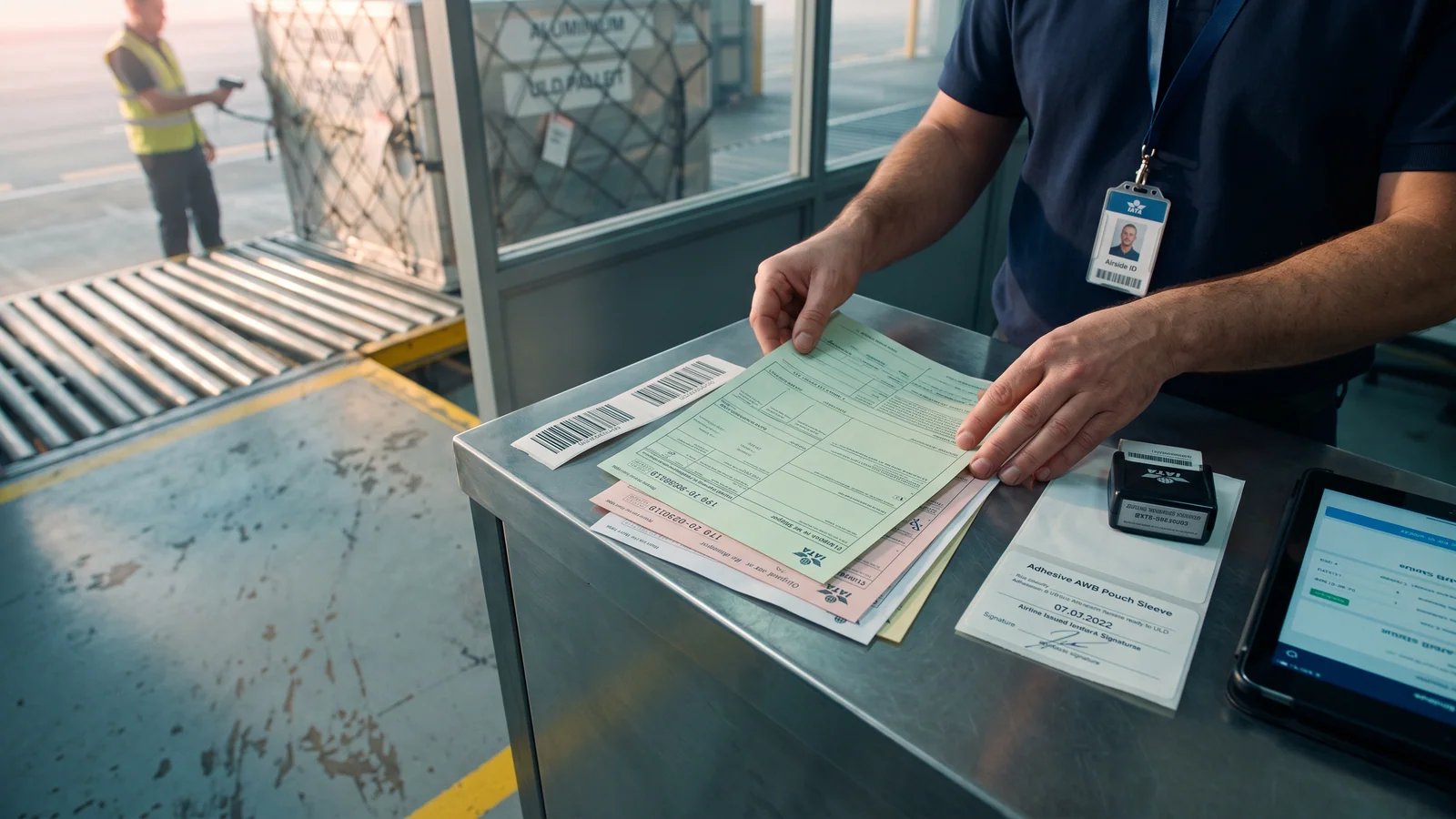
Quick Answer: An air waybill (AWB) is the non-negotiable contract of carriage for air cargo, issued under IATA standards in three originals. It proves the carrier received your goods, sets the terms of transport, and carries an 11-digit number — a 3-digit airline prefix, 7-digit serial and a modulus-7 check digit — used for tracking and customs.
- An air waybill is non-negotiable: it is not a document of title, so goods release to the named consignee only — no endorsement, no surrender of originals.
- Every AWB number has 11 digits: 3-digit IATA airline prefix + 7-digit serial + 1 check digit calculated by dividing the serial by 7.
- A master air waybill (MAWB) binds the forwarder to the airline; a house air waybill (HAWB) binds the shipper to the forwarder — one MAWB can cover dozens of HAWBs.
- Carrier liability is capped at 19 SDR per kilogram under the Montreal Convention unless you declare a higher value for carriage and pay the valuation charge.
This guide walks through every part of the document: the 28 boxes, the number structure, MAWB versus HAWB, the e-AWB, and how charges appear. If you already know what you are shipping, the calculator on this page prices your air freight from your exact origin.
What is an air waybill and what is it used for?
Quick Answer: An air waybill is the transport document an airline or its agent issues for cargo moving by air. It works as three things at once: the contract of carriage, the receipt proving the carrier took the goods, and the evidence of agreed terms, weights and charges. It also doubles as the shipment's tracking number.
Air waybill meaning, in one line: it is the IATA standard document covering one shipment from one origin airport to one destination airport. The format follows IATA Resolution 600a, and the legal framework is the Montreal Convention 1999, which most trading nations have ratified. Every air shipment that moves commercially has one.
The AWB performs three legal functions at the same time:
- Contract of carriage — it binds the shipper and the carrier to agreed routing, rates and conditions printed on the reverse.
- Receipt of goods — it proves the carrier accepted the stated number of pieces and gross weight in apparent good order.
- Documentary evidence — it records rate class, chargeable weight, charge codes and declared values that customs and the carrier both rely on.
One detail trips up first-time shippers. The AWB contract is airport to airport, even when you bought a door-to-door service. Pickup and final delivery sit outside the air waybill, under your forwarder's separate agreement.
Pro tip
The AWB is not an invoice, not a packing list and not proof of ownership. Customs authorities such as CBP, DIAN and SUNAT read it alongside your commercial invoice and packing list. If the three documents disagree on pieces, weight or description, clearance stops.
Is an air waybill negotiable or a document of title?
Quick Answer: No. An air waybill is non-negotiable and is not a document of title. Cargo releases only to the consignee named in Box 2, after identity check and customs clearance. Nobody endorses or surrenders an AWB to claim goods, which is why Letters of Credit handled by air need the bank named as consignee.
Non-negotiable means you cannot transfer ownership of the cargo by signing the back of the document. An ocean bill of lading issued "to order" can be endorsed and sold while the vessel sails. An AWB cannot. The airline releases to the named party, full stop.
For a seller, that changes the risk picture. Air cargo from Miami to Bogotá arrives in hours, often before the bank paperwork clears. If the buyer is the named consignee and has not paid, they can still collect the freight at the destination warehouse.
The standard fix under a Letter of Credit is to consign the AWB to the issuing bank and show the buyer as "Notify Party". The bank then controls release and instructs the carrier only once the buyer pays or accepts the draft.
Common and expensive mistake
Naming the buyer as consignee on an open-account air shipment gives away your leverage the moment the plane lands. Confirm consignee instructions in writing before the AWB is issued — changing a consignee after arrival usually needs customs approval at destination, not just a carrier amendment.
What do the 11 digits of an air waybill number mean?
Quick Answer: An air waybill number has 11 digits in three parts: a 3-digit IATA airline prefix, a 7-digit serial number, and a 1-digit check digit. The check digit is the remainder when the 7-digit serial is divided by 7. Airlines print it as 000-00000000, and that number is also your tracking reference.
Here is a worked air waybill example. Take 125-34567890:
- 125 is the IATA airline prefix — British Airways is the issuing carrier.
- 3456789 is the serial number assigned to this single shipment.
- 0 is the check digit: 3,456,789 ÷ 7 = 493,827 with a remainder of 0, so the final digit is 0.
That modulus-7 rule is why a mistyped AWB number almost always fails validation instead of pointing at someone else's cargo. Customs systems and airline manifests both reject a number whose check digit does not compute.
| Airline prefix | Carrier | Main hub |
|---|---|---|
| 001 | American Airlines Cargo | Miami (MIA) |
| 006 | Delta Cargo | Atlanta (ATL) |
| 014 | Air Canada Cargo | Toronto (YYZ) |
| 020 | Lufthansa Cargo | Frankfurt (FRA) |
| 045 | LATAM Cargo | Santiago (SCL) |
| 057 | Air France Cargo | Paris (CDG) |
| 125 | British Airways / IAG Cargo | London (LHR) |
| 235 | Turkish Cargo | Istanbul (IST) |
| 729 | Copa Airlines Cargo | Panama City (PTY) |
House air waybill numbers follow no IATA rule. Forwarders use their own alphanumeric format, such as WAL25-0098417. The prefix on the master tells you which airline holds the contract if you ever file a cargo claim.
What information is included on an air waybill?
Quick Answer: A standard IATA air waybill carries around 28 numbered boxes. The essentials are shipper and consignee names and addresses, issuing carrier agent and IATA code, airport of departure and destination, routing and flight, number of pieces, gross weight, chargeable weight, rate class, nature of goods, charge codes and signatures.
The boxes group into six logical blocks. Reading them in blocks is far easier than reading them in numerical order.
| Block | Boxes | What goes in it |
|---|---|---|
| Parties | 1–5 | AWB number, shipper name and account, consignee name and account, issuing agent name, agent IATA code |
| Routing | 6–11 | Airport of departure, to/by carrier legs, destination airport, requested flight and date |
| Charge declarations | 12–17 | Currency, charge code, PP/CC for weight and other charges, declared value for carriage, declared value for customs |
| Cargo details | 18–22 | Pieces, gross weight, rate class, chargeable weight, rate per kg, total, nature and quantity of goods, dimensions |
| Charge summary | 23–26 | Weight charge, valuation charge, taxes, other charges due agent (C) and due carrier (A), totals |
| Execution | 27–28 | Shipper signature, carrier signature, place, date and issuing office |
Chargeable weight decides your freight cost. It is the greater of actual gross weight or volumetric weight, calculated at the IATA ratio of 1:6000 — length × width × height in centimetres, divided by 6,000. One cubic metre equals 166.67 kg of volumetric weight.
Two boxes absorb everything that does not fit elsewhere. Accounting Information carries payment and customs instructions. Handling Information carries the Notify Party, dangerous-goods references and special stowage notes.
Pro tip
Write the Nature and Quantity of Goods to match your commercial invoice and HS/HTS description word for word. "Electronic parts" against an invoice reading "lithium-ion battery packs" is the fastest route to an inspection hold at Bogotá or Lima. Enter NVD (no value declared) and NCV (no customs value) only when you genuinely decline to declare a higher value.
House air waybill vs master air waybill: what's the difference?
Quick Answer: A master air waybill (MAWB) is issued by the airline to the freight forwarder and covers the whole consolidated unit. A house air waybill (HAWB) is issued by the forwarder to the individual shipper and covers one consignment inside that consolidation. One MAWB can cover 40 or more HAWBs.
A master air waybill is the airline's contract with whoever tendered the cargo — usually a forwarder or NVOCC acting as consolidator. A house air waybill is the forwarder's own contract with you, the shipper, for your specific boxes inside that unit.
| Feature | Master air waybill (MAWB) | House air waybill (HAWB) |
|---|---|---|
| Issued by | Airline / contracting carrier | Freight forwarder or consolidator |
| Issued to | Freight forwarder | Individual shipper |
| Covers | Entire consolidated unit | One consignment inside it |
| Number per flight shipment | 1 | 1 to 40+ |
| Shown to customs | Yes, on the flight manifest | Yes, via the FHL house manifest |
| Used for airline tracking | Yes | No — forwarder portal only |
| Contractual parties | Airline ↔ forwarder | Forwarder ↔ shipper |
The flow runs: shipper tenders cargo and receives a HAWB, the forwarder tenders the built unit and receives the MAWB, the airline flies it, and at destination a CFS deconsolidates the unit and releases each consignment against the matching house air waybill.
Direct shipments skip the house entirely. Urgent single-piece cargo often moves on an MAWB with the shipper named directly, which gives you live airline tracking but no consolidation savings.
Multimodal moves complicate the picture. A sea-air shipment issues an ocean bill of lading for the water leg and an AWB for the flight — our guide on what sea-air shipping is and when you should use it explains how the two documents hand off at the transshipment hub.
Who issues and signs the air waybill, and when is it valid?
Quick Answer: The carrier or its IATA-accredited cargo agent issues the air waybill, but the shipper is legally responsible for the accuracy of the details. It becomes a binding contract when both the shipper (or agent on their behalf) and the carrier sign, and the carrier accepts the goods at the airport warehouse.
A paper AWB prints in three originals plus up to nine copies. The colors are standardized worldwide:
- Original 1 — green: for the issuing carrier, signed by the shipper.
- Original 2 — pink: travels with the goods and goes to the consignee at destination.
- Original 3 — blue: returns to the shipper, signed by the carrier, as proof the carrier received the goods.
- Copies 4–12: delivery receipt, airport-of-destination copy, second and third carrier copies, agent copy and extra shipper copies.
Signing the AWB activates the shipper warranty clause. You certify that the description, piece count, weight and dangerous-goods status are correct and complete. That liability stays with you even when your forwarder typed every box.
Watch the cut-off, not the departure time
Warehouse acceptance cut-off usually falls four to eight hours before scheduled departure on long-haul widebody flights, and earlier for dangerous goods. Cargo that arrives after cut-off rolls to the next flight even if the aircraft is still on the ground. Forwarders sign "as agent for the carrier" — on an MAWB the airline, not the forwarder, is the contracting carrier.
What is an e-AWB and does it replace the paper air waybill?
Quick Answer: The e-AWB is the electronic air waybill: an EDI or XML message that replaces the paper original under IATA Resolution 672 and the Multilateral e-AWB Agreement. One signature on the multilateral agreement lets a forwarder file electronically with every participating airline. Paper still travels on lanes where customs or the airport demands it.
IATA Resolution 672 made the e-AWB the default contract of carriage on enabled trade lanes. Before the Multilateral e-AWB Agreement, each forwarder signed a separate bilateral contract with each airline. Now one signature covers every participating carrier.
| Feature | Paper AWB | Electronic AWB (e-AWB) |
|---|---|---|
| Format | Printed IATA form, 3 originals | FWB / FHL EDI or XML message |
| Governing rule | IATA Resolution 600a | IATA Resolution 672 + Multilateral Agreement |
| Data transmission | At warehouse handover | Before cargo arrives at the terminal |
| Typical data error rate | Higher — manual re-keying | Lower — single data entry |
| Copies required | 3 originals + up to 9 copies | 0 originals |
| Lane availability | Everywhere | Major gateways; limited at secondary airports |
| Cost impact | Printing, courier, archiving | Lower handling and documentation cost |
In Latin America and the Caribbean, e-AWB coverage is solid into Bogotá (BOG), Lima (LIM), São Paulo (GRU), Panama City (PTY) and Santiago (SCL). Several secondary airports and provincial customs posts still ask for a printed copy of the pink original, so forwarders keep paper on hand.
Two message types do the work behind the scenes. The FWB carries the master waybill data and the FHL carries the house manifest that lists every HAWB inside the consolidation.
Air waybill vs bill of lading vs sea waybill: how do they compare?
Quick Answer: An air waybill covers air cargo and is always non-negotiable. A bill of lading covers ocean freight and can be negotiable, acting as a document of title that must be surrendered. A sea waybill covers ocean freight but is non-negotiable like an AWB, releasing cargo to the named consignee only.
| Feature | Air waybill | Bill of lading | Sea waybill |
|---|---|---|---|
| Issuing party | Airline or IATA agent | Ocean carrier or NVOCC | Ocean carrier or NVOCC |
| Mode | Air | Ocean | Ocean |
| Negotiable? | Never | Yes, if "to order" | Never |
| Document of title? | No | Yes | No |
| Goods released | To named consignee, ID check | Against surrendered original | To named consignee, ID check |
| Letter of Credit use | Consign to bank | Standard LC instrument | Limited, bank must be consignee |
| Originals issued | 3 | 3 | 0 (release by data) |
Customs authorities read these documents as a set. CBP, DIAN, SUNAT, SAT and Receita Federal match the transport document against the commercial invoice and the HS/HTS classification before releasing anything.
| Document | Purpose | Issued by | Shows value? | Shows weight/pieces? |
|---|---|---|---|---|
| Air waybill | Contract of carriage and receipt | Carrier or agent | Declared value only | Yes |
| Commercial invoice | Basis for duty and tax assessment | Seller | Yes | Sometimes |
| Packing list | Physical content verification | Seller or packer | No | Yes |
| Certificate of origin | Proves origin for tariff preference | Chamber of commerce or exporter | No | No |
Advance reporting rules differ by mode. Air imports to the USA require ACAS data before the aircraft departs; ocean imports require ISF "10+2" filed 24 hours before vessel loading. A combined move generates both — see our Sea-Air China to Colombia calculator for a lane that produces an ocean B/L and an AWB on the same shipment.
What does an air waybill cost and how do charges appear on it?
Quick Answer: The air waybill itself carries a small documentation or AWB fee, but the big numbers in the charge boxes are freight, fuel and security surcharges, and handling. Charges show as PP (prepaid, shipper pays) or CC (collect, consignee pays). Walio's calculator prices your exact air shipment in seconds.
The charge codes are short and specific. PP means prepaid at origin by the shipper. CC means collect at destination from the consignee. "As agreed" hides the rate from the consignee, common on resale shipments. Other charges carry a C if due to the agent and an A if due to the carrier.
What actually moves the price:
- Chargeable weight — the greater of gross weight or volume ÷ 6,000
- Airport pair and the number of connections
- Commodity, density and whether screening is straightforward
- Dangerous goods classification and packing group
- Peak season surcharge and capacity on the lane
Under the Montreal Convention, carrier liability for lost or damaged air cargo is capped at 19 Special Drawing Rights per kilogram. Declare a higher value for carriage and pay the valuation charge, or buy separate cargo insurance.
The AWB does not show everything you will pay. Terminal handling, CFS deconsolidation, customs broker fees, duties and local taxes are billed at destination by the handling agent and the national authority, not by the airline.
Your origin decides your gateway and your price. Florida flies through Miami, Texas through Houston, California through Los Angeles, the Northeast through JFK, Ontario through Toronto, Quebec through Montreal and Western Canada through Vancouver.
 Miami(MIA)
 Bogotá(BOG)
Walio prices air cargo, LCL, FCL, parcels and vehicle shipping from your exact origin. For multimodal examples, compare the Sea-Air Hong Kong to Costa Rica rates and the Sea-Air Vietnam to Panama calculator.
How do you track, correct or amend an air waybill?
Quick Answer: Track an air shipment by entering the 11-digit AWB number — with or without the dash — on the airline's cargo tracking page or in your forwarder's portal. To correct an AWB after issuance, the carrier issues a Cargo Correction Advice (CCA); changes after departure cost money and can delay clearance.
To track, find the MAWB number printed on your HAWB, then enter it on the airline's cargo site. Status codes read in sequence:
- RCS — received from shipper at the warehouse
- MAN — manifested on a specific flight
- DEP — departed origin airport
- ARR / RCF — arrived and received from flight
- NFD — consignee notified; DLV — delivered
A Cargo Correction Advice (CCA) fixes weight, charges, consignee or routing after the AWB is issued. Carriers charge for it, and a consignee change after arrival often needs customs approval at destination, not just the airline's agreement.
The five AWB errors that cost the most
Consignee name that does not match the importer's tax ID (RUT in Colombia, NIT in Guatemala, RFC in Mexico, RUC in Peru); wrong chargeable weight; vague goods description; missing dangerous-goods declaration; wrong payment code. Keep Original 3, the blue copy — it is your evidence the carrier received the goods if you file a claim.
For a practical look at how documentation and transit interact on a real lane, see our Sea-Air Hong Kong to Jamaica rates guide.
You now know what is an air waybill, how the 11-digit number works, and how MAWB and HAWB fit together. The next step is a number for your own shipment. Enter your airport pair, weight and dimensions in the calculator above and see your price in seconds — no signup, no follow-up calls.
The difference is negotiability: an air waybill is always non-negotiable and never a document of title, while an ocean bill of lading can be negotiable and must be surrendered to release the cargo. An AWB releases goods to the named consignee after identity check and customs clearance. That makes air shipments faster to clear but gives the seller less control if the buyer has not paid.
Eleven digits. The first three are the IATA airline prefix (125 is British Airways, 045 is LATAM), the next seven are the serial number assigned to that shipment, and the eleventh is a check digit equal to the remainder of the serial divided by 7. Use the full number to track the shipment on the airline's cargo portal.
The shipper is legally responsible for the accuracy of every detail, even when a freight forwarder or carrier agent physically prepares and issues the document. Both the shipper (or their agent) and the carrier sign it, and it becomes a binding contract when the carrier accepts the goods at the airport warehouse. Wrong weights or vague descriptions remain the shipper's liability.
No. An air waybill is proof that the carrier received the goods and evidence of the transport contract, not proof of ownership. Ownership is established by the commercial invoice, the sales contract and payment terms. For Letter of Credit transactions, sellers consign the AWB to the issuing bank so the bank controls release at destination.
The air waybill fee itself is a small documentation charge, usually bundled into the freight quote; the real cost sits in chargeable weight, fuel and security surcharges, handling and destination charges. Chargeable weight is the greater of actual gross weight or volume divided by 6,000. Enter your airport pair, weight and dimensions in the calculator on this page to see your air freight price in seconds.